USMLE Step 1 • ECG Pattern Recognition
Recognizing High-Yield ECG Patterns Quickly
Learn how to recognize the most commonly tested ECG patterns on Step 1, including arrhythmias, ST-segment changes, electrolyte abnormalities, AV blocks, and classic clinical associations.

Recognizing high-yield ECG patterns quickly is an important Step 1 skill because ECG findings often connect physiology, pathology, pharmacology, and emergency medicine in one question.
Step 1 does not expect you to read ECGs like a cardiologist. It expects you to recognize classic patterns and understand what they mean.
The exam may show you an ECG tracing, describe the rhythm in words, or give you symptoms and ask for the underlying mechanism. Your job is to identify the pattern, connect it to the diagnosis, and avoid common distractors.
This guide breaks down the ECG patterns most commonly tested on Step 1 and shows you how to recognize them fast.
Free USMLE Training
Free USMLE Step 1 Bootcamp
Join our free USMLE masterclass where we break down high-yield Step 1 concepts, ECG patterns, NBME-style clues, and clinical reasoning strategies.
Reserve My SpotWhy ECG Pattern Recognition Matters for Step 1
ECG questions are high-yield because they test more than rhythm identification. They test cardiac physiology, ion channels, conduction pathways, myocardial ischemia, electrolyte disturbances, and medication effects.
A single ECG pattern can point toward the diagnosis, mechanism, complication, or best next step.
- Peaked T waves suggest hyperkalemia.
- Irregularly irregular rhythm suggests atrial fibrillation.
- ST elevation in contiguous leads suggests acute myocardial infarction.
- Prolonged QT interval suggests risk for torsades de pointes.
- Coved ST elevation in V1 to V3 suggests Brugada syndrome.
The Big Rule
Do not try to memorize every ECG detail. Learn the high-yield patterns the USMLE repeatedly tests and connect each one to its mechanism.
The Quick ECG Recognition System
When you see an ECG question, use a simple pattern-recognition checklist instead of staring at the tracing randomly.
| Step | What to Check | Why It Matters |
|---|---|---|
| 1. Rate | Fast, slow, or normal | Helps separate tachyarrhythmias, bradyarrhythmias, and normal rhythm. |
| 2. Rhythm | Regular or irregular | Irregularly irregular rhythm is classic for atrial fibrillation. |
| 3. P Waves | Present, absent, flutter waves, or dissociated | Helps identify atrial fibrillation, atrial flutter, and AV blocks. |
| 4. PR Interval | Normal, prolonged, progressive, or fixed | High-yield for AV block recognition. |
| 5. QRS Width | Narrow or wide | Wide QRS can suggest ventricular rhythm, bundle branch block, or hyperkalemia. |
| 6. ST Segment | Elevation or depression | Key for ischemia and infarction patterns. |
| 7. T Wave and QT Interval | Peaked, inverted, flattened, or prolonged QT | High-yield for electrolytes and medication toxicity. |
High-Yield Arrhythmia Patterns
Arrhythmia questions usually test rhythm, P waves, QRS width, and the clinical setting.
| ECG Pattern | Diagnosis | Step 1 Clue |
|---|---|---|
| Regular sinus rhythm, P wave before every QRS | Normal sinus rhythm | Normal atrial impulse from the SA node. |
| Irregularly irregular rhythm with no clear P waves | Atrial fibrillation | Risk of left atrial thrombus and embolic stroke. |
| Sawtooth flutter waves | Atrial flutter | Macro-reentrant atrial rhythm, often with 2:1 conduction. |
| Rapid narrow-complex tachycardia | Supraventricular tachycardia | Often caused by reentry through the AV node. |
| Wide-complex tachycardia | Ventricular tachycardia | Often occurs after myocardial infarction or structural heart disease. |
| Chaotic rhythm with no identifiable QRS complexes | Ventricular fibrillation | Requires immediate defibrillation in clinical settings. |
Arrhythmia Rule
If the rhythm is irregularly irregular and there are no clear P waves, think atrial fibrillation first.
AV Block Patterns
AV blocks are classic Step 1 ECG questions because they test the relationship between P waves and QRS complexes.
| ECG Pattern | Diagnosis | How to Recognize It |
|---|---|---|
| PR interval greater than 200 ms, no dropped beats | First-degree AV block | Every P wave conducts, but conduction is delayed. |
| Progressively lengthening PR interval, then dropped QRS | Mobitz type I AV block | Also called Wenckebach. |
| Constant PR interval with sudden dropped QRS | Mobitz type II AV block | More dangerous and can progress to complete heart block. |
| P waves and QRS complexes are independent | Third-degree AV block | Complete AV dissociation. |
AV Block Rule
Mobitz I gets progressively longer before dropping. Mobitz II drops suddenly with a constant PR interval.
ST-Segment and Ischemia Patterns
ST-segment changes are high-yield because they connect ECG findings to myocardial ischemia, coronary artery anatomy, and cardiac enzymes.
| ECG Finding | Meaning | High-Yield Association |
|---|---|---|
| ST elevation in contiguous leads | Acute transmural myocardial infarction | STEMI pattern. |
| ST depression | Subendocardial ischemia | Can appear with NSTEMI or demand ischemia. |
| Pathologic Q waves | Prior myocardial infarction | Represents electrically silent infarcted myocardium. |
| T-wave inversion | Ischemia or repolarization abnormality | Interpret with symptoms and lead distribution. |
| Diffuse ST elevation with PR depression | Pericarditis | Sharp pleuritic chest pain improved by leaning forward. |
Electrolyte ECG Patterns
Electrolyte abnormalities are among the fastest ECG patterns to recognize once you know the classic clues.
| ECG Pattern | Diagnosis | Mechanism |
|---|---|---|
| Peaked T waves | Hyperkalemia | Altered cardiac membrane excitability. |
| Widened QRS and sine-wave pattern | Severe hyperkalemia | Life-threatening conduction disturbance. |
| Flattened T waves and U waves | Hypokalemia | Delayed repolarization. |
| Short QT interval | Hypercalcemia | Shortened ventricular repolarization. |
| Prolonged QT interval | Hypocalcemia | Delayed ventricular repolarization. |
Electrolyte Rule
Hyperkalemia is the classic Step 1 ECG emergency. Peaked T waves can progress to QRS widening and ventricular arrhythmias.
Drug-Related ECG Patterns
Step 1 often links ECG changes to pharmacology, especially antiarrhythmics, psych medications, antibiotics, and overdose syndromes.
| ECG Finding | Drug or Toxin Association | Step 1 Point |
|---|---|---|
| Prolonged QT interval | Class IA and Class III antiarrhythmics | Increased risk of torsades de pointes. |
| Wide QRS complex | Tricyclic antidepressant overdose | Sodium bicarbonate is classically tested. |
| Bradycardia and AV block | Beta blockers or calcium channel blockers | Reduced SA and AV nodal conduction. |
| QT prolongation | Macrolides, fluoroquinolones, antipsychotics | Think torsades risk when QT is prolonged. |
| Scooped ST depression | Digoxin effect | Can also cause arrhythmias with toxicity. |
Inherited and Structural ECG Patterns
Some ECG patterns point toward inherited channelopathies or structural heart disease. These are high-yield because they connect ECGs to sudden cardiac death risk.
| ECG or Clinical Pattern | Diagnosis | High-Yield Association |
|---|---|---|
| Coved ST elevation in V1 to V3 | Brugada syndrome | Sudden cardiac death risk from sodium channel abnormality. |
| Short PR interval, delta wave, wide QRS | Wolff-Parkinson-White syndrome | Accessory pathway through bundle of Kent. |
| Long QT interval with syncope | Long QT syndrome | Risk of torsades de pointes. |
| Left ventricular hypertrophy pattern | Hypertension or aortic stenosis | Chronic pressure overload. |
| Electrical alternans | Large pericardial effusion | Swinging heart inside fluid-filled pericardial sac. |
High-Yield Step 1 Resource
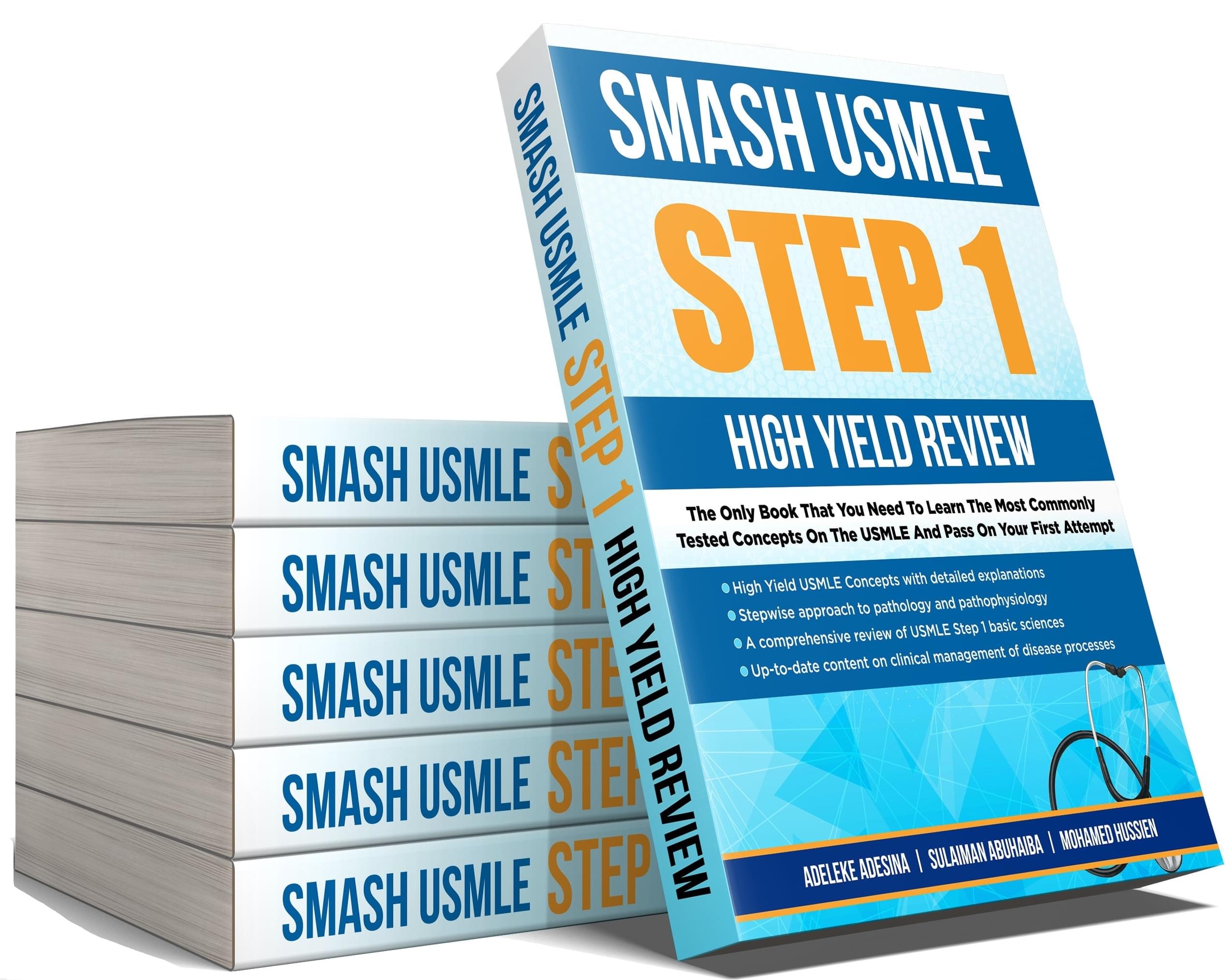
SmashUSMLE High Yield Step 1 Book
Use the SmashUSMLE High Yield Step 1 Book to review ECG patterns, cardiac physiology, arrhythmias, pharmacology, and high-yield Step 1 mechanisms.
- Strengthen high-yield cardiac concepts
- Connect ECG patterns to mechanisms
- Review arrhythmias and ischemia patterns
- Use alongside SmashUSMLE, NBME review, and QBank practice
Common ECG Mistakes to Avoid
1. Trying to Interpret Every Small Detail
Step 1 usually tests classic ECG patterns. Focus first on rate, rhythm, P waves, PR interval, QRS width, ST changes, T waves, and QT interval.
2. Forgetting the Clinical Context
ECG findings become much easier when you connect them to symptoms, medications, electrolytes, and cardiac history.
3. Confusing Mobitz I and Mobitz II
Mobitz I has progressive PR lengthening before a dropped beat. Mobitz II has a constant PR interval with sudden dropped beats.
4. Missing Electrolyte Clues
Peaked T waves, U waves, widened QRS complexes, and QT changes are classic Step 1 clues for potassium and calcium abnormalities.
5. Memorizing ECG Names Without Mechanisms
The USMLE may ask for the mechanism, complication, or drug association. Always connect the ECG pattern to the underlying physiology.
Student Success Story
⭐ 4.8 Google Rating | 120+ ReviewsSee How SmashUSMLE Students Improve Their Scores
Learn how structured clinical reasoning, NBME-focused review, and disciplined preparation can help IMGs break through score plateaus.
Want to learn the same clinical reasoning system used by SmashUSMLE students?
Join Free BootcampNeed Help Recognizing ECG Patterns Faster?
If ECG questions slow you down, the problem is usually not intelligence. It is lack of a repeatable recognition system.
SmashUSMLE Reviews helps students connect ECG findings to physiology, pathology, pharmacology, and NBME-style clinical reasoning.
FAQ: Recognizing High-Yield ECG Patterns Quickly
Do I need to master ECG interpretation for Step 1?
You do not need cardiologist-level ECG skills for Step 1. You need to recognize classic patterns and understand their mechanisms.
What ECG patterns are most high-yield for Step 1?
High-yield patterns include atrial fibrillation, atrial flutter, AV blocks, STEMI, pericarditis, hyperkalemia, hypokalemia, QT prolongation, Brugada syndrome, and Wolff-Parkinson-White syndrome.
How do I tell atrial fibrillation from atrial flutter?
Atrial fibrillation is irregularly irregular with no clear P waves. Atrial flutter classically has sawtooth flutter waves.
How do I remember AV blocks?
First-degree AV block has a prolonged PR interval. Mobitz I has progressive PR lengthening. Mobitz II has sudden dropped beats with a constant PR interval. Third-degree block has AV dissociation.
How can SmashUSMLE help with ECG questions?
SmashUSMLE helps students connect ECG patterns to mechanisms, clinical clues, and NBME-style question strategy so they can answer faster and with more confidence.
Ready to Improve Your USMLE Scores?
ECG questions become easier when you stop guessing and start using a pattern recognition system. Join thousands of students using SmashUSMLE to prepare smarter for Step 1, Step 2 CK, and Step 3.