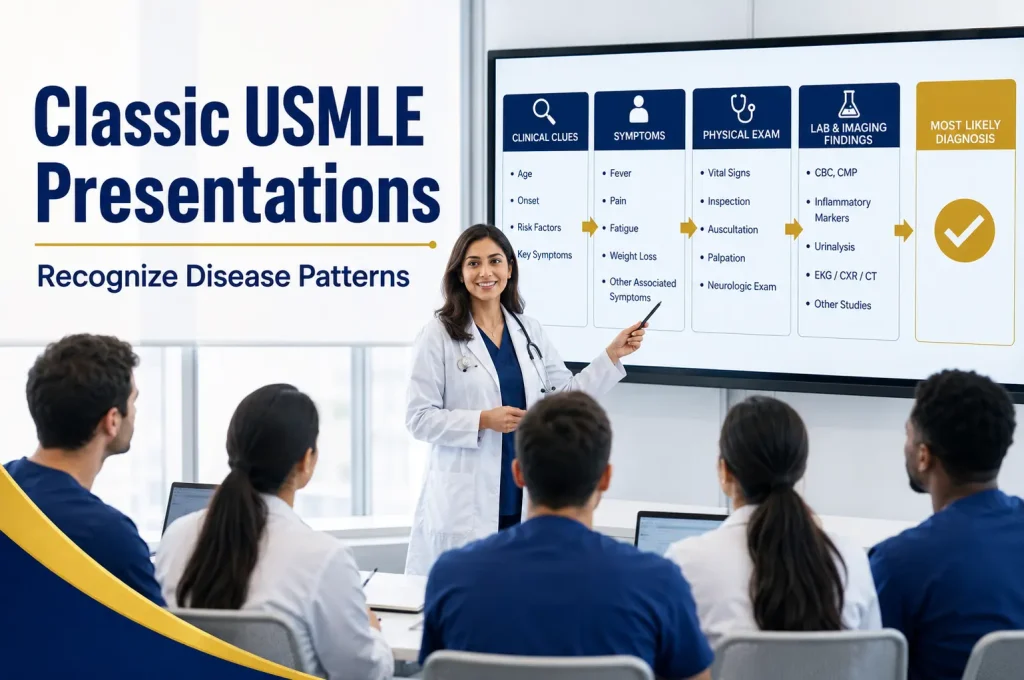

How to recognize classic USMLE disease presentations is one of the most important skills for medical students and IMGs because the exam often tests diseases through clinical patterns, not isolated facts.
Many students know the disease name, but they miss the question because they fail to connect the patient’s age, timeline, symptoms, risk factors, physical exam findings, labs, and answer choices into one clear diagnosis.
Classic presentations help you move faster. They give you a starting point. But strong students do not stop at recognition. They confirm the pattern with evidence from the vignette and avoid distractors that only match one clue.
This guide will show you how to recognize classic USMLE disease presentations using clinical scripts, QBank practice, NBME review, and the SmashUSMLE clinical reasoning system.
Free USMLE Training
Free USMLE Step 1 Bootcamp
Join our free USMLE masterclass where we break down high-yield concepts, NBME strategies, and clinical reasoning systems used by thousands of medical students and IMGs.
Reserve My SpotWhat Classic USMLE Disease Presentations Mean
A classic disease presentation is the most testable way a condition appears in a clinical vignette. It usually includes a typical patient profile, a predictable timeline, key symptoms, physical exam findings, and confirming labs or imaging.
The USMLE does not always give you the diagnosis directly. Instead, it gives you clues. Your job is to recognize the pattern and prove the answer using the evidence in the stem.
Classic Presentations Help You Identify
- The most likely diagnosis.
- The underlying mechanism.
- The next best step in management.
- The expected lab or imaging finding.
- The most likely complication.
- The risk factor or prevention strategy.
- The drug mechanism or adverse effect.
The Big Rule
Do not memorize a disease as a definition. Learn how that disease walks into the exam room.
How to Build a Disease Presentation Script
A disease presentation script is a short mental template that helps you recognize a condition quickly inside a USMLE vignette.
Instead of memorizing scattered facts, organize each disease around the clues the exam is most likely to test.
The SmashUSMLE Disease Script Framework
- Patient type: Who usually gets this disease?
- Timeline: Does it happen suddenly, gradually, chronically, or in episodes?
- Chief complaint: What symptom brings the patient in?
- Key findings: What physical exam clues support the diagnosis?
- Labs or imaging: What confirms the pattern?
- Mechanism: What is the underlying pathophysiology?
- Testable angle: What is the USMLE likely to ask?
Clinical Script Rule
If you can summarize a disease presentation in one clear sentence, you are much more likely to recognize it under timed conditions.
Start With the Patient Clues
The first few details in a USMLE vignette often matter more than students realize. Age, sex, pregnancy status, immune status, occupation, travel, medication history, and risk factors can narrow the diagnosis quickly.
Strong students do not read these details casually. They use them to build the differential.
High-Yield Patient Clues
| Patient Clue | Question to Ask | Why It Matters |
|---|---|---|
| Age | What diseases are common in this age group? | Pediatric, young adult, pregnant, and elderly patients often point to different diagnoses. |
| Sex | Does this condition have a sex association? | Some autoimmune, reproductive, genetic, and malignancy patterns depend on sex. |
| Risk Factors | What exposure or history increases disease probability? | Smoking, IV drug use, travel, sexual history, diet, family history, and occupation matter. |
| Medications | Could this be a drug effect? | Many classic presentations are medication adverse effects. |
| Immune Status | Is the patient immunocompromised? | Opportunistic infections and malignancy risks change quickly. |
Use Timeline to Narrow the Diagnosis
Timeline is one of the fastest ways to separate look-alike diseases. The same symptom can mean something completely different depending on whether it started minutes ago, days ago, months ago, or has been recurring for years.
If you ignore timeline, you will fall for distractors.
How Timeline Guides USMLE Diagnosis
| Timeline | Common Pattern | Study Strategy |
|---|---|---|
| Minutes to Hours | Ischemia, arrhythmia, anaphylaxis, trauma, acute obstruction, shock | Think emergency diagnosis and immediate management. |
| Days | Infection, inflammation, medication reaction, acute endocrine issue | Look for fever, exposure, new drugs, and systemic symptoms. |
| Weeks | Subacute infection, autoimmune disease, malignancy, inflammatory disease | Pay attention to weight loss, night sweats, fatigue, and progressive symptoms. |
| Months to Years | Chronic disease, degeneration, endocrine disease, slowly progressive malignancy | Think complications, risk factors, and long-term physiology. |
| Recurrent Episodes | Migraine, seizures, metabolic disease, stones, autoimmune flares, panic attacks | Look for triggers, associated symptoms, and what resolves the episode. |
Timeline Rule
A diagnosis that sounds right but does not fit the timeline is usually not the best answer.
Classic Presentations by Organ System
Classic presentations become easier when you organize them by system. This helps you compare similar diseases and avoid confusing one condition for another.
The goal is not to memorize every disease in isolation. The goal is to recognize the pattern the USMLE is most likely to test.
Examples of Classic USMLE Disease Patterns
| System | Classic Presentation Pattern | Common USMLE Task |
|---|---|---|
| Cardiology | Chest pain pattern, murmur timing, dyspnea, syncope, edema, ECG changes | Diagnosis, mechanism, next best step, complication. |
| Pulmonology | Shortness of breath, cough, wheezing, hypoxemia, smoking history, occupational exposure | Diagnosis, physiology, imaging finding, management. |
| Neurology | Weakness pattern, sensory loss, headache type, seizure description, cranial nerve findings | Lesion localization, diagnosis, mechanism, treatment. |
| Renal | Edema, hypertension, hematuria, proteinuria, electrolyte changes, acid-base disorder | Mechanism, diagnosis, lab interpretation. |
| Endocrine | Weight change, heat or cold intolerance, glucose pattern, blood pressure changes | Hormone mechanism, diagnosis, treatment. |
| Infectious Disease | Fever, exposure, travel, immune status, rash, organism clue, antibiotic association | Organism, virulence factor, treatment, prevention. |
| Gastrointestinal | Abdominal pain location, diarrhea type, jaundice, bleeding, liver enzyme pattern | Diagnosis, mechanism, imaging, next best step. |
| Hematology | Anemia pattern, bleeding, clotting, lymphadenopathy, smear findings | Diagnosis, lab interpretation, mechanism. |
High-Yield Step 1 Resource
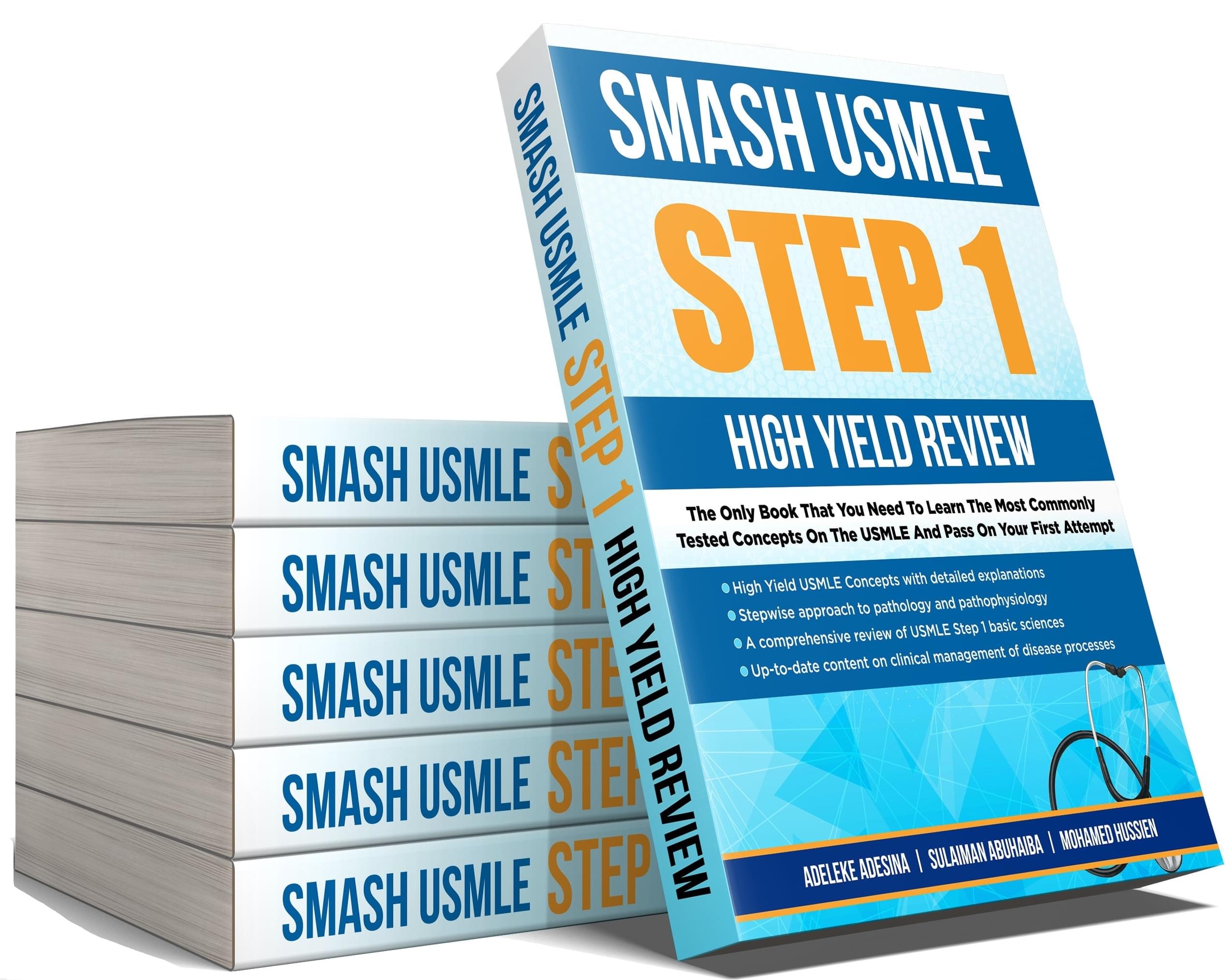
SmashUSMLE High Yield Step 1 Book
If you need a focused review resource, use the SmashUSMLE High Yield Step 1 Book to organize the concepts, clinical patterns, and reasoning points that matter most for Step 1.
- Strengthen high-yield Step 1 foundations
- Review core systems more efficiently
- Connect facts to NBME-style reasoning
- Use alongside QBank practice and NBME review
How Labs and Imaging Confirm the Pattern
Labs and imaging are not random details. They are evidence. The best students use them to confirm or reject the disease pattern they are considering.
When you see abnormal labs, ask what mechanism explains them. When you see imaging findings, ask what diagnosis they support and whether the timeline fits.
How to Use Objective Data
- Identify the abnormal lab or imaging finding.
- Connect the abnormality to the patient’s symptoms.
- Ask what mechanism would cause that abnormality.
- Compare the finding with the answer choices.
- Avoid choosing an answer from one clue alone.
Lab and Imaging Rule
Objective findings should confirm the clinical pattern, not replace clinical reasoning.
How to Avoid Look-Alike Disease Traps
Many USMLE questions are difficult because two or three answer choices look possible. The difference usually comes down to one important clue: timeline, patient type, physical exam, lab pattern, or mechanism.
Top students do not simply pick the first disease that sounds familiar. They compare the options against the full presentation.
Common Look-Alike Traps
- Same symptom, different timeline: Acute dyspnea is different from chronic progressive dyspnea.
- Same lab, different mechanism: Anemia patterns require MCV, reticulocytes, smear, and clinical context.
- Same pain location, different diagnosis: Abdominal pain depends on location, timing, associated symptoms, and exam findings.
- Same rash, different trigger: Infectious, autoimmune, allergic, and drug-related rashes can overlap.
- Same diagnosis, different next step: Stable and unstable patients are managed differently.
Distractor Rule
The correct answer must fit the patient, timeline, symptoms, objective findings, and the exact question being asked.
How to Practice Classic Presentations With QBank Blocks
QBank practice is where disease presentations become recognizable. But you need to review questions in a way that builds pattern recognition.
Do not just ask, “Why was this answer right?” Ask, “What presentation was the exam trying to teach me?”
The Classic Presentation QBank Method
- Read the last line first so you know the task.
- Identify the patient type and timeline.
- Write the suspected disease pattern before reviewing the answer.
- Circle the clues that confirmed the diagnosis.
- Write one sentence summarizing the disease presentation.
- Track repeated diseases you keep missing.
- Use SmashUSMLE Reviews to rebuild weak patterns.
| Practice Method | When to Use It | Goal |
|---|---|---|
| Focused System Blocks | When one organ system is weak | Recognize repeated disease patterns in that system. |
| Mixed Timed Blocks | When preparing for exam conditions | Recognize presentations without knowing the topic in advance. |
| Incorrect Question Review | When you keep missing similar diseases | Identify the clue pattern you failed to recognize. |
| NBME Review | After each practice assessment | Find which disease presentations are still weak. |
Common Mistakes Students Make
1. Memorizing Disease Names Without Presentations
Knowing a disease definition is not enough. You must know how that disease appears in a clinical vignette.
2. Ignoring Patient Age and Risk Factors
Age, exposure, immune status, pregnancy, medications, and family history can completely change the likely diagnosis.
3. Choosing an Answer From One Clue
One clue may be tempting, but the best answer must fit the entire presentation.
4. Forgetting the Last Line
You can recognize the disease and still miss the question if you do not answer the exact task being asked.
5. Reviewing Questions Without Writing the Pattern
If you do not write the disease presentation in your own words, you may miss the same pattern again.
Student Success Story
⭐ 4.8 Google Rating | 120+ ReviewsSee How SmashUSMLE Students Improve Their Scores
Learn how structured clinical reasoning, NBME-focused review, and disciplined preparation can help IMGs break through score plateaus.
Want to learn the same clinical reasoning system used by SmashUSMLE students?
Join Free BootcampNeed Help Recognizing Classic USMLE Disease Presentations?
If you know the content but still miss questions, the problem may be disease pattern recognition. More memorization alone may not fix it.
SmashUSMLE Reviews helps students recognize classic disease presentations, connect clinical clues, review missed questions correctly, and prepare for Step 1, Step 2 CK, and Step 3 with a smarter system.
FAQ: How to Recognize Classic USMLE Disease Presentations
What is a classic USMLE disease presentation?
A classic USMLE disease presentation is the typical way a condition appears in a vignette, including patient type, timeline, symptoms, exam findings, labs, imaging, and mechanism.
How do I get better at recognizing disease presentations?
Build short disease scripts, do QBank questions consistently, review missed questions by pattern, and use NBME results to identify weak systems.
Why do I know the disease but still miss the question?
You may be recognizing the topic but not answering the exact task. The question may ask for mechanism, complication, next best step, or expected finding instead of diagnosis.
Should I memorize classic presentations?
You should learn them as clinical scripts, not isolated buzzwords. Focus on patient type, timeline, key clues, mechanism, and testable angle.
How should I review missed disease presentation questions?
Write the disease pattern in one sentence, identify the clue you missed, explain the distractor trap, and review related questions.
When should I get tutoring for disease recognition?
Consider tutoring if you keep missing similar presentations, your NBME scores are stuck, or you cannot identify why your clinical reasoning is not improving.
Ready to Recognize USMLE Disease Presentations Faster?
USMLE success improves when you stop memorizing randomly and start recognizing how diseases actually present in clinical vignettes. Join thousands of medical students and IMGs using SmashUSMLE’s clinical reasoning system to prepare for Step 1, Step 2 CK, and Step 3.