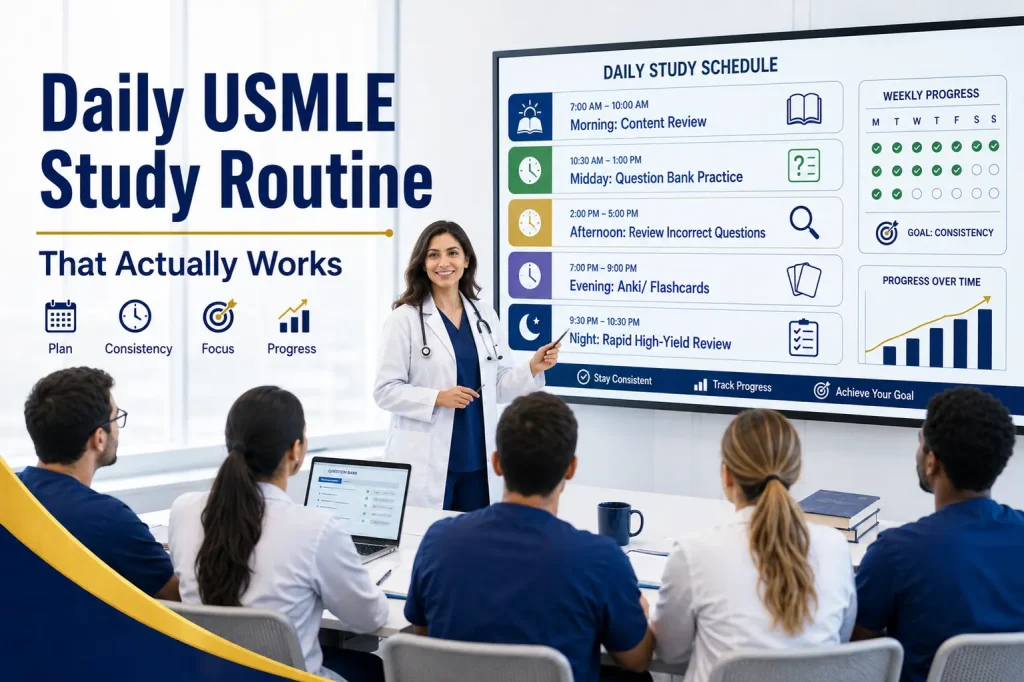

How to create a daily USMLE study routine that works is one of the most important skills for medical students and IMGs because success on Step 1, Step 2 CK, or Step 3 depends on consistency, structure, and honest weak-area repair.
Most students do not fail because they refuse to study. They struggle because their days are disorganized. They wake up unsure what to do, jump between resources, avoid difficult topics, and end the day feeling guilty.
A strong daily routine removes guesswork. It tells you when to learn, when to do questions, when to review mistakes, when to take breaks, and when to measure progress with NBME-style assessments.
This guide will show you how to build a daily USMLE study routine using SmashUSMLE Reviews, QBank practice, NBME analysis, active recall, spaced repetition, and realistic scheduling.
Free USMLE Training
Free USMLE Step 1 Bootcamp
Join our free USMLE masterclass where we break down high-yield concepts, NBME strategies, and clinical reasoning systems used by thousands of medical students and IMGs.
Reserve My SpotWhy Your Daily USMLE Routine Matters
Your daily routine determines whether your studying actually turns into score improvement. A weak routine creates stress, inconsistency, and shallow review. A strong routine creates momentum.
The goal is not to make every day perfect. The goal is to make every day clear.
A Good USMLE Routine Helps You
- Know exactly what to study each day.
- Spend more time on weak areas instead of comfortable topics.
- Balance content review with QBank practice.
- Review missed questions deeply instead of rushing through explanations.
- Build endurance for timed blocks and exam-day pacing.
- Reduce anxiety because your plan is organized.
- Track whether your NBME performance is improving.
The Big Rule
A daily USMLE routine should not be built around how much you can cram. It should be built around what will improve your next QBank block and NBME score.
The Core Principles of a Strong USMLE Study Routine
A strong routine is simple, repeatable, and focused. It does not require ten resources or a color-coded schedule that collapses after three days.
Your routine should include learning, application, review, and weak-area correction every day.
The SmashUSMLE Daily Study Framework
- Learn: Review high-yield content using SmashUSMLE lessons, Masterclass, or self-paced course material.
- Apply: Complete QBank questions related to the topic or weak system.
- Review: Analyze missed questions and identify the reason for each mistake.
- Reinforce: Use active recall, flashcards, or a weak-area notebook.
- Measure: Use NBME performance to adjust your plan weekly.
Routine Rule
Every study day should answer one question: What weakness am I fixing today?
A Daily USMLE Study Routine That Works
The best daily routine depends on your timeline, baseline score, and responsibilities. But most students benefit from a structure that separates content review, questions, deep review, and reinforcement.
Full-Time Daily USMLE Study Template
| Time Block | Task | Purpose |
|---|---|---|
| Morning | SmashUSMLE lesson, Masterclass review, or self-paced content review | Build high-yield understanding before doing questions. |
| Late Morning | Focused QBank block | Apply what you just reviewed and identify gaps. |
| Afternoon | Deep question review | Understand why each missed answer was wrong and what concept was tested. |
| Late Afternoon | Weak-area repair | Review the system, topic, or mechanism that caused repeated misses. |
| Evening | Active recall, flashcards, or missed-concept notebook | Reinforce patterns and prevent repeated mistakes. |
Daily Study Rule
Do not end the day by asking, “How many hours did I study?” Ask, “What did I understand better today than I did yesterday?”
Morning Study Block: Learn High-Yield Concepts
Your morning block should be used for the hardest thinking of the day. This is when you should review difficult systems, rebuild weak foundations, and study concepts that require focus.
Do not waste your best mental energy scrolling through random notes or reorganizing your schedule.
What to Do During the Morning Block
- Choose one high-yield topic or weak system.
- Use SmashUSMLE Reviews, Masterclass, or self-paced lessons to rebuild the concept.
- Write down the key mechanism in your own words.
- Connect the topic to how USMLE questions test it.
- Prepare to apply the topic immediately in a QBank block.
Morning Rule
Learn first, then apply. Do not spend the entire morning passively watching videos without testing yourself.
Question Block: Apply What You Learned
QBank practice is where you find out whether you actually understand the material. Reading feels comfortable. Questions reveal the truth.
A strong daily routine should include questions almost every study day.
How to Use Daily QBank Blocks
- Use focused blocks when repairing weak systems.
- Use mixed timed blocks when building exam readiness.
- Start with quality before increasing volume.
- Review every missed question carefully.
- Track repeated errors in a weak-area notebook.
| QBank Block Type | When to Use It | Best Purpose |
|---|---|---|
| Focused Untimed | Early in weak-area repair | Build understanding without rushing. |
| Focused Timed | After basic review | Apply concepts under pressure. |
| Mixed Timed | Closer to test day | Build exam stamina and switching ability. |
| Incorrects Review | After patterns repeat | Fix recurring mistakes. |
High-Yield Step 1 Resource
SmashUSMLE High Yield Step 1 Book
If you need a focused review resource, use the SmashUSMLE High Yield Step 1 Book to organize the concepts, clinical patterns, and reasoning points that matter most for Step 1.
- Strengthen high-yield Step 1 foundations
- Review core systems more efficiently
- Connect facts to NBME-style reasoning
- Use alongside QBank practice and NBME review

Review Block: Turn Misses Into Improvement
The review block is the most important part of your daily USMLE routine. This is where you convert wrong answers into score improvement.
Do not rush explanations. Do not simply read and move on. Your goal is to identify why you missed the question and how you will avoid that mistake next time.
The Daily Missed Question Review Method
- Identify the tested concept: What was the question really asking?
- Find your mistake type: Content gap, application gap, misread, timing issue, or distractor trap.
- Explain the correct answer: Write why it is correct in one or two sentences.
- Explain your wrong answer: Write why it was tempting but wrong.
- Create a takeaway: Write one rule you can review later.
| Mistake Type | What It Means | How to Fix It |
|---|---|---|
| Content Gap | You did not know the fact or mechanism. | Review the topic and do focused questions. |
| Application Gap | You knew the fact but could not apply it. | Practice clinical vignettes and explain reasoning aloud. |
| Distractor Trap | You picked a tempting answer not supported by the stem. | Force yourself to prove the answer using clues. |
| Timing Issue | You rushed or overthought. | Practice timed blocks and pacing discipline. |
| Misread Question | You answered a different question than the one asked. | Read the last line first and identify the task. |
Review Rule
You do not need a long note for every missed question. You need a clear takeaway that changes how you answer the next question.
How to Build Your Day Around Weak Areas
Your daily routine should not treat every topic equally. If your NBME or QBank performance shows weakness in cardiology, renal, biostatistics, or microbiology, those areas need priority.
Strong students use data to decide what to study next. Struggling students often study what feels familiar.
Weekly Weak-Area Planning
- Review your NBME or QBank performance at the end of each week.
- Choose two or three weak systems to prioritize.
- Assign one weak system to each major study day.
- Use SmashUSMLE lessons to rebuild the topic.
- Use QBank blocks to test whether the weakness is improving.
- Use tutoring if your scores are stuck despite consistent effort.
Weak-Area Rule
Your weakest topics should appear in your schedule before your favorite topics.
Daily Routine for Students Who Work or Have Limited Time
Not every student has eight to ten hours a day to study. Many IMGs, working students, parents, and clinical students need a smaller routine that still works.
If your time is limited, your routine must become more focused. You cannot afford random studying.
Limited-Time Daily USMLE Routine
| Available Time | Daily Routine | Priority |
|---|---|---|
| 1 Hour | 30 minutes content review, 20 minutes questions, 10 minutes takeaway review | Consistency and active recall. |
| 2 Hours | 45 minutes SmashUSMLE review, 45 minutes QBank, 30 minutes missed-question review | Balanced learning and application. |
| 3 Hours | 60 minutes content, 60 minutes questions, 60 minutes deep review | Weak-area repair and question skill. |
| 4+ Hours | Content block, QBank block, review block, active recall block | Dedicated-style preparation. |
Limited-Time Rule
If you only have one or two hours, do not spend all of it passively watching videos. You need questions and review almost every day.
Common Daily Study Routine Mistakes
1. Building a Schedule That Is Too Perfect
If your routine depends on perfect sleep, perfect focus, and zero interruptions, it will fail. Build a routine that works in real life.
2. Studying Too Many Resources in One Day
Jumping between too many resources creates mental clutter. Pick a primary system, then use supporting resources only when needed.
3. Avoiding Questions Until You Feel Ready
Questions are part of learning. You do not need to feel ready before starting QBank practice.
4. Reviewing Questions Too Fast
A completed block does not help much if you do not understand your misses.
5. Ignoring NBME Feedback
Your NBME performance should guide your weekly routine. If a weak area keeps showing up, it needs more attention.
Student Success Story
⭐ 4.8 Google Rating | 120+ ReviewsSee How SmashUSMLE Students Improve Their Scores
Learn how structured clinical reasoning, NBME-focused review, and disciplined preparation can help IMGs break through score plateaus.
Want to learn the same clinical reasoning system used by SmashUSMLE students?
Join Free BootcampNeed Help Building a USMLE Study Routine That Actually Works?
If your study days feel scattered, your QBank scores are not improving, or your NBME results are stuck, the problem may not be effort. It may be your system.
SmashUSMLE Reviews helps students build structure, identify weak areas, review questions correctly, and prepare for Step 1, Step 2 CK, and Step 3 with a smarter daily routine.
FAQ: How to Create a Daily USMLE Study Routine That Works
What should a daily USMLE study routine include?
A strong daily routine should include content review, QBank practice, missed-question review, weak-area repair, and active recall.
How many hours should I study each day for the USMLE?
The right number depends on your timeline, baseline, and responsibilities. Many dedicated students study six to eight hours daily, while working students may need a focused one to three hour plan.
Should I do questions every day?
Most students should do questions almost every study day. Questions help you apply content, identify weak areas, and build test-taking skill.
Should I study content before doing questions?
If a topic is very weak, review the core concept first, then apply it with questions. As you get closer to exam day, timed mixed blocks become more important.
How do I know if my daily routine is working?
Your routine is working if your missed-question patterns are decreasing, your weak areas are improving, and your NBME scores are moving in the right direction.
When should I get tutoring?
Consider tutoring if your scores are stuck, your routine feels disorganized, you keep missing the same question types, or you cannot identify why your performance is not improving.
Ready to Build a Smarter USMLE Study Routine?
USMLE preparation becomes easier when your daily routine has structure. Join thousands of medical students and IMGs using SmashUSMLE’s clinical reasoning system to prepare for Step 1, Step 2 CK, and Step 3.