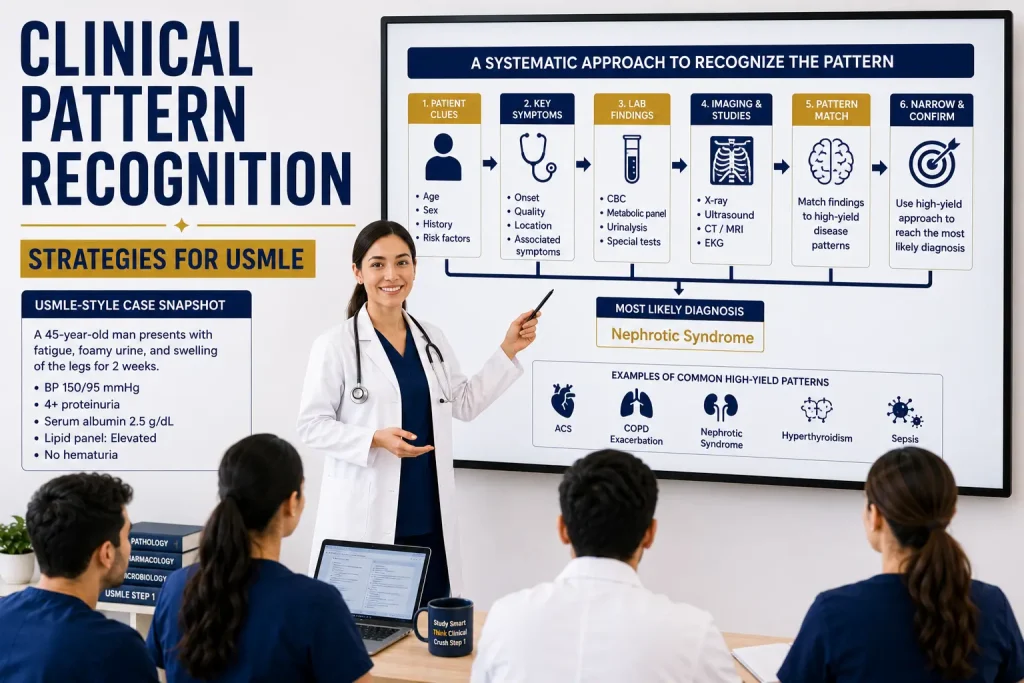

Clinical pattern recognition strategies for USMLE can help you move from memorizing isolated facts to thinking like the exam expects. The USMLE is not just testing what you know. It is testing whether you can recognize disease patterns inside clinical vignettes.
Many students miss questions because they know the content but fail to connect the age, timeline, symptoms, vitals, labs, imaging, and answer choices into one clear pattern.
The strongest students learn how to identify the clinical script quickly, confirm it with supporting clues, eliminate distractors, and avoid being pulled away by one misleading detail.
This guide will show you how to build clinical pattern recognition using SmashUSMLE Reviews, QBank practice, NBME analysis, and a structured question approach.
Free USMLE Training
Free USMLE Step 1 Bootcamp
Join our free USMLE masterclass where we break down high-yield concepts, NBME strategies, and clinical reasoning systems used by thousands of medical students and IMGs.
Reserve My SpotWhat Clinical Pattern Recognition Means on USMLE
Clinical pattern recognition means identifying the likely diagnosis, mechanism, complication, or next step based on a cluster of clues rather than one memorized fact.
The USMLE often gives you a patient story with enough information to recognize a pattern, but it also includes extra details to test whether you can stay focused.
Strong Pattern Recognition Helps You
- Recognize classic disease presentations faster.
- Separate important clues from distracting details.
- Connect symptoms, labs, imaging, and mechanisms.
- Predict the answer before looking at the options.
- Avoid tempting but unsupported answer choices.
- Improve timing during long question blocks.
- Review missed questions more effectively.
The Big Rule
Do not memorize diseases as isolated facts. Learn the clinical pattern: who gets it, how it presents, what confirms it, and what the exam is likely to ask.
How to Build a Clinical Script
A clinical script is a mental template for a disease. It helps you recognize the condition when it appears inside a vignette.
Instead of memorizing a long list, build a short pattern that connects the most testable details.
The SmashUSMLE Clinical Script Framework
- Patient type: Who usually gets this condition?
- Timeline: Is it acute, subacute, chronic, recurrent, or progressive?
- Core symptoms: What symptoms define the condition?
- Physical exam clues: What findings support the diagnosis?
- Labs or imaging: What confirms the pattern?
- Mechanism: What is the underlying pathophysiology?
- USMLE task: What is the exam most likely to ask?
Clinical Script Rule
If you cannot summarize a disease pattern in one sentence, you probably do not know it well enough for a difficult USMLE vignette.
The Key Clues You Must Train Yourself to Notice
USMLE vignettes are built from clues. Top students do not treat every clue equally. They learn which clues carry the most diagnostic weight.
Age, sex, risk factors, timing, vital signs, medications, exposures, labs, and imaging all help narrow the answer.
High-Yield Clinical Clue Categories
| Clue Type | What to Ask | Why It Matters |
|---|---|---|
| Age | What diseases fit this age group? | Many conditions have classic age patterns. |
| Timeline | Did this happen suddenly or gradually? | Acute versus chronic changes the differential. |
| Risk Factors | What exposures, behaviors, or history matter? | Risk factors often point to the tested diagnosis. |
| Vitals | Is the patient stable or unstable? | Vitals often determine the next best step. |
| Labs | Which abnormality explains the presentation? | Lab patterns often confirm the mechanism. |
| Medications | Could this be a drug effect? | Adverse effects are heavily tested. |
Why Timeline Matters in USMLE Questions
Timeline is one of the most important pattern recognition tools on the USMLE. The same symptom can mean completely different things depending on whether it developed over minutes, days, weeks, or years.
Many wrong answers become tempting when you ignore timing.
How Timeline Changes the Diagnosis
| Timeline | What It Suggests | USMLE Strategy |
|---|---|---|
| Minutes to Hours | Acute emergencies, trauma, ischemia, allergic reactions | Think stability, immediate management, and life threats. |
| Days | Infection, inflammation, medication effects | Look for fever, exposures, immune status, and new drugs. |
| Weeks | Subacute infection, malignancy, autoimmune disease | Connect constitutional symptoms and progressive findings. |
| Months to Years | Chronic disease, degeneration, endocrine disorders | Look for long-term complications and risk factors. |
| Recurrent Episodes | Genetic, metabolic, seizure, migraine, autoimmune, or episodic disorders | Ask what triggers the episodes and what resolves them. |
Timeline Rule
Before choosing an answer, ask whether the timeline fits. A correct-sounding diagnosis with the wrong timeline is usually a trap.
How to Use Labs and Imaging Clues
Labs and imaging should not be read as random numbers or pictures. They should be interpreted as part of the clinical pattern.
Top students ask what the abnormal result means physiologically and how it connects to the patient’s symptoms.
How to Interpret Lab Clues
- Identify the abnormal value first.
- Ask what mechanism would cause that abnormality.
- Connect the abnormality to the patient’s symptoms.
- Check whether the answer choices match the mechanism.
- Avoid choosing an answer based on one lab value alone.
Lab Rule
A lab value is not the answer by itself. It is evidence. Use it to support the pattern.
High-Yield Step 1 Resource
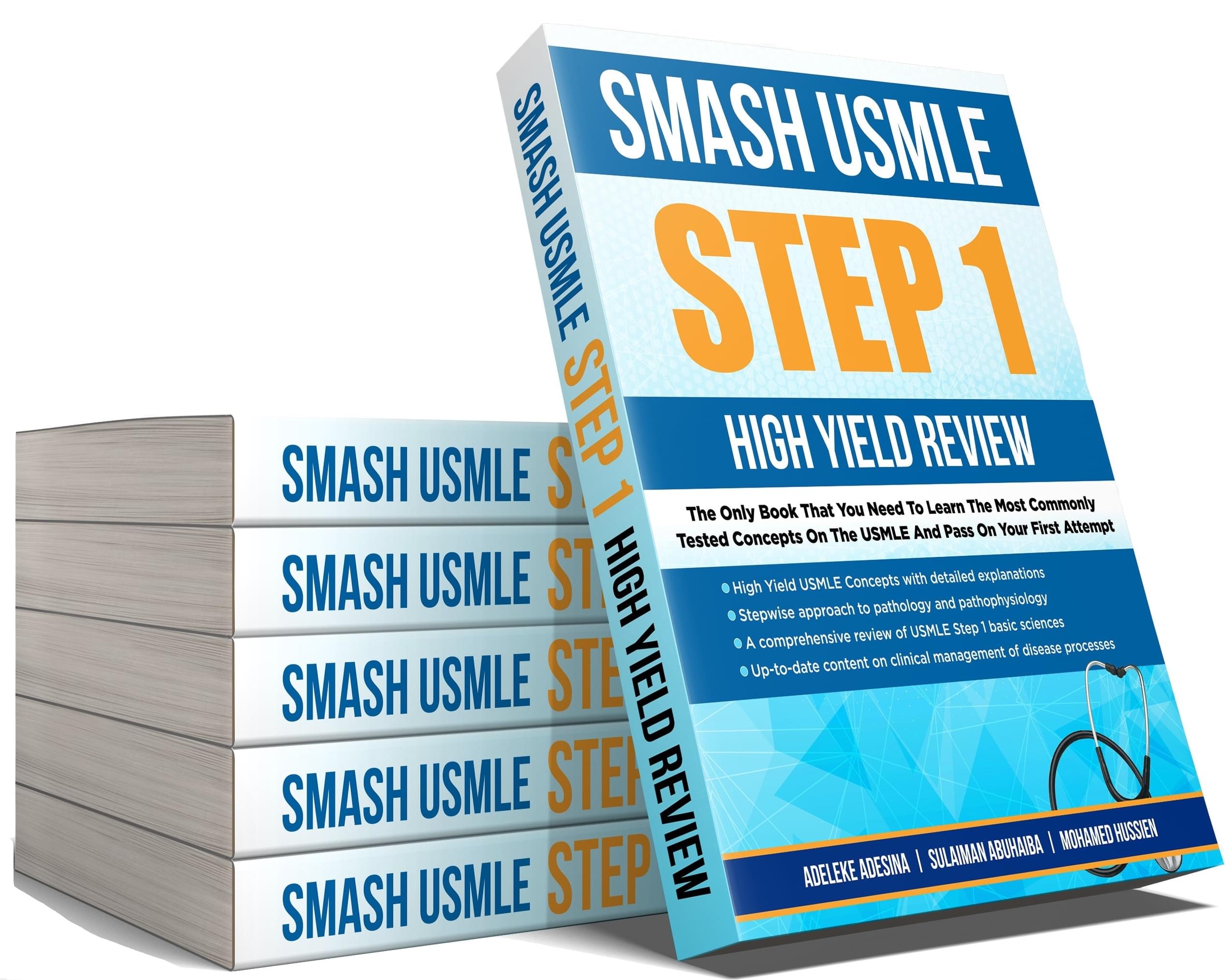
SmashUSMLE High Yield Step 1 Book
If you need a focused review resource, use the SmashUSMLE High Yield Step 1 Book to organize the concepts, clinical patterns, and reasoning points that matter most for Step 1.
- Strengthen high-yield Step 1 foundations
- Review core systems more efficiently
- Connect facts to NBME-style reasoning
- Use alongside QBank practice and NBME review
How to Avoid Distractor Traps
Distractors are designed to look familiar. They often match one clue but fail to match the full pattern.
Strong students do not ask, “Have I seen this answer before?” They ask, “Does this answer fit the full clinical script?”
Common USMLE Distractor Traps
- Single-clue trap: An answer matches one detail but ignores the rest of the vignette.
- Wrong timeline trap: The disease fits the symptom but not the speed of progression.
- Wrong patient trap: The disease usually occurs in a different age group or risk group.
- Wrong mechanism trap: The diagnosis sounds right, but the pathophysiology does not fit.
- Wrong management trap: The treatment may be used later, but it is not the next best step.
Distractor Rule
Do not let one familiar clue override the full pattern. The best answer must fit the patient, timeline, mechanism, and question being asked.
How to Train Pattern Recognition With QBank Practice
QBank practice is one of the best ways to build clinical pattern recognition, but only if you review questions correctly.
Your goal is not just to finish questions. Your goal is to recognize recurring patterns faster and more accurately.
The Pattern Recognition QBank Method
- Read the last line first to identify the task.
- Identify the patient type and timeline.
- Highlight only the clues that change the diagnosis or management.
- Predict the pattern before looking deeply at the answer choices.
- After reviewing, write one short clinical script for missed questions.
- Track repeated patterns in a weak-area notebook.
| Practice Type | Best Use | Goal |
|---|---|---|
| Focused Blocks | Weak system repair | Recognize patterns within one topic area. |
| Mixed Blocks | Exam readiness | Switch between patterns quickly. |
| Timed Blocks | Pacing practice | Build speed without careless guessing. |
| Incorrect Review | Repeated misses | Fix the exact pattern you keep missing. |
How to Use NBME Review to Find Pattern Gaps
NBME exams help you identify whether your pattern recognition is improving. They show which systems, question types, and clinical clues are still causing problems.
Do not use NBMEs only as score predictors. Use them as diagnostic tools.
Questions to Ask After Every NBME
- Which clinical patterns did I fail to recognize?
- Which systems produced the most repeated misses?
- Did I miss the diagnosis, mechanism, next step, or complication?
- Did I choose distractors based on one clue?
- Did I ignore timing, vitals, labs, or risk factors?
- Do I need coaching to identify why my scores are stuck?
Common Pattern Recognition Mistakes
1. Memorizing Facts Without Clinical Context
Facts matter, but they must be connected to patient presentations. The USMLE tests application, not isolated recall alone.
2. Ignoring the Last Line
If you do not know what the question is asking, you may recognize the disease but still choose the wrong answer.
3. Overvaluing One Clue
One clue can support a diagnosis, but the full pattern must fit. Do not let one familiar detail pull you into a trap.
4. Failing to Review Missed Patterns
If you miss the same pattern repeatedly, you need to write it down, review it, and do targeted practice.
5. Avoiding Mixed Blocks Too Long
Focused blocks are useful early, but mixed blocks train you to recognize patterns when the topic is not announced.
Student Success Story
⭐ 4.8 Google Rating | 120+ ReviewsSee How SmashUSMLE Students Improve Their Scores
Learn how structured clinical reasoning, NBME-focused review, and disciplined preparation can help IMGs break through score plateaus.
Want to learn the same clinical reasoning system used by SmashUSMLE students?
Join Free BootcampNeed Help Building Clinical Pattern Recognition for USMLE?
If you know the content but still miss questions, your issue may be clinical reasoning and pattern recognition. More memorization alone may not fix the problem.
SmashUSMLE Reviews helps students identify weak areas, recognize clinical patterns, review missed questions correctly, and prepare for Step 1, Step 2 CK, and Step 3 with a smarter system.
FAQ: Clinical Pattern Recognition Strategies for USMLE
What is clinical pattern recognition for USMLE?
Clinical pattern recognition is the ability to connect patient clues, timeline, symptoms, labs, imaging, and mechanisms to identify the correct diagnosis or next step.
How do I improve pattern recognition for USMLE questions?
Build clinical scripts for common conditions, do QBank questions consistently, review missed questions by pattern, and use NBME results to find weak areas.
Why do I know the topic but still miss the question?
This usually means you have an application gap. You may know the fact but struggle to recognize how the exam presents it inside a clinical vignette.
Should I use focused or mixed QBank blocks?
Use focused blocks when repairing weak systems. Use mixed timed blocks when building exam readiness and practicing real pattern recognition.
How should I review missed questions for pattern recognition?
Identify the clinical pattern you missed, write the key clues, name the distractor trap, and create a short clinical script to review later.
When should I get tutoring for USMLE pattern recognition?
Consider tutoring if your NBME scores are stuck, you keep missing similar clinical patterns, or you cannot identify why your question strategy is not improving.
Ready to Improve Your Clinical Pattern Recognition?
USMLE success improves when you stop memorizing randomly and start recognizing the patterns behind the questions. Join thousands of medical students and IMGs using SmashUSMLE’s clinical reasoning system to prepare for Step 1, Step 2 CK, and Step 3.