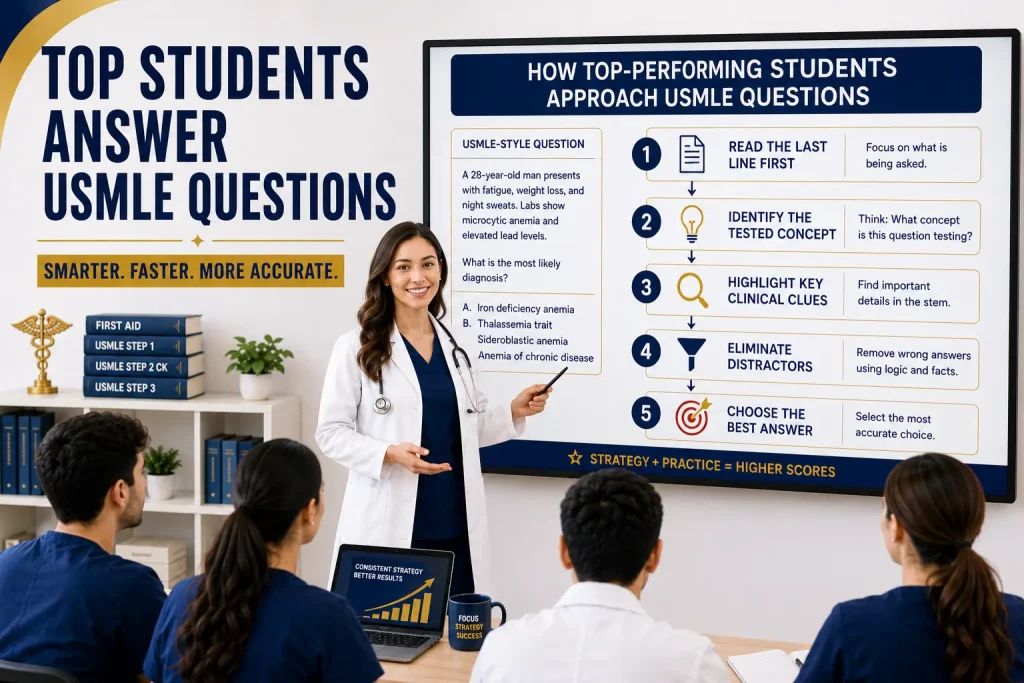

How top-performing students approach USMLE questions is different from how struggling students approach them. High performers do not just read faster or memorize more facts. They use a disciplined system.
They know how to identify the true question being asked, connect clues to mechanisms, eliminate distractors, and avoid changing answers based on panic.
The USMLE rewards clinical reasoning. That means your goal is not just to know information. Your goal is to apply information inside a patient vignette under timed conditions.
This guide will show you how strong students think through USMLE questions and how to build that same approach using SmashUSMLE Reviews, QBank practice, NBME review, and one-on-one coaching.
Free USMLE Training
Free USMLE Step 1 Bootcamp
Join our free USMLE masterclass where we break down high-yield concepts, NBME strategies, and clinical reasoning systems used by thousands of medical students and IMGs.
Reserve My SpotWhat Top-Performing Students Do Differently
Top-performing students approach USMLE questions with structure. They do not randomly highlight the entire stem, panic over unfamiliar details, or pick an answer just because it sounds familiar.
They slow down at the right moments and speed up at the right moments. They know that most USMLE questions are built around a central teaching point.
High-Scoring Students Usually Do These Things Well
- They read the last line before getting lost in the vignette.
- They identify what subject the question is testing.
- They separate useful clues from distracting details.
- They predict the answer before looking at the options when possible.
- They eliminate wrong answers with logic, not emotion.
- They review missed questions by pattern, not embarrassment.
- They use NBME data to guide what they study next.
The Big Rule
Top students do not ask, “Do I recognize this question?” They ask, “What concept is this question testing, and what evidence supports the answer?”
Step 1: Read the Last Line First
The last line tells you what the exam wants. It may ask for diagnosis, mechanism, next best step, risk factor, complication, treatment, or interpretation.
If you read the full vignette without knowing the task, you may waste time collecting details that do not matter.
Examples of Last-Line Tasks
| Last-Line Wording | What It Usually Means | Your Strategy |
|---|---|---|
| What is the most likely diagnosis? | Pattern recognition | Find the key symptoms, timeline, and exam clues. |
| What is the mechanism? | Pathophysiology | Connect the presentation to the underlying process. |
| What is the next best step? | Clinical decision-making | Determine stability, urgency, and guideline-based management. |
| What is the most likely complication? | Disease progression | Ask what happens if this condition continues untreated. |
| Which finding would be expected? | Concept application | Predict the lab, imaging, or physical exam result. |
SmashUSMLE Question Rule
Read the last line first, then read the answer choices briefly, then return to the vignette with a purpose.
Step 2: Identify the Core Concept
Every strong USMLE question is built around a core concept. The vignette may look complicated, but the exam usually wants one central idea.
The mistake many students make is treating every detail as equally important. Top students ask, “What is the exam testing here?”
Core Concepts Commonly Tested on USMLE
- Pathophysiology mechanism
- Classic disease presentation
- Drug mechanism or adverse effect
- Microbiology clue pattern
- Biochemistry pathway defect
- Risk factor or prevention strategy
- Diagnosis versus next best step
- Emergency management priority
If you can name the concept, you are no longer guessing. You are reasoning.
The High-Scorer Mindset
Do not just ask, “What disease is this?” Ask, “What concept does this disease allow the exam writer to test?”
Step 3: Use Clinical Clues Correctly
USMLE questions are not random stories. Age, sex, timing, symptoms, vitals, labs, medications, and risk factors are usually placed there for a reason.
Top students do not memorize every possible clue. They learn how clues work together.
How to Sort Clinical Clues
| Clue Type | What to Ask | Example Use |
|---|---|---|
| Age | What diagnoses are common in this age group? | Infant, young adult, elderly patient patterns. |
| Timeline | Is this acute, subacute, chronic, or recurrent? | Hours versus months can completely change the diagnosis. |
| Vitals | Is the patient stable or unstable? | Shock, sepsis, respiratory failure, emergency management. |
| Labs | Which abnormality explains the presentation? | Anion gap, electrolytes, CBC pattern, liver tests. |
| Medications | Could this be a drug effect? | Anticoagulants, steroids, antibiotics, psychiatric medications. |
When you practice this repeatedly, long vignettes become less intimidating. You stop reading passively and start extracting useful data.
Step 4: Eliminate Distractors Like a High Scorer
Distractors are not random wrong answers. They are designed to attract students who recognize a clue but do not fully understand the concept.
Top-performing students eliminate answer choices by asking why each option is wrong.
Common USMLE Distractor Types
- Right disease, wrong question: The answer sounds related but does not answer the last line.
- Right topic, wrong mechanism: The diagnosis may fit, but the pathophysiology does not.
- Common association trap: The answer is associated with one clue but ignores the full vignette.
- Timing trap: The option fits a different stage of the disease.
- Management trap: The treatment may be correct later, but not as the next best step.
Answer Choice Rule
Do not pick an answer because it is familiar. Pick it because the vignette gives enough evidence to support it.
High-Yield Step 1 Resource
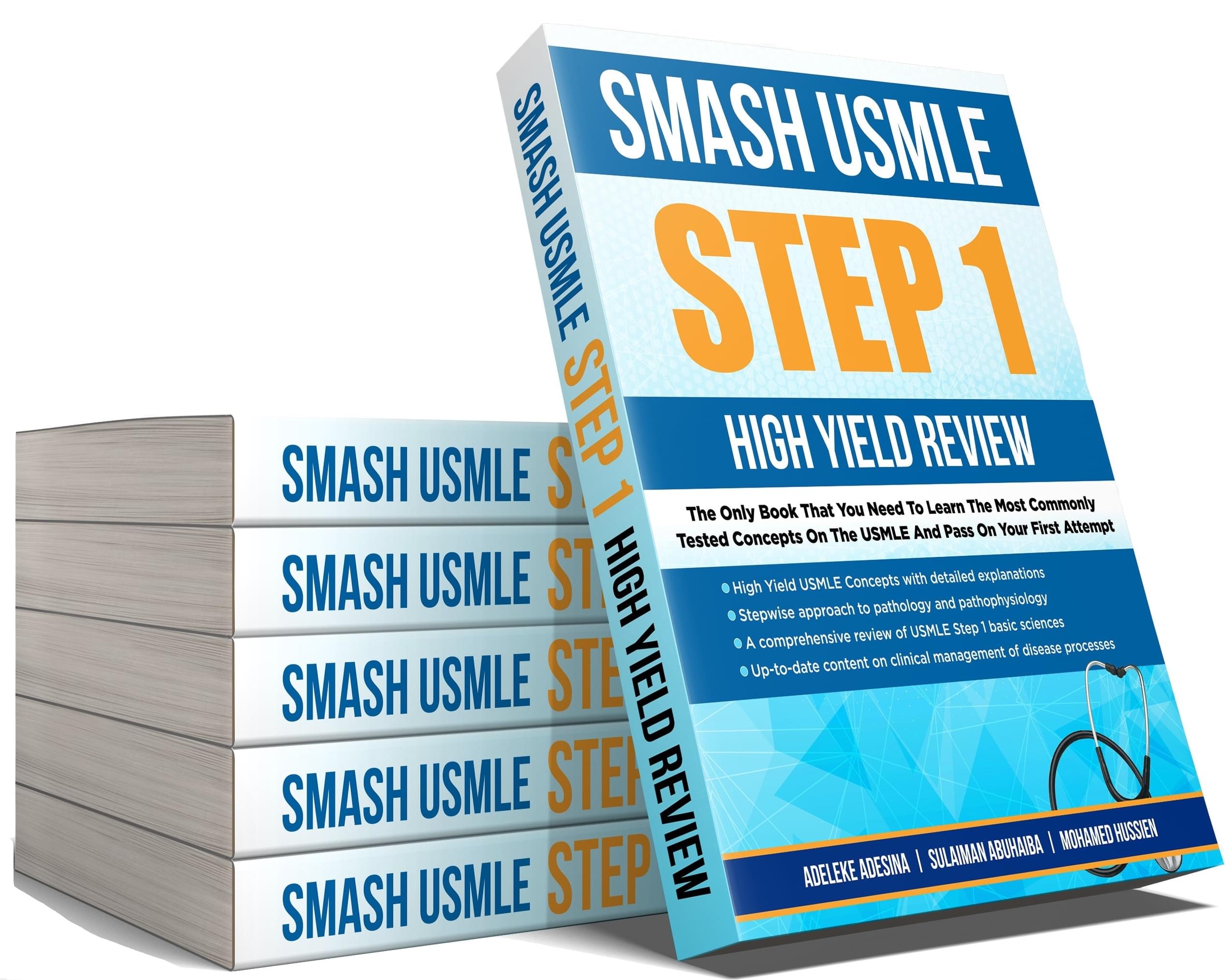
SmashUSMLE High Yield Step 1 Book
If you need a focused review resource, use the SmashUSMLE High Yield Step 1 Book to organize the concepts, clinical patterns, and reasoning points that matter most for Step 1.
- Strengthen high-yield Step 1 foundations
- Review core systems more efficiently
- Connect facts to NBME-style reasoning
- Use alongside QBank practice and NBME review
How to Review Missed USMLE Questions
Reviewing missed questions is where score improvement happens. But most students review questions too passively.
Reading an explanation and saying, “That makes sense,” is not enough. You need to identify why you missed the question and what pattern you must recognize next time.
The SmashUSMLE Missed Question Review Method
- Step 1: Identify the tested concept.
- Step 2: Write why the correct answer is correct.
- Step 3: Write why your answer was wrong.
- Step 4: Identify the trap that pulled you in.
- Step 5: Create one short takeaway you can review later.
| Error Type | What It Means | How to Fix It |
|---|---|---|
| Content gap | You did not know the concept. | Review the topic and do focused questions. |
| Application gap | You knew the fact but could not use it. | Practice clinical vignettes and explain mechanisms aloud. |
| Question misread | You missed what the question was asking. | Read the last line first and underline the task. |
| Distractor trap | You picked a tempting but unsupported answer. | Force yourself to prove the answer from the stem. |
| Timing issue | You rushed or overthought. | Use timed blocks and build pacing discipline. |
How to Use QBank Blocks to Build Question Skill
QBank practice is not just about volume. Doing more questions only helps if your review process is strong.
Top students use QBank blocks to train reasoning, timing, pattern recognition, and weak-area repair.
Best Way to Structure QBank Practice
- Use focused blocks when rebuilding weak systems.
- Use timed mixed blocks when preparing for exam conditions.
- Review every missed question by concept and trap.
- Track repeated misses in a weak-area notebook.
- Use SmashUSMLE Reviews to rebuild topics that keep appearing in missed questions.
QBank Rule
Do not measure progress by how many questions you complete. Measure progress by whether you stop missing the same patterns.
How Top Students Use NBME Exams
Top students do not use NBMEs only to predict their score. They use NBMEs to diagnose what needs to change.
After an NBME, your goal is to identify weak systems, repeated question types, timing problems, and content areas that need repair.
Questions to Ask After Every NBME
- Which systems are consistently weak?
- Which topics keep appearing in missed questions?
- Am I missing questions because of knowledge, reasoning, or timing?
- Am I overthinking easy questions?
- Do I need tutoring to identify why my scores are stuck?
This is where SmashUSMLE coaching can help. A tutor can look at your patterns and help you fix the real issue instead of guessing what to study next.
Common Question Approach Mistakes
1. Reading the Stem Without Knowing the Task
If you do not read the last line first, you may waste time collecting details that do not answer the actual question.
2. Picking Familiar Answers Too Quickly
Familiar does not mean correct. The right answer must fit the full vignette and answer the last line.
3. Ignoring the Timeline
Acute, subacute, chronic, recurrent, and progressive presentations often point to very different answers.
4. Reviewing Questions Passively
Reading explanations without identifying your mistake pattern will not fix your score.
5. Avoiding NBMEs Until the End
Waiting too long to take NBMEs delays the feedback you need to improve.
Student Success Story
⭐ 4.8 Google Rating | 120+ ReviewsSee How SmashUSMLE Students Improve Their Scores
Learn how structured clinical reasoning, NBME-focused review, and disciplined preparation can help IMGs break through score plateaus.
Want to learn the same clinical reasoning system used by SmashUSMLE students?
Join Free BootcampNeed Help Improving Your USMLE Question Strategy?
If you keep missing questions even after studying the content, the problem may not be effort. It may be your question approach.
SmashUSMLE Reviews helps students build clinical reasoning, identify weak areas, review missed questions correctly, and use QBank and NBME practice with a smarter system.
FAQ: How Top-Performing Students Approach USMLE Questions
How do top students approach USMLE questions?
Top students read the last line first, identify the task, recognize the tested concept, use clinical clues carefully, eliminate distractors, and review missed questions by pattern.
Should I read the answer choices before the vignette?
A quick glance at the answer choices can help you understand the category of the question, but do not let the options bias you too early. Use the vignette to prove the answer.
Why do I miss questions even when I know the topic?
This usually happens because of an application gap. You may know the fact but struggle to apply it to clinical clues, mechanisms, or next-best-step reasoning.
How should I review missed USMLE questions?
Identify the tested concept, explain why the correct answer is right, explain why your answer was wrong, name the trap, and write one short takeaway.
How many QBank questions should I do per day?
The right number depends on your timeline and baseline, but quality matters more than volume. A smaller number of deeply reviewed questions is better than many poorly reviewed questions.
When should I get help with my question strategy?
Consider tutoring if your NBME scores are stuck, you keep choosing distractors, you cannot explain why you miss questions, or you feel like your studying is not translating into score improvement.
Ready to Improve Your USMLE Question Strategy?
USMLE improvement starts when you stop guessing and start using a system. Join thousands of medical students and IMGs using SmashUSMLE’s clinical reasoning method to prepare for Step 1, Step 2 CK, and Step 3.