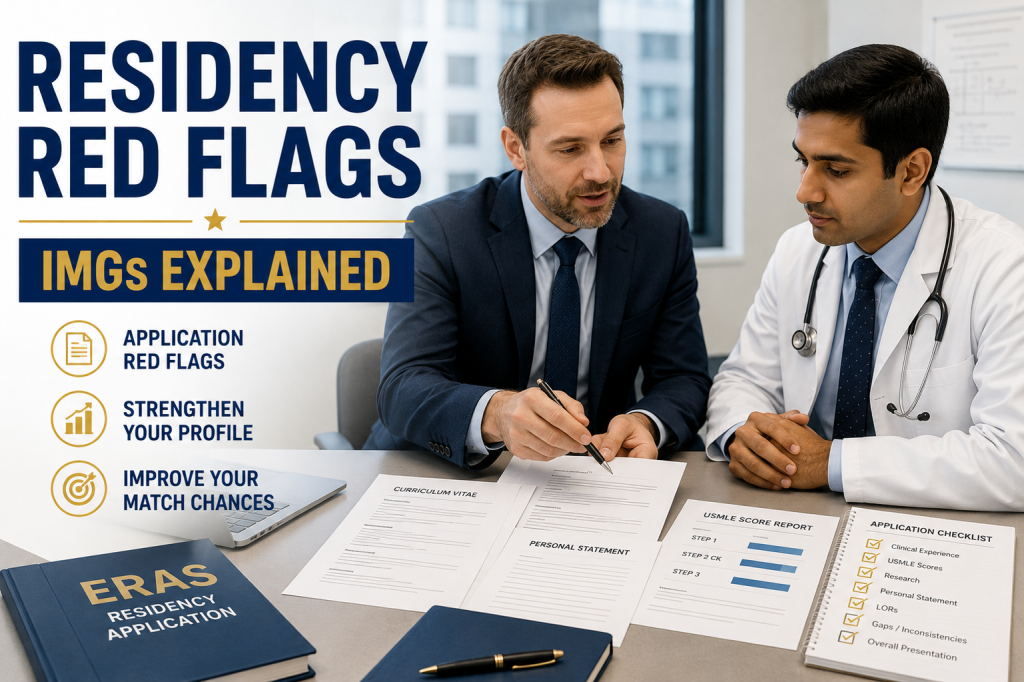

Residency red flags for IMGs can make the Match more difficult, but they do not automatically end your chances.
Many international medical graduates worry that one weakness in their application means programs will reject them immediately. The truth is more nuanced.
Residency programs look at patterns. A red flag becomes more concerning when it is unexplained, repeated, or paired with a weak overall application.
This guide will explain the most common IMG residency red flags, why programs care about them, and how to address them with a stronger strategy.
Free USMLE Training
Free USMLE Step 1 Bootcamp
Join our free USMLE masterclass where we break down high-yield concepts, NBME strategies, and clinical reasoning systems used by thousands of medical students and IMGs.
Reserve My SpotWhy Residency Red Flags Matter for IMGs
Residency programs use applications to predict whether a candidate will succeed clinically, communicate well, pass exams, work safely, and fit into the program culture.
For IMGs, programs may look more closely at certain areas because training systems, grading standards, clinical experience, and letters can vary widely between countries.
- Exam history helps programs estimate board readiness.
- Clinical experience helps programs assess patient care exposure.
- Letters show how supervisors describe your performance.
- Graduation year helps programs understand how recent your training is.
- Interview performance shows communication, maturity, and professionalism.
The Big Rule
A red flag does not have to destroy your Match chances. But ignoring it, hiding it, or explaining it poorly can make it worse.
The SmashUSMLE Red Flag Framework
When reviewing your residency application, do not panic. Use a structured framework to identify the issue and decide how to strengthen the rest of your application.
| Step | Question to Ask | Why It Matters |
|---|---|---|
| Step 1 | What is the red flag? | You need to identify whether the issue is academic, clinical, timing-related, professionalism-related, or communication-related. |
| Step 2 | Is it isolated or repeated? | One issue is easier to address than a repeated pattern of poor performance. |
| Step 3 | Can I show improvement? | Programs want evidence that the problem has been corrected. |
| Step 4 | Do I have strong supporting evidence? | Strong scores, USCE, letters, research, and interview performance can help balance concerns. |
| Step 5 | Can I explain it professionally? | Your explanation should be honest, brief, mature, and focused on growth. |
USMLE Exam Red Flags
USMLE performance is one of the most visible parts of an IMG residency application.
Programs may be concerned about exam failures, low scores, multiple attempts, delayed exams, or inconsistent performance across Step exams.
| Exam Red Flag | Why Programs Care | How to Strengthen the Application |
|---|---|---|
| Step failure | Raises concern about board readiness and test-taking consistency. | Show strong improvement on the next attempt and strengthen clinical experience. |
| Low Step 2 CK score | Can affect screening, especially for competitive programs. | Apply strategically, improve other parts of the application, and target IMG-friendly programs. |
| Multiple attempts | May suggest repeated academic difficulty. | Explain briefly, show correction, and provide evidence of current readiness. |
| Large score drop | May raise concern about inconsistency or preparation issues. | Use your personal statement or interview only if needed to explain context maturely. |
| Delayed exams | May raise questions about timeline, motivation, or preparation gaps. | Show a clear timeline, ongoing clinical work, and recent productivity. |
Exam Strategy
If you have an exam red flag, your next score and your overall application must show that the issue has been corrected.
Clinical Gaps and Graduation Year
Clinical gaps and older year of graduation are common concerns for IMGs.
Programs may wonder whether you are still clinically active, familiar with patient care, and ready to enter residency training.
- Long gap since graduation
- No recent clinical experience
- Unexplained time away from medicine
- Long delay between exams
- No clear clinical or academic activity during the gap
Gap Rule
A gap is easier to explain when you can show recent clinical activity, studying, research, volunteering, teaching, or other meaningful medical involvement.
Limited US Clinical Experience
US clinical experience is important for IMGs because it helps programs see how you function in the United States healthcare system.
Limited USCE can make your application weaker, especially if your letters are all from outside the United States.
| USCE Issue | Why It Matters | Better Strategy |
|---|---|---|
| No US clinical experience | Programs may not know how you perform in the US system. | Seek observerships, externships, hands-on rotations, or research-linked clinical exposure. |
| Only old USCE | Outdated clinical experience may not reassure programs. | Add recent USCE before applying when possible. |
| Weak specialty alignment | Experience outside your target specialty may be less persuasive. | Prioritize USCE in your intended specialty. |
| No US letters | Programs often value letters from physicians familiar with US clinical expectations. | Build relationships during rotations and request strong, specific letters. |
Weak Letters of Recommendation
Letters of recommendation can either strengthen or weaken your application.
A weak letter is not always negative. Sometimes it is generic, vague, short, or written by someone who barely knows you.
- Generic letter with no specific examples
- Letter from someone who did not directly supervise you
- Letter that does not mention clinical skills
- Letter that sounds neutral rather than enthusiastic
- No letter from your target specialty
- No recent letter showing current performance
Letter Rule
A strong letter should be specific, recent, clinically relevant, and written by someone who can clearly describe your performance.
Application and Interview Red Flags
Some red flags are not about scores. They come from how the application is written or how the applicant communicates during interviews.
| Red Flag | Why It Hurts | Better Approach |
|---|---|---|
| Generic personal statement | Does not explain who you are or why the specialty fits you. | Write a focused story with clear specialty motivation and growth. |
| Poor explanation of failure | Can sound defensive, vague, or immature. | Be honest, brief, accountable, and improvement-focused. |
| Unprofessional online presence | May raise concerns about judgment. | Clean up public profiles before application season. |
| Weak interview answers | Can undermine a strong paper application. | Practice behavioral questions, red flag explanations, and specialty-specific answers. |
| Overapplying without strategy | Wastes money and may miss better-fit programs. | Build a targeted IMG-friendly program list. |
How IMGs Can Address Red Flags
The goal is not to pretend the red flag does not exist. The goal is to show maturity, growth, and readiness.
A good red flag strategy has three parts:
- Acknowledge: Be honest if the issue needs explanation.
- Correct: Show what you did to fix the problem.
- Prove: Provide evidence through scores, USCE, letters, research, or recent clinical activity.
Red Flag Explanation Rule
Keep explanations brief. Do not blame others. Focus on what changed and why you are stronger now.
Common Mistakes IMGs Make
1. Ignoring the Red Flag
If the issue is obvious, pretending it does not exist can make the program fill in the blanks themselves.
2. Overexplaining Failure
Long explanations can sound defensive. Keep it concise, accountable, and focused on improvement.
3. Applying Without a Strategy
IMGs need a targeted application strategy based on specialty, scores, visa status, graduation year, USCE, and program history.
4. Waiting Too Long to Get USCE
Strong US clinical experience and letters take time. Do not wait until the last minute.
5. Submitting Generic Materials
A generic personal statement, weak CV, and vague letters can make an already borderline application weaker.
Student Success Story
⭐ 4.8 Google Rating | 120+ ReviewsSee How SmashUSMLE Students Improve Their Scores
Learn how structured clinical reasoning, NBME-focused review, and disciplined preparation can help IMGs break through score plateaus.
Want to learn the same clinical reasoning system used by SmashUSMLE students?
Join Free BootcampNeed Help Strengthening Your IMG Residency Application?
If you have exam failures, low scores, clinical gaps, limited USCE, or weak application materials, you need a clear strategy instead of panic.
SmashUSMLE Reviews helps IMGs strengthen their USMLE performance, clinical reasoning, application strategy, and residency readiness through structured courses, tutoring, and advising.
FAQ: Residency Red Flags for IMGs Explained
What are common residency red flags for IMGs?
Common red flags include USMLE failures, low scores, multiple attempts, old graduation year, clinical gaps, limited US clinical experience, weak letters, visa limitations, and poor interview performance.
Can IMGs match with a USMLE failure?
Yes, some IMGs can still match with a USMLE failure, but the application must be strategic. Strong improvement, US clinical experience, good letters, and smart program selection become very important.
Is an old graduation year a residency red flag?
It can be. Programs may worry about clinical readiness, especially if there is no recent clinical experience. Recent USCE, active medical work, and strong letters can help.
How should I explain a red flag in my residency application?
Be honest, brief, accountable, and focused on improvement. Avoid blaming others or giving long explanations that sound defensive.
Can strong US clinical experience help overcome red flags?
Yes. Strong, recent US clinical experience and specific letters from supervising physicians can help reassure programs about your readiness.
How can SmashUSMLE help IMGs with red flags?
SmashUSMLE Reviews helps IMGs improve USMLE performance, build stronger study systems, prepare for exams, and strengthen their overall residency strategy.
Ready to Strengthen Your Residency Application?
Residency red flags become less intimidating when you stop guessing and start building a strategy. Join thousands of medical students and IMGs using SmashUSMLE’s system to improve USMLE performance, strengthen clinical reasoning, and move closer to residency.