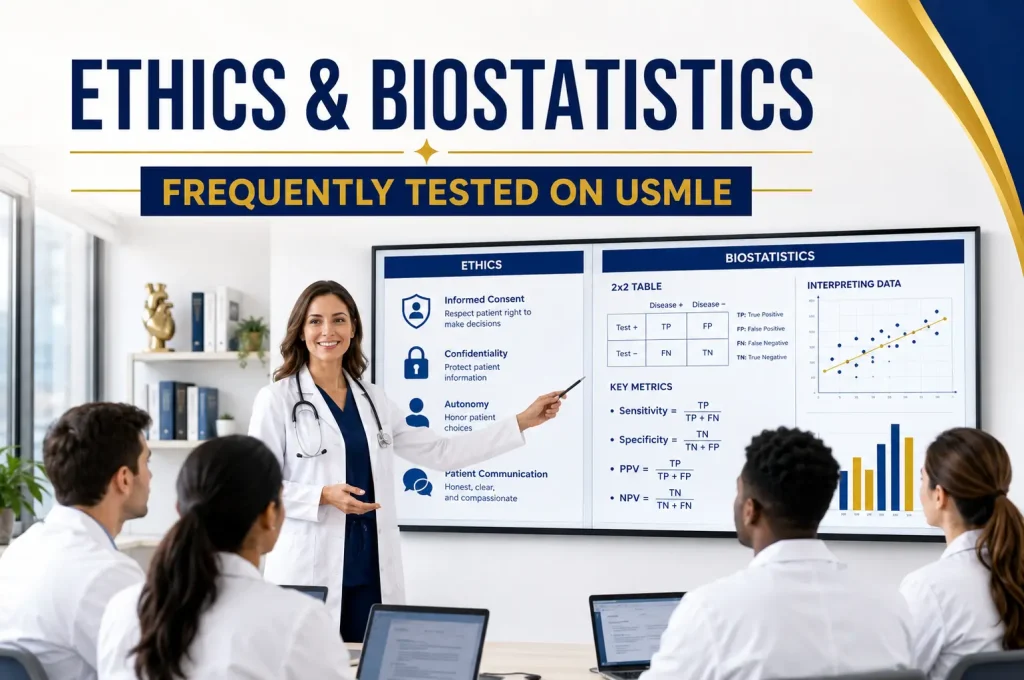

Ethics and biostatistics questions frequently tested on USMLE can feel tricky because they often test judgment, interpretation, and wording instead of simple memorization.
Many students lose points in these sections because they try to memorize isolated facts without learning the pattern behind the question.
Ethics questions usually test what the physician should say or do next. Biostatistics questions usually test whether you can identify the correct concept, formula, study design, or interpretation.
This guide will help you recognize the most common ethics and biostatistics question patterns, avoid common distractors, and build a simple system for answering these questions faster.
Free USMLE Training
Free USMLE Step 1 Bootcamp
Join our free USMLE masterclass where we break down high-yield concepts, NBME strategies, and clinical reasoning systems used by thousands of medical students and IMGs.
Reserve My SpotWhy Ethics and Biostatistics Matter on USMLE
Ethics and biostatistics questions are high-yield because they appear across Step 1, Step 2 CK, and Step 3. These questions test how you think, not just what you memorized.
Ethics questions often focus on communication, consent, confidentiality, capacity, professionalism, end-of-life care, and patient autonomy.
Biostatistics questions often focus on study design, bias, diagnostic testing, epidemiology equations, confidence intervals, p-values, and interpretation of research data.
- Ethics questions test what the physician should do or say next.
- Biostatistics questions test how to interpret data and research findings.
- Both sections reward pattern recognition.
- Both sections punish rushing and overthinking.
- Both sections can be improved with a repeatable system.
The Big Rule
Ethics questions usually reward patient-centered communication. Biostatistics questions usually reward careful identification of the concept before using a formula.
The SmashUSMLE Ethics and Biostatistics Framework
Use a structured approach so you do not get trapped by confusing wording.
| Step | Question to Ask | Why It Matters |
|---|---|---|
| Step 1 | Is this an ethics question or a biostatistics question? | This tells you whether to focus on communication, decision-making, research design, or formulas. |
| Step 2 | What is the core issue? | Identify consent, capacity, confidentiality, bias, screening, risk, odds, or treatment effect. |
| Step 3 | Is the question asking what to do next or what the data means? | Ethics often asks next best response. Biostatistics often asks interpretation or calculation. |
| Step 4 | Can I eliminate extreme or judgmental answers? | Ethics answers should usually respect autonomy, explore concerns, and avoid confrontation. |
| Step 5 | Do I need a formula or just the concept? | Many biostatistics questions test directionality or interpretation, not math. |
Frequently Tested Ethics Question Patterns
USMLE ethics questions are usually built around a few recurring patterns. Learn the pattern, then choose the answer that best respects the patient and gathers more information.
| Ethics Topic | Common USMLE Pattern | Best Approach |
|---|---|---|
| Patient autonomy | Patient refuses treatment or requests a different plan. | Assess understanding, explain risks and benefits, respect informed refusal. |
| Informed consent | Patient needs a procedure or treatment decision. | Explain diagnosis, options, risks, benefits, alternatives, and consequences of refusal. |
| Capacity | Patient makes a decision that seems medically unwise. | Assess whether the patient understands, appreciates, reasons, and communicates a choice. |
| Confidentiality | Family member asks for private patient information. | Do not disclose without patient permission unless legally required. |
| Medical error | A mistake occurs in patient care. | Disclose honestly, explain what happened, apologize, and discuss next steps. |
| End-of-life care | Patient has poor prognosis or family disagrees about care. | Clarify goals, honor patient wishes, and use advance directives or surrogate decision-maker when needed. |
Communication and Patient-Centered Questions
Communication questions usually ask for the best physician response. The correct answer is often the one that explores the patient’s concern without judging, dismissing, or forcing a decision.
- Use open-ended questions.
- Acknowledge emotion.
- Explore the patient’s understanding.
- Ask permission before giving advice when appropriate.
- Avoid arguing, threatening, blaming, or immediately correcting.
- Respect patient values and preferences.
Communication Rule
When in doubt, choose the answer that listens first, explores the concern, and keeps the conversation patient-centered.
Informed Consent and Decision-Making Capacity
Informed consent and capacity are heavily tested because they combine ethics, law, communication, and patient autonomy.
| Concept | High-Yield Meaning | USMLE Clue |
|---|---|---|
| Informed consent | Patient receives enough information to make a voluntary decision. | Procedure, surgery, medication, or risk discussion. |
| Capacity | Patient can understand, appreciate, reason, and communicate a choice. | Patient refuses care, appears confused, intoxicated, psychotic, or cognitively impaired. |
| Competence | Legal determination made by a court. | Do not confuse with bedside capacity assessment. |
| Informed refusal | Capable patient can refuse recommended care. | Explain risks, confirm understanding, document refusal. |
| Emergency exception | Treat without consent if immediate life-threatening emergency and patient cannot consent. | Unconscious patient with urgent need and no surrogate available. |
Capacity Rule
A patient can make a medically bad decision and still have capacity if they understand the situation and consequences.
Confidentiality and Disclosure Questions
Confidentiality questions test whether you know when patient information must be protected and when disclosure is required.
In general, do not share patient information with family, employers, schools, or others unless the patient gives permission or disclosure is legally required.
- Do not disclose adult patient information to family without permission.
- Report suspected child abuse, elder abuse, and certain public health risks.
- Warn identifiable victims when there is a serious threat of harm.
- Respect adolescent confidentiality when legally appropriate.
- Protect privacy even when family members are pressuring for information.
Confidentiality Rule
Protect confidentiality unless the patient consents, disclosure is legally required, or there is a serious risk of harm to others.
Frequently Tested Biostatistics Question Patterns
Biostatistics questions often look difficult because the wording is dense. The key is to identify the category before touching the numbers.
| Biostatistics Topic | Common USMLE Pattern | Best Approach |
|---|---|---|
| Sensitivity | Test ability to detect disease when disease is present. | Use TP / (TP + FN). |
| Specificity | Test ability to identify no disease when disease is absent. | Use TN / (TN + FP). |
| PPV | Probability of disease after a positive test. | Use TP / (TP + FP). |
| NPV | Probability of no disease after a negative test. | Use TN / (TN + FN). |
| Relative risk | Cohort study comparing risk in exposed vs unexposed. | Use risk in exposed / risk in unexposed. |
| Odds ratio | Case-control study comparing exposure history. | Use odds of exposure in cases / odds of exposure in controls. |
| NNT | Treatment benefit question. | Use 1 / absolute risk reduction. |
Study Design and Bias
Study design questions test whether you know how researchers collect data and what errors can distort results.
| Concept | High-Yield Clue | USMLE Meaning |
|---|---|---|
| Cohort study | Starts with exposure and follows for outcome. | Can calculate incidence and relative risk. |
| Case-control study | Starts with disease status and looks backward for exposure. | Best associated with odds ratio. |
| Randomized controlled trial | Patients are assigned to treatment or control. | Strong design for testing interventions. |
| Selection bias | Groups differ because of how participants were selected. | Sample does not represent the target population. |
| Recall bias | Patients with disease remember exposures differently. | Common in case-control studies. |
| Lead-time bias | Earlier diagnosis appears to improve survival without changing disease course. | Common in screening questions. |
| Length-time bias | Screening detects slower-growing disease more often. | Makes screening appear more beneficial than it may be. |
Screening Tests and 2x2 Tables
Screening test questions often use 2x2 tables. Label the table before calculating anything.
| Disease Present | Disease Absent | |
|---|---|---|
| Test Positive | True Positive | False Positive |
| Test Negative | False Negative | True Negative |
2x2 Table Rule
Sensitivity and specificity start with disease status. PPV and NPV start with test result.
Classic Ethics and Biostatistics Patterns on USMLE
These are the patterns you should recognize quickly during your exam.
| Question Stem Clue | Likely Concept | Best Reasoning |
|---|---|---|
| Patient refuses treatment but understands risks | Autonomy and informed refusal | Respect the decision after confirming understanding. |
| Family asks for adult patient’s diagnosis | Confidentiality | Ask the patient for permission before disclosing. |
| Patient is unconscious and needs emergency treatment | Emergency exception | Treat if delay would threaten life or health. |
| Patient makes an unusual decision | Capacity | Assess understanding, appreciation, reasoning, and ability to communicate a choice. |
| Cohort study comparing exposed and unexposed groups | Relative risk | Cohort studies can directly compare risk. |
| Case-control study looking backward for exposure | Odds ratio | Case-control studies usually use odds ratio. |
| Earlier screening appears to increase survival time without changing mortality | Lead-time bias | Diagnosis happens earlier, but death is not delayed. |
| Probability of disease after positive test | Positive predictive value | PPV = TP / (TP + FP). |
| Probability of no disease after negative test | Negative predictive value | NPV = TN / (TN + FN). |
Common Mistakes Students Make
1. Choosing the Most Forceful Ethics Answer
USMLE ethics usually rewards listening, exploring, and respecting patient autonomy. Avoid answers that threaten, judge, dismiss, or force.
2. Ignoring Capacity
A patient’s decision may seem wrong, but that does not automatically mean they lack capacity.
3. Disclosing Information Too Quickly
Do not disclose private patient information to family members unless the patient gives permission or disclosure is required.
4. Memorizing Biostatistics Formulas Without Understanding the Question
First identify the concept. Then choose the formula.
5. Confusing Study Designs
Cohort starts with exposure. Case-control starts with disease. This distinction helps you choose relative risk versus odds ratio.
Student Success Story
⭐ 4.8 Google Rating | 120+ ReviewsSee How SmashUSMLE Students Improve Their Scores
Learn how structured clinical reasoning, NBME-focused review, and disciplined preparation can help IMGs break through score plateaus.
Want to learn the same clinical reasoning system used by SmashUSMLE students?
Join Free BootcampNeed Help Mastering Ethics and Biostatistics for USMLE?
If ethics and biostatistics questions feel confusing, you do not need to guess your way through them. You need a clear system for recognizing the question pattern and choosing the best answer.
SmashUSMLE Reviews helps students use high-yield ethics, biostatistics strategy, NBME analysis, QBank practice, and one-on-one tutoring to master difficult USMLE topics.
FAQ: Ethics and Biostatistics Questions Frequently Tested on USMLE
What ethics topics are most frequently tested on USMLE?
Commonly tested ethics topics include informed consent, capacity, confidentiality, medical error disclosure, end-of-life care, patient autonomy, and physician-patient communication.
What biostatistics topics are most frequently tested on USMLE?
Commonly tested topics include sensitivity, specificity, PPV, NPV, relative risk, odds ratio, NNT, study design, bias, confidence intervals, and p-values.
How should I answer ethics questions on USMLE?
Choose answers that respect patient autonomy, explore the patient’s concerns, communicate clearly, avoid judgment, and protect confidentiality when appropriate.
How do I know when to use relative risk versus odds ratio?
Use relative risk for cohort studies and randomized trials. Use odds ratio for case-control studies.
What is the best way to avoid biostatistics mistakes?
Identify the concept first, label any 2x2 table carefully, then choose the formula or interpretation.
How can SmashUSMLE help with ethics and biostatistics?
SmashUSMLE Reviews helps students break down ethics and biostatistics questions using pattern recognition, QBank practice, NBME weak-area analysis, and tutoring support.
Ready to Improve Your USMLE Scores?
Ethics and biostatistics become easier when you stop guessing and start recognizing the pattern. Join thousands of medical students and IMGs using SmashUSMLE’s clinical reasoning system to prepare for Step 1, Step 2 CK, and Step 3.