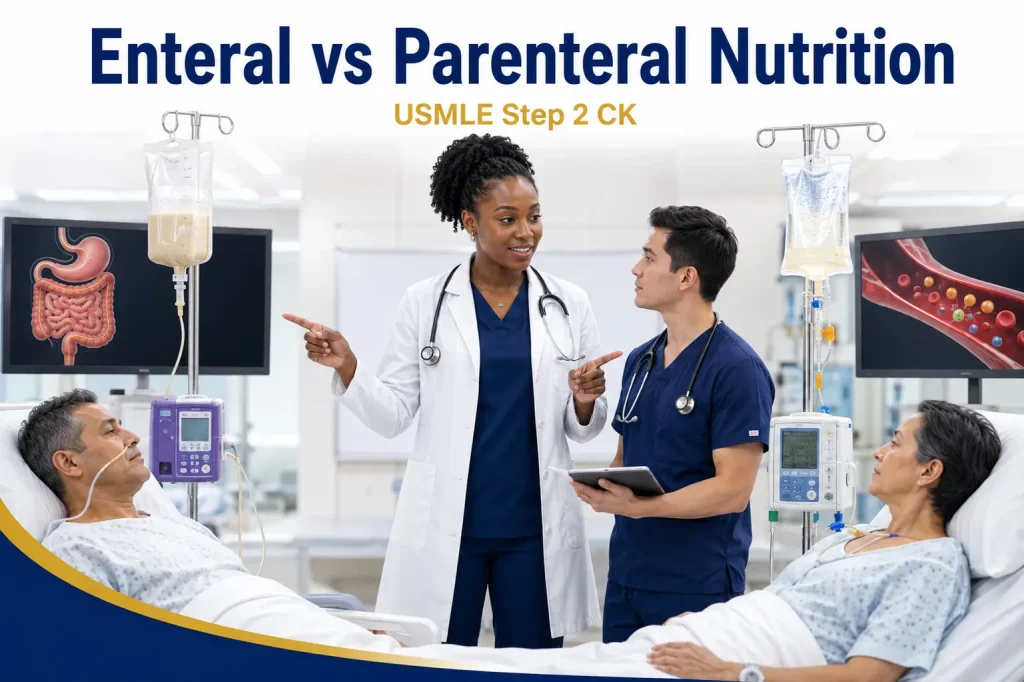

Enteral vs Parenteral Nutrition for Step 2 CK is a high-yield nutrition topic because the exam often asks you to choose the safest feeding route for a hospitalized patient.
The core rule is simple. If the gut works, use it. Enteral nutrition is preferred when the gastrointestinal tract is functional because it preserves gut integrity and has fewer serious complications than parenteral nutrition.
Parenteral nutrition is used when the GI tract cannot be used safely or effectively. Step 2 CK loves this distinction because it tests clinical reasoning, not memorization.
Free USMLE Training
Free USMLE Bootcamp
Join our free USMLE masterclass where we break down high-yield clinical reasoning, NBME strategy, and board-style question patterns.
Reserve My SpotEnteral vs Parenteral Nutrition: The Big Rule
The most important rule for Enteral vs Parenteral Nutrition for Step 2 CK is this: if the gut is functional, enteral nutrition is preferred.
Enteral nutrition means feeding through the gastrointestinal tract. This can include oral feeding, nasogastric tube feeding, nasojejunal feeding, gastrostomy tube feeding, or jejunostomy tube feeding.
Parenteral nutrition bypasses the GI tract and delivers nutrients intravenously. It is used when the GI tract cannot be used.
The Big Rule
If the GI tract works, use enteral nutrition. If the GI tract does not work or cannot be used safely, use parenteral nutrition.
When to Use Enteral Nutrition for Step 2 CK
Enteral nutrition is preferred when the patient cannot eat enough by mouth but has a functional GI tract.
This is common in patients with stroke, dysphagia, prolonged intubation, severe illness, trauma, burns, or postoperative recovery when the gut is still usable.
Common Indications for Enteral Nutrition
- Functional GI tract but poor oral intake
- Dysphagia after stroke
- Prolonged mechanical ventilation
- Severe burns or trauma with usable GI tract
- Malnutrition with intact bowel function
- Head and neck cancer affecting swallowing
- Neurologic disease causing aspiration risk
Step 2 CK Pearl
A patient who cannot swallow but has a working GI tract usually needs enteral tube feeding, not parenteral nutrition.
When to Use Parenteral Nutrition for Step 2 CK
Parenteral nutrition is used when the GI tract cannot be used safely or effectively. It is not first-line just because a patient is hospitalized or critically ill.
Step 2 CK often gives you a patient with bowel obstruction, severe ileus, short bowel syndrome, high-output fistula, mesenteric ischemia, or severe malabsorption. These are situations where enteral feeding may not work.
Common Indications for Parenteral Nutrition
- Nonfunctional GI tract
- Prolonged bowel obstruction
- Severe ileus
- Short bowel syndrome
- High-output enterocutaneous fistula
- Severe malabsorption
- Severe pancreatitis when enteral feeding is not tolerated
- Mesenteric ischemia or bowel infarction
Board Trap
Do not choose parenteral nutrition just because the patient is not eating. First ask whether the GI tract can still be used.
Enteral vs Parenteral Nutrition Table
| Feature | Enteral Nutrition | Parenteral Nutrition |
|---|---|---|
| Route | Uses the GI tract | Intravenous nutrition |
| Preferred when | GI tract is functional | GI tract cannot be used |
| Examples | NG tube, NJ tube, PEG tube, J tube | Central venous total parenteral nutrition |
| Main advantage | Preserves gut integrity and has fewer infectious complications | Provides nutrition when bowel feeding is impossible |
| Major risks | Aspiration, diarrhea, tube displacement | Catheter infection, thrombosis, hyperglycemia, liver dysfunction |
| Board-style rule | Use if the gut works | Use if the gut does not work |
Contraindications to Enteral Nutrition
Enteral nutrition is preferred, but only when it is safe and physiologically possible. If the bowel cannot absorb nutrients or feeding increases risk, parenteral nutrition may be needed.
When Enteral Feeding May Not Be Appropriate
- Bowel obstruction
- Severe ileus
- Mesenteric ischemia
- Severe hemodynamic instability
- High-output fistula that prevents absorption
- Severe malabsorption
- Severe vomiting or intolerance despite attempts at tube feeding
Clinical Reasoning Point
The question is not simply whether the patient can eat by mouth. The real question is whether the GI tract can safely receive and absorb nutrition.
Complications of Enteral vs Parenteral Nutrition for Step 2 CK
Step 2 CK commonly tests complications. Enteral nutrition and parenteral nutrition have different risk profiles.
Enteral Nutrition Complications
- Aspiration pneumonia
- Diarrhea
- Nausea and vomiting
- Tube clogging
- Tube displacement
- Sinusitis with nasogastric tubes
Parenteral Nutrition Complications
- Central line-associated bloodstream infection
- Catheter thrombosis
- Hyperglycemia
- Electrolyte abnormalities
- Liver dysfunction
- Gallbladder stasis
- Refeeding syndrome in high-risk patients
Board Trap
Parenteral nutrition is not harmless. If enteral nutrition is possible, it is usually preferred because parenteral nutrition carries central line and metabolic risks.
Refeeding Syndrome for Step 2 CK
Refeeding syndrome is a high-yield complication that can occur when nutrition is restarted in a severely malnourished patient.
When feeding begins, insulin secretion increases. This drives phosphate, potassium, and magnesium into cells. The most classic abnormality is hypophosphatemia.
Refeeding Syndrome Clues
- Severe malnutrition
- Alcohol use disorder
- Eating disorder
- Prolonged starvation
- Low phosphate after feeding begins
- Weakness, arrhythmias, respiratory failure, or seizures
Step 2 CK Pearl
In refeeding syndrome, think hypophosphatemia first. Start nutrition slowly and correct electrolytes carefully in high-risk patients.
How Step 2 CK Tests Enteral vs Parenteral Nutrition
Step 2 CK usually tests nutrition through clinical vignettes. The exam wants you to identify whether the bowel works and whether feeding through the GI tract is safe.
Common Board Patterns
| Clinical Scenario | Best Nutrition Choice | Why |
|---|---|---|
| Stroke patient with dysphagia but working GI tract | Enteral nutrition | The patient cannot swallow safely, but the gut works. |
| Patient with bowel obstruction and prolonged inability to eat | Parenteral nutrition | The GI tract cannot be used effectively. |
| Critically ill intubated patient with functional bowel | Enteral nutrition | Enteral feeding is preferred when tolerated. |
| Short bowel syndrome with severe malabsorption | Parenteral nutrition | The bowel cannot absorb enough nutrients. |
| Severely malnourished patient restarted on feeding | Monitor for refeeding syndrome | Watch phosphate, potassium, and magnesium. |
Student Success Story
⭐ 4.8 Google Rating | 120+ ReviewsSee How Students Improve With SmashUSMLE
SmashUSMLE helps students stop memorizing randomly and start using clinical reasoning, high-yield review, and structured question strategy.
Want to learn the same clinical reasoning system used by SmashUSMLE students?
Join Free BootcampNeed Help Mastering Step 2 CK Nutrition?
Nutrition questions look simple, but Step 2 CK often hides them inside ICU care, postoperative management, malnutrition, bowel disease, and electrolyte complications.
SmashUSMLE Reviews helps students master clinical reasoning, high-yield nutrition, and board-style question patterns for Step 1, Step 2 CK, and Step 3.
FAQ: Enteral vs Parenteral Nutrition for Step 2 CK
What is the main rule for enteral vs parenteral nutrition?
If the GI tract works, use enteral nutrition. If the GI tract cannot be used safely or effectively, use parenteral nutrition.
When is enteral nutrition preferred?
Enteral nutrition is preferred when the patient cannot meet nutritional needs by mouth but has a functional GI tract.
When is parenteral nutrition used?
Parenteral nutrition is used when the GI tract is nonfunctional or cannot be used, such as bowel obstruction, severe ileus, short bowel syndrome, or severe malabsorption.
What is the biggest complication of parenteral nutrition?
Important complications include central line infection, catheter thrombosis, hyperglycemia, electrolyte abnormalities, and liver dysfunction.
What electrolyte abnormality is classic in refeeding syndrome?
Hypophosphatemia is the classic electrolyte abnormality in refeeding syndrome.
Ready to Improve Your USMLE Scores?
USMLE nutrition questions become easier when you stop memorizing random facts and start recognizing clinical patterns. Learn the route, know the complications, and master the next best step.