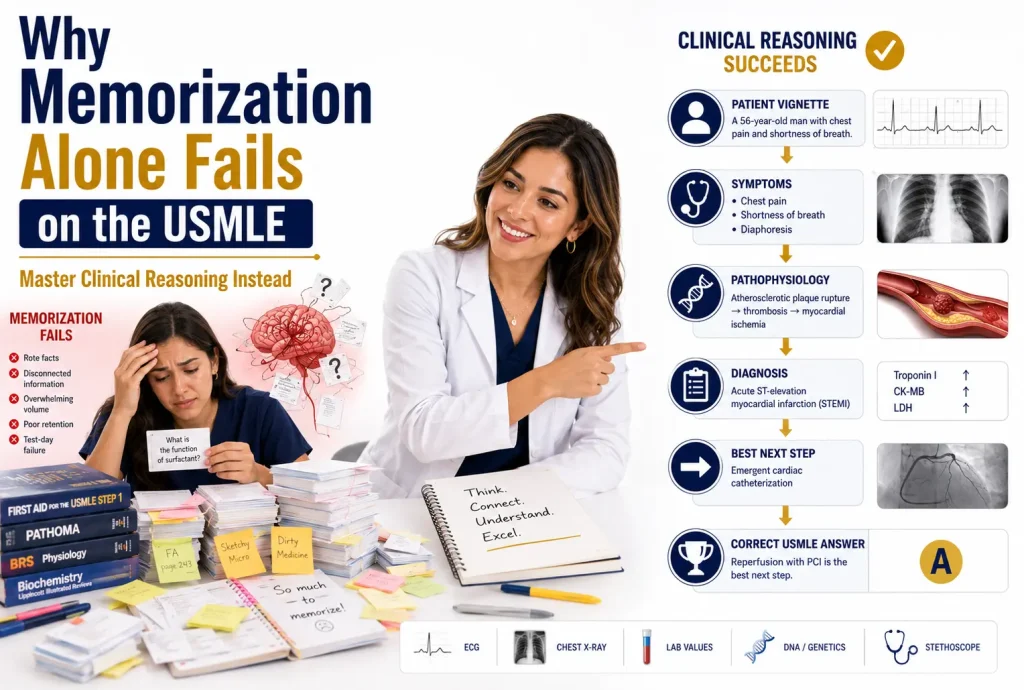

Why memorization alone fails on the USMLE is simple: the exam does not only test what you know. It tests whether you can apply what you know inside a clinical vignette.
Many students memorize thousands of facts, complete endless flashcards, and still struggle with NBME or UWorld questions. However, the problem is not always effort. Often, the problem is the study method.
The USMLE rewards students who understand mechanisms, recognize clinical patterns, avoid distractors, and connect basic science to patient care.
Free USMLE Training
Free USMLE Step 1 Bootcamp
Join our free USMLE masterclass where we teach high-yield concepts, NBME strategies, and clinical reasoning systems.
Reserve My SpotWhy Memorization Alone Fails on the USMLE
Memorization can help you recognize isolated facts. However, USMLE questions are rarely written as isolated facts.
Instead, the exam gives you a patient with symptoms, labs, imaging clues, risk factors, and answer choices that all seem possible. Therefore, you need more than recall. You need interpretation.
The Big Rule
Memorization gives you the pieces. Clinical reasoning teaches you how to put the pieces together.
Facts Without Frameworks Are Fragile
When you memorize random details, your knowledge can collapse under pressure. However, when you organize facts by mechanism and disease pattern, the information becomes easier to retrieve.
Distractors Expose Weak Reasoning
USMLE answer choices are designed to test judgment. A wrong answer may match one clue, but the correct answer matches the full case.
Why Clinical Reasoning Matters More
Clinical reasoning helps you move from facts to decisions. It allows you to ask, “What is happening to this patient?” instead of simply asking, “What do I remember?”
This shift matters because Step 1, Step 2 CK, and Step 3 all reward students who can connect mechanisms to clinical presentations.
Clinical Reasoning Advantage
Once you understand the mechanism, the vignette becomes less confusing. You stop chasing buzzwords and start recognizing patterns.
Memorization vs Clinical Reasoning
| Memorization Approach | Clinical Reasoning Approach |
|---|---|
| Focuses on isolated facts | Connects facts to mechanisms |
| Looks for buzzwords | Interprets the full clinical picture |
| Feels strong during passive review | Performs better during questions |
| Breaks down with confusing vignettes | Handles distractors more effectively |
How to Study Smarter for the USMLE
Use Questions as a Diagnostic Tool
Do not only ask why the correct answer is right. Also ask why every wrong answer is wrong. This is where major score improvement happens.
Build Mechanism-Based Understanding
For every disease, connect the cause, pathophysiology, symptoms, labs, diagnosis, and treatment. As a result, your review becomes more organized and more durable.
Practice Clinical Vignettes Early
Many students wait too long to do questions. Instead, start early so your brain learns how the USMLE presents information.
- Read the last line first.
- Identify what the question is really asking.
- Summarize the patient in one sentence.
- Choose the answer that best fits the full case.
- Review the wrong answers carefully.
Need Help Moving Beyond Memorization?
If you are overwhelmed by flashcards, UWorld explanations, NBME scores, and random resources, you are not alone. Most students do not need more material. They need a better system.
SmashUSMLE Reviews helps students build clinical reasoning, identify weak areas, and approach USMLE questions with a structured plan.
Student Success Story
⭐ 4.8 Google Rating | 120+ ReviewsSmashUSMLE Student Success Story
See how structured clinical reasoning, focused review, and a better USMLE study system can help students move beyond memorization.
Want to learn the same clinical reasoning system used by SmashUSMLE students?
Join Free BootcampFAQ: Why Memorization Alone Fails on the USMLE
Is memorization useless for the USMLE?
No. Memorization is useful, but it is not enough by itself. You still need clinical reasoning to apply facts inside patient vignettes.
Why do I know the content but still miss questions?
This usually means you have an application gap. You may recognize the fact, but you may not be connecting it to the clinical clues in the question.
Should I stop using flashcards?
No. Use flashcards for retention, but do not let them replace questions, NBME review, and mechanism-based learning.
How do I improve clinical reasoning?
Review questions by mechanism, summarize each case in one sentence, and explain why each wrong answer is wrong.
Ready to Stop Guessing on USMLE Questions?
USMLE prep becomes easier when you stop memorizing randomly and start using a clinical reasoning system.