IMG Residency Match • Application Strategy
What Residency Programs Look for Beyond USMLE Scores
Learn what residency programs evaluate beyond USMLE scores, including clinical readiness, letters of recommendation, professionalism, communication skills, specialty fit, application red flags, and interview performance.

What residency programs look for beyond USMLE scores is one of the most important things every IMG should understand before applying to residency.
USMLE scores matter. They can help you pass filters, show academic readiness, and strengthen your application. But scores alone do not guarantee interviews or a Match.
Residency programs are not only asking, “Can this applicant pass exams?” They are asking, “Can this applicant function safely, communicate clearly, learn quickly, work well with a team, and become a strong resident in our program?”
That is why clinical experience, letters of recommendation, personal statement quality, interview skills, professionalism, specialty fit, and red flag management all matter.
This guide explains what residency programs look for beyond USMLE scores and how IMGs can build a more complete, competitive application.
Free USMLE Training
Free USMLE Bootcamp
Join our free USMLE masterclass where we break down high-yield concepts, NBME strategies, and clinical reasoning systems used by thousands of medical students and IMGs.
Reserve My SpotWhy USMLE Scores Matter But Are Not Enough
USMLE scores are important because they help programs compare applicants and assess academic readiness. For IMGs, strong scores can help overcome concerns about school familiarity, grading differences, and distance from U.S. training systems.
But once a program reviews your full application, they are looking for much more than exam performance.
- Can you take care of patients safely?
- Can you communicate clearly with patients and teams?
- Can you accept feedback without becoming defensive?
- Do your letters support your application story?
- Do you understand the specialty you are applying to?
- Are there red flags that need explanation?
The Big Rule
USMLE scores may get your application reviewed, but your full application determines whether programs trust you enough to interview and rank you.
Clinical Readiness
Residency programs want applicants who can transition into supervised clinical work without needing to relearn the basics of patient care, documentation, teamwork, and responsibility.
For IMGs, clinical readiness is especially important because programs want evidence that you understand U.S. clinical expectations.
Signs of Clinical Readiness
- You can present patients clearly and logically.
- You understand basic diagnostic and management reasoning.
- You know when to ask for help.
- You can follow up on tasks reliably.
- You respond well to feedback.
- You show maturity under pressure.
Clinical Readiness Rule
Programs do not expect you to know everything. They expect you to be safe, honest, teachable, and dependable.
Letters of Recommendation
Strong letters of recommendation can make a major difference because they give programs outside validation of your clinical performance.
A strong letter does not simply say you are hardworking. It gives specific examples of your patient care, communication, professionalism, improvement, and readiness for residency.
What Programs Want to See in Letters
- Specific comments about your clinical performance
- Evidence that you work well with the team
- Examples of strong communication
- Comments about reliability and professionalism
- Evidence that you improved with feedback
- A clear statement that you are ready for residency
| Weak Letter | Strong Letter | Why It Matters |
|---|---|---|
| Generic praise | Specific examples | Programs trust details more than vague compliments. |
| Writer barely knows you | Writer supervised you closely | Close observation makes the letter more credible. |
| No clinical detail | Comments on patient care and teamwork | Residency is clinical work, not just academics. |
| Polite but bland | Confident recommendation | Programs notice enthusiasm and specificity. |
U.S. Clinical Experience
U.S. clinical experience helps programs understand whether you can adapt to the workflow, communication style, documentation expectations, and team culture of U.S. medicine.
For IMGs, USCE can also help create stronger letters and a more believable application story.
How to Make USCE Count
- Be punctual and prepared every day.
- Read about the patients you see.
- Practice clear oral presentations.
- Ask for feedback and apply it quickly.
- Be respectful to everyone on the team.
- Earn letters from physicians who directly observed your work.
USCE Rule
Do not treat U.S. clinical experience like a checkbox. Treat it like an audition for residency.
Professionalism and Work Ethic
Residency is demanding. Programs want residents who show up prepared, take responsibility, communicate honestly, and do not create avoidable problems for the team.
Professionalism is often evaluated through letters, MSPE comments, clinical evaluations, interview behavior, email communication, and how you explain challenges in your application.
Professional Behaviors Programs Value
- Reliability
- Humility
- Accountability
- Respect for staff and patients
- Ability to receive feedback
- Good judgment
- Consistency under stress
Communication Skills
Communication is one of the most important skills in residency. Programs want applicants who can explain information clearly, listen carefully, and work well with patients, families, nurses, attendings, and other residents.
Strong communication can help an IMG stand out even when other applicants have similar scores.
Where Communication Shows Up
- Your personal statement
- Your ERAS experiences
- Your emails to coordinators
- Your interview answers
- Your letters of recommendation
- Your clinical evaluations
Communication Rule
Programs are not only listening to what you say. They are judging how clearly, maturely, and professionally you say it.
Specialty Fit
Residency programs want to know that your specialty choice makes sense. They are looking for evidence that your experiences, goals, skills, and personality fit the specialty.
This does not mean you need a perfect application. It means your story should be believable.
Ways to Show Specialty Fit
- Relevant clinical rotations
- Specialty-specific letters
- Research or projects related to the specialty
- Volunteer work connected to patient populations you care about
- A personal statement that explains your specialty choice clearly
- Interview answers that show mature understanding of the field
Personal Statement and Application Story
Your personal statement should not simply repeat your CV. It should help programs understand who you are, why this specialty fits you, and what kind of resident you are likely to become.
For IMGs, the personal statement is also a chance to connect your journey, clinical growth, and readiness for U.S. training.
A Strong Personal Statement Should Show
- Why you chose the specialty
- What experiences shaped your decision
- How you have grown clinically and personally
- Why you are ready for residency
- What you will contribute to a program
Personal Statement Rule
Do not write a generic essay about passion. Write a focused story that makes your application easier to understand.
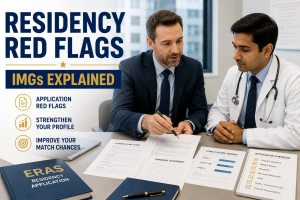
How Programs View Red Flags
Red flags do not automatically end your residency chances, but they must be handled carefully. Programs want honesty, accountability, and evidence that the problem has been corrected.
Common red flags include exam failures, long gaps after graduation, lack of recent clinical experience, weak letters, unexplained career changes, professionalism concerns, and poor interview performance.
| Red Flag | Program Concern | Best Response |
|---|---|---|
| USMLE failure | Academic readiness | Show improvement, stronger later performance, and a changed study system. |
| Graduation gap | Clinical freshness | Show recent clinical work, USCE, research, or structured preparation. |
| Weak clinical exposure | Readiness for residency | Build recent experience and secure stronger letters. |
| Generic application | Lack of specialty fit | Clarify your story, specialty interest, and program alignment. |
Red Flag Rule
Do not hide from a red flag. Explain it briefly, own it, and show what changed.
Interview Performance
The interview is where programs decide whether the person matches the application. A strong interview can help you rise. A weak interview can damage even a strong application.
Programs want applicants who are clear, honest, professional, self-aware, and easy to work with.
What Programs Evaluate During Interviews
- Communication style
- Maturity
- Self-awareness
- Specialty understanding
- Ability to explain red flags
- Interest in the program
- Team fit
Interview Rule
The goal is not to sound perfect. The goal is to sound prepared, honest, thoughtful, and ready for residency.
Student Success Story
⭐ 4.8 Google Rating | 120+ ReviewsSee How SmashUSMLE Students Improve Their Scores
Learn how structured clinical reasoning, NBME-focused review, and disciplined preparation can help IMGs break through score plateaus.
Want to learn the same clinical reasoning system used by SmashUSMLE students?
Join Free BootcampNeed Help Building a Stronger IMG Application?
If you are an IMG preparing for USMLE exams, residency applications, interviews, or Match strategy, you need more than random advice. You need a clear system.
SmashUSMLE Reviews helps IMGs strengthen USMLE preparation, clinical reasoning, NBME performance, application readiness, and interview confidence.
FAQ: What Residency Programs Look for Beyond USMLE Scores
Do residency programs care about more than USMLE scores?
Yes. Programs also evaluate clinical experience, letters of recommendation, professionalism, communication skills, specialty fit, personal statement quality, red flags, and interview performance.
Can an IMG match with average USMLE scores?
Yes, but the rest of the application must be strong. Clinical experience, strong letters, a clear specialty story, and strong interview performance become even more important.
What matters most after USMLE scores?
Strong letters of recommendation, recent clinical experience, professionalism, communication skills, specialty fit, and interview performance are all major factors.
How can IMGs show clinical readiness?
IMGs can show clinical readiness through U.S. clinical experience, strong evaluations, detailed letters, clear patient presentations, and interview answers that demonstrate sound clinical reasoning.
How should IMGs handle red flags?
IMGs should address red flags honestly and briefly, take responsibility when appropriate, and show what changed through improved performance, recent experience, or stronger preparation.
Can interview performance change Match chances?
Yes. Interview performance can strongly affect how programs rank applicants because it shows communication, maturity, judgment, fit, and readiness for residency.
Ready to Build a Stronger Residency Application?
Your USMLE scores matter, but your full application tells programs who you are. Build your clinical reasoning, strengthen your story, prepare your interviews, and approach the Match with a clear plan.