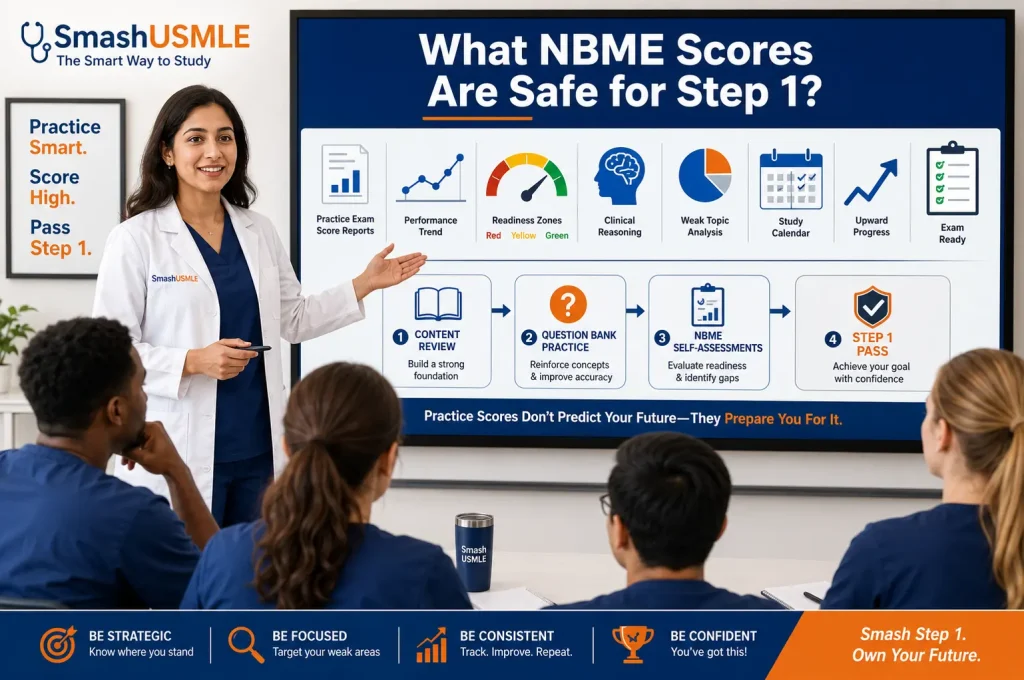

Safe NBME scores for Step 1 are not about one lucky passing score. They are about consistent performance, a clear upward trend, strong weak-area control, and confidence under timed conditions.
Because Step 1 is pass/fail, many students think they only need to barely pass an NBME before test day. That is risky. A small margin can disappear quickly because of stress, fatigue, timing issues, or a weaker test-day topic mix.
The goal is not perfection. The goal is a safe buffer.
Free USMLE Training
Free USMLE Step 1 Bootcamp
Learn how to interpret NBME scores, fix weak areas, and build a safer Step 1 readiness plan.
Reserve My SpotWhat NBME Score Is Safe for Step 1?
A safer Step 1 position usually means you are consistently above the passing range on more than one recent NBME, not barely passing once.
Many students aim for a comfortable buffer before sitting for Step 1. Your exact safety margin should depend on your school policy, advisor recommendations, score trend, Free 120 performance, and how stable your weak areas are.
The Big Rule
Do not make your Step 1 decision from one NBME score alone. Use your trend, weak areas, and exam-day readiness.
NBME Score Zones Before Step 1
Use the zones below as a practical readiness framework, not as a guarantee.
| NBME Pattern | Readiness Meaning | Best Next Step |
|---|---|---|
| Clearly below passing range | High risk | Delay if possible and rebuild weak areas aggressively. |
| Barely passing once | Still risky | Do not rely on one score. Confirm with another NBME and Free 120. |
| Consistently passing with a small margin | Possible but not ideal | Strengthen weak systems and improve test-day buffer. |
| Consistently passing with a comfortable buffer | Safer position | Continue final review, Free 120, and exam-day strategy. |
| Strong upward trend across multiple NBMEs | Good sign | Confirm stability and avoid changing too much late. |
Safety Rule
Barely passing is not the same as being safely ready.
Why Score Trend Matters More Than One Score
One score can be misleading. A trend tells you whether your preparation is working.
- Are your scores improving?
- Are your weak systems shrinking?
- Are you finishing timed blocks comfortably?
- Are you missing fewer questions from distractor traps?
- Are you consistently above your safety margin?
If your score jumps once but your weak areas remain severe, be careful. If your scores are steadily rising and your weak systems are improving, that is more reassuring.
How Free 120 Fits Into Readiness
Free 120 should be used as a final exam-style practice tool, not as your only readiness marker.
Use Free 120 to evaluate:
- Exam-style timing
- Question interpretation
- Stamina
- Confidence close to test day
- Whether your NBME trend feels stable
Free 120 Rule
Free 120 should support your NBME trend, not replace it.
When You Should Delay Step 1
Delaying Step 1 can be the smartest decision if your data shows you are not ready.
Consider delaying if:
- Your NBME scores are below passing range
- You barely passed only one NBME
- Your scores are inconsistent
- You keep missing the same weak systems
- You are running out of time on blocks
- You have not reviewed Free 120 or recent NBME mistakes
- You are hoping test day will magically go better
Delay Rule
Delay if the data says you are gambling. Use the delay to fix the reason you are not safe yet.
How to Improve Your NBME Safety Margin Before Test Day
If your scores are close but not safe, do not restart everything. Use a focused correction plan.
| Problem | What It Means | Best Fix |
|---|---|---|
| Weak systems | Repeated low performance in the same topics | Targeted review plus focused QBank blocks |
| Application errors | You know facts but miss vignettes | Practice one-sentence case summaries |
| Distractor traps | You choose familiar wrong answers | Review why every wrong answer is wrong |
| Timing issues | You rush late questions | Timed mixed blocks with pacing checkpoints |
| Score inconsistency | Performance changes too much between exams | Stabilize weak areas before testing |
Student Success Story
⭐ 4.8 Google Rating | 120+ ReviewsSee How SmashUSMLE Students Improve Their Scores
Learn how structured clinical reasoning, NBME-focused review, and disciplined preparation can help students build a safer Step 1 readiness margin.
Want to learn the same clinical reasoning system used by SmashUSMLE students?
Join Free BootcampNeed Help Knowing If Your NBME Scores Are Safe?
If your NBME scores are close, inconsistent, or confusing, do not guess. You need a clear readiness review and a focused weak-area plan.
SmashUSMLE Reviews helps students use NBME data, QBank practice, clinical reasoning, and one-on-one tutoring to build a safer path to Step 1.
FAQ: What NBME Scores Are Safe for Step 1?
What NBME score is safe for Step 1?
A safer position is usually consistent performance above the passing range on more than one recent NBME, supported by Free 120 and improved weak areas.
Is one passing NBME enough for Step 1?
Usually no. One passing score is reassuring, but repeated safe performance is stronger.
Should I delay Step 1 if I barely passed an NBME?
If you barely passed only once, consider getting more data before testing. Confirm readiness with another assessment and focused review.
Does Free 120 replace NBME exams?
No. Free 120 is useful close to test day, but it should support your NBME trend rather than replace it.
Ready to Build a Safer Step 1 Plan?
Step 1 readiness should be based on evidence, not hope. SmashUSMLE can help you interpret your NBME scores, repair weak areas, and prepare with more confidence.