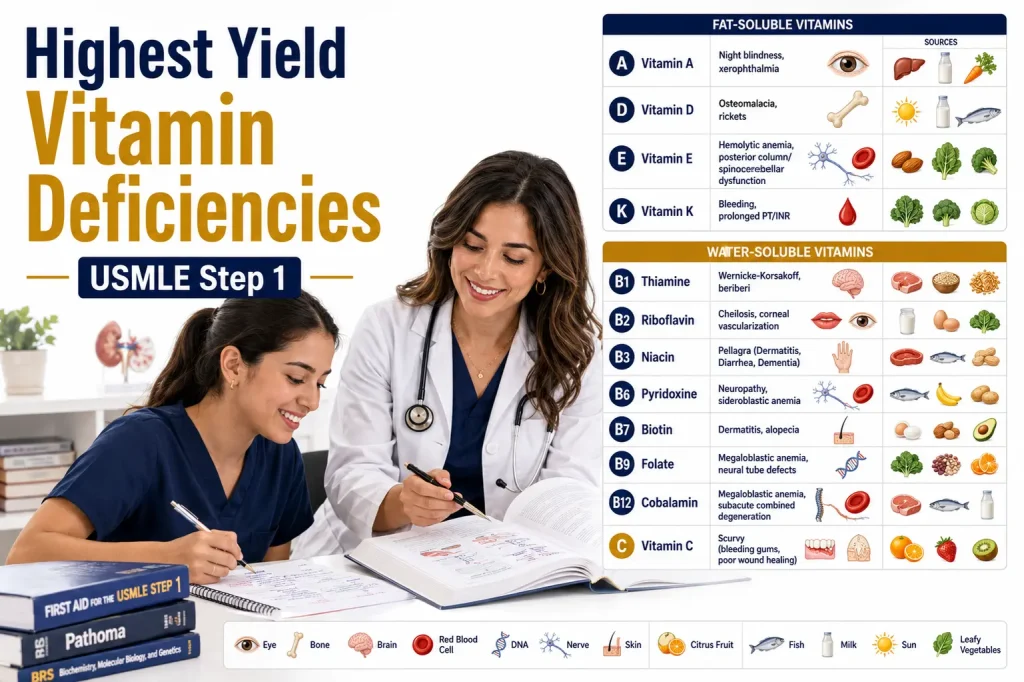

Vitamin Deficiencies for USMLE Step 1 are among the highest-yield nutrition topics tested on the exam. Learning the classic clinical presentations, risk factors, and laboratory findings makes it much easier to recognize these questions quickly and earn easy Step 1 points.
Step 1 does not usually ask vitamin questions in isolation. Instead, it gives you a patient with a risk factor, a symptom pattern, and one clue that points directly to the deficient vitamin.
Therefore, your goal is not to memorize a random list. Your goal is to recognize the pattern quickly inside a clinical vignette.
Free USMLE Training
Free USMLE Step 1 Bootcamp
Join our free USMLE masterclass where we break down high-yield concepts, NBME strategies, and clinical reasoning systems used by thousands of medical students and IMGs.
Reserve My SpotFat-Soluble Vitamin Deficiencies: A, D, E, and K
Fat-soluble vitamins are absorbed with dietary fat. As a result, patients with pancreatic insufficiency, cystic fibrosis, cholestasis, Crohn disease, or other malabsorption syndromes can develop multiple deficiencies.
The Big Rule
When a vignette mentions fat malabsorption, immediately think of vitamins A, D, E, and K.
Vitamin A Deficiency
Vitamin A deficiency causes night blindness, xerophthalmia, dry skin, and impaired immune function. The classic Step 1 clue is difficulty seeing at night.
Vitamin D Deficiency
Vitamin D deficiency causes rickets in children and osteomalacia in adults. Look for bone pain, muscle weakness, low calcium, low phosphate, and increased alkaline phosphatase.
Vitamin E Deficiency
Vitamin E deficiency causes hemolytic anemia and neurologic dysfunction involving the posterior columns and spinocerebellar tracts. Think ataxia, loss of vibration sense, and fat malabsorption.
Vitamin K Deficiency
Vitamin K deficiency causes bleeding due to impaired activation of clotting factors II, VII, IX, and X. The classic lab clue is prolonged PT/INR.
Water-Soluble B Vitamin Deficiencies
Water-soluble vitamins are not stored as much as fat-soluble vitamins. Because of that, deficiency can develop faster in alcoholism, poor diet, pregnancy, chronic illness, and medication-related depletion.
Vitamin B1: Thiamine
Thiamine deficiency causes Wernicke-Korsakoff syndrome, beriberi, and high-output cardiac failure. The biggest Step 1 clue is alcohol use disorder with confusion, ophthalmoplegia, and ataxia.
Vitamin B2: Riboflavin
Riboflavin deficiency causes cheilosis, corneal vascularization, and glossitis. It is less commonly tested, but still a classic board association.
Vitamin B3: Niacin
Niacin deficiency causes pellagra. Remember the three D’s: dermatitis, diarrhea, and dementia.
Vitamin B6: Pyridoxine
Pyridoxine deficiency causes peripheral neuropathy, seizures, sideroblastic anemia, and irritability. A major trigger is isoniazid therapy.
Vitamin B7: Biotin
Biotin deficiency causes dermatitis, alopecia, and enteritis. A classic clue is eating raw egg whites because avidin binds biotin.
Vitamin B9: Folate
Folate deficiency causes megaloblastic anemia without neurologic symptoms. It is also associated with neural tube defects during pregnancy.
Vitamin B12: Cobalamin
Vitamin B12 deficiency causes megaloblastic anemia plus neurologic symptoms. Think paresthesias, impaired vibration sense, and subacute combined degeneration.
Vitamin C Deficiency
Vitamin C is needed for collagen synthesis. Deficiency causes scurvy, which presents with bleeding gums, petechiae, poor wound healing, corkscrew hairs, and perifollicular hemorrhage.
USMLE Mechanism
Vitamin C deficiency impairs hydroxylation of proline and lysine during collagen formation.
High-Yield Vitamin Deficiency Table
| Vitamin | Deficiency Syndrome | Classic USMLE Clue |
|---|---|---|
| Vitamin A | Night blindness, xerophthalmia | Difficulty seeing at night |
| Vitamin D | Rickets, osteomalacia | Bone pain, low calcium, high alkaline phosphatase |
| Vitamin E | Hemolytic anemia, neurologic dysfunction | Ataxia and posterior column findings |
| Vitamin K | Bleeding, prolonged PT/INR | Newborn, antibiotics, fat malabsorption |
| B1 | Wernicke-Korsakoff, beriberi | Alcohol use disorder |
| B3 | Pellagra | Dermatitis, diarrhea, dementia |
| B6 | Neuropathy, sideroblastic anemia | Isoniazid use |
| B9 | Megaloblastic anemia | No neurologic symptoms |
| B12 | Megaloblastic anemia, subacute combined degeneration | Neurologic symptoms plus anemia |
| Vitamin C | Scurvy | Bleeding gums, poor wound healing, corkscrew hairs |
How to Answer Vitamin Deficiency Questions Faster
First, identify the risk factor. Next, connect it to the vitamin type. Then, match the clinical finding to the classic deficiency syndrome.
For example, alcoholism points strongly toward thiamine deficiency. Meanwhile, isoniazid therapy points toward vitamin B6 deficiency. Fat malabsorption should make you think of vitamins A, D, E, and K.
Test-Day Pattern
Ask yourself three questions: What is the patient missing? What system is affected? What single clue makes the diagnosis obvious?
High-Yield Nutrition Resource
High Yield USMLE Nutrition Recall
If nutrition questions keep slowing you down, use the High Yield USMLE Nutrition Recall book to review vitamins, deficiencies, minerals, metabolism, and clinical nutrition patterns.
- Review high-yield vitamin deficiencies
- Master nutrition patterns for Step 1
- Connect deficiency clues to clinical vignettes
- Use alongside NBME and QBank practice
Student Success Story
⭐ 4.8 Google Rating | 120+ ReviewsStudent Success Testimonial
See how structured USMLE preparation, clinical reasoning, and focused review can help students move forward with confidence.
Want to learn the same clinical reasoning system used by SmashUSMLE students?
Join Free BootcampNeed Help Mastering USMLE Nutrition?
Nutrition questions are easy points when you study them the right way. SmashUSMLE Reviews helps you simplify high-yield Step 1 topics with clinical patterns, exam logic, and focused review.
FAQ: Highest Yield Vitamin Deficiencies for USMLE Step 1
What are the most tested vitamin deficiencies on Step 1?
The most tested deficiencies include vitamins A, D, E, K, B1, B3, B6, B9, B12, and C.
Which vitamin deficiency is associated with alcoholism?
Thiamine deficiency is strongly associated with alcohol use disorder and can cause Wernicke-Korsakoff syndrome.
Which vitamin deficiency is caused by isoniazid?
Isoniazid can cause vitamin B6 deficiency, leading to neuropathy and sideroblastic anemia.
How do I tell folate deficiency from B12 deficiency?
Both can cause megaloblastic anemia, but B12 deficiency causes neurologic symptoms while folate deficiency does not.
Ready to Improve Your USMLE Scores?
Step 1 preparation becomes easier when you stop studying randomly and start using a system. Join thousands of medical students and IMGs using SmashUSMLE’s clinical reasoning system.