USMLE Nutrition • 2026 Exam Update
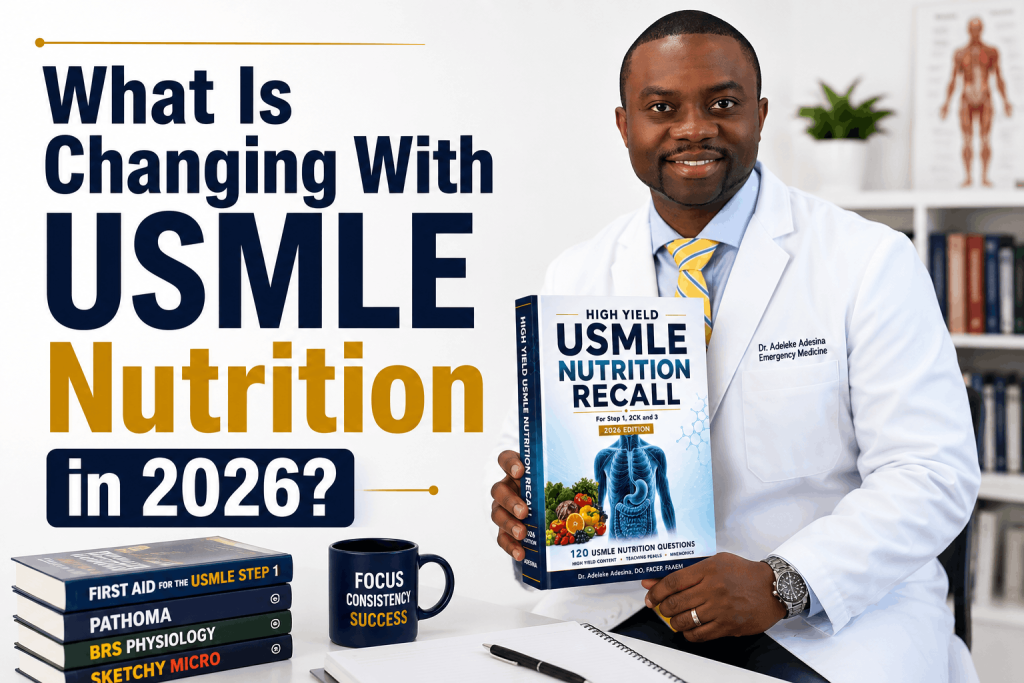
What Is Changing With USMLE Nutrition in 2026?
Learn what the 2026 USMLE nutrition update means for Step 1, Step 2 CK, and Step 3, what topics are highest yield, and how to prepare without panic.

What is changing with USMLE nutrition in 2026? Beginning in June 2026, nutrition science content is being enhanced across Step 1, Step 2 CK, and Step 3, making nutrition harder to ignore during USMLE preparation.
Nutrition has always been tested, but many students treated it like a small memorization topic: vitamin A, B1, B3, B12, vitamin C, vitamin D, and a few deficiency charts.
The problem is that nutrition does not live in one subject. It overlaps with biochemistry, GI, endocrine, hematology, pediatrics, pregnancy, chronic disease prevention, obesity, patient counseling, and hospital medicine.
This guide breaks down what is changing, what is not changing, what students should study, and how to use the High Yield USMLE Nutrition Recall Book and Masterclass Nutrition Course to prepare more efficiently.
Free USMLE Training
Free USMLE Step 1 Bootcamp
Join our free USMLE masterclass where we break down high-yield concepts, NBME strategy, clinical reasoning, and how to study smarter for Step 1, Step 2 CK, and Step 3.
Reserve My SpotWhat Is Changing With USMLE Nutrition in 2026?
The biggest change is not that nutrition suddenly becomes a brand-new subject. Nutrition was already on the USMLE.
The change is that nutrition science content is being enhanced across all three Step exams beginning in June 2026. USMLE also announced that nutrition content-area performance feedback will be added to score reports for examinees and medical schools.
The score report feedback schedule is:
| Exam | Nutrition Feedback Added | What Students Should Know |
|---|---|---|
| Step 3 | No later than June 24, 2026 | Expect nutrition to appear in patient management, chronic disease, inpatient care, and safety questions. |
| Step 2 CK | No later than July 1, 2026 | Expect clinical nutrition, counseling, obesity, pregnancy, pediatrics, and hospitalized patient nutrition. |
| Step 1 | No later than July 8, 2026 | Passing Step 1 examinees still will not see content-area feedback, consistent with current Step 1 reporting. |
The Big Takeaway
Nutrition is becoming more visible across the USMLE, but it remains integrated into organ systems and clinical reasoning. Do not study it as a random vitamin chart only.
What Is Not Changing?
The USMLE is not telling students to abandon pathology, physiology, pharmacology, microbiology, biochemistry, or clinical medicine.
Nutrition is being emphasized more clearly, but it is still tested through patient care, disease mechanisms, clinical decision-making, prevention, and organ-system reasoning.
That means the correct response is not panic. The correct response is strategy.
- Keep using your core USMLE resources.
- Continue reviewing official USMLE content outlines and practice materials.
- Connect nutrition to clinical vignettes instead of memorizing isolated facts.
- Practice nutrition questions weekly instead of saving nutrition for the end.
Study Rule
Do not study nutrition separately from medicine. Study nutrition as part of disease, prevention, metabolism, patient safety, and clinical management.
Why Nutrition Is Becoming More Important
Nutrition matters because it affects real patient outcomes. It influences chronic disease prevention, obesity, diabetes, cardiovascular risk, pregnancy outcomes, pediatric growth, frailty, wound healing, immune function, and inpatient complications.
Future USMLE nutrition questions may not simply ask, “Which vitamin deficiency causes scurvy?”
They may describe a patient with alcohol use disorder, confusion, nystagmus, gait instability, and hypoglycemia, then ask what nutrient should be given before glucose.
USMLE-Style Nutrition Question
A 52-year-old man with alcohol use disorder is brought to the emergency department with confusion, horizontal nystagmus, and an unsteady gait. His serum glucose is low. The physician plans to administer IV dextrose. Which nutrient should be administered first?
- A. Vitamin B12
- B. Thiamine
- C. Folate
- D. Niacin
Correct Answer: B. Thiamine
This patient has Wernicke encephalopathy due to thiamine deficiency. Thiamine is required for carbohydrate metabolism. Giving glucose before thiamine can worsen neurologic injury.
High-Yield Pearl: In alcohol use disorder with altered mental status, give thiamine before glucose.
High-Yield Nutrition Topics for Step 1
For Step 1, nutrition is mostly tested through mechanisms. You need to understand how nutrients affect enzymes, cofactors, metabolism, organ systems, and disease states.
- Vitamin deficiency mechanisms
- Vitamin toxicities
- Enzyme cofactors
- Metabolic pathways
- Malabsorption
- Starvation physiology
- Refeeding syndrome
- Protein-calorie malnutrition
- Lipid metabolism
- Obesity physiology
- Diabetes and insulin resistance
- Pregnancy nutrition
- Pediatric growth and nutrition
Step 1 loves mechanism-based nutrition questions. Do not stop at “B12 causes macrocytic anemia.” Know why B12 deficiency causes neurologic findings, what methylmalonic acid means, and which patients are at risk.
High-Yield Nutrition Topics for Step 2 CK
For Step 2 CK, nutrition becomes more clinical. You may need to identify the deficiency, choose the next best step, counsel the patient, manage complications, or recognize nutrition-related risk after surgery or chronic disease.
- Obesity counseling and management
- Diabetes lifestyle counseling
- Cardiovascular risk reduction
- Bariatric surgery deficiencies
- Malnutrition in older adults
- Pregnancy nutrition
- Pediatric failure to thrive
- Enteral versus parenteral nutrition
- Nutrition in chronic kidney disease
- Nutrition in cirrhosis
- Nutrition in inflammatory bowel disease
USMLE-Style Nutrition Question
A 38-year-old woman undergoes Roux-en-Y gastric bypass surgery. One year later, she presents with fatigue, numbness in her feet, and difficulty walking. Physical exam shows decreased vibration sense and proprioception. Laboratory studies show macrocytic anemia. Which deficiency is most likely?
- A. Vitamin B12
- B. Vitamin C
- C. Vitamin K
- D. Vitamin A
Correct Answer: A. Vitamin B12
Bariatric surgery can predispose to vitamin B12 deficiency. Macrocytic anemia plus neurologic symptoms should make you think of B12 deficiency.
Download the Musculoskeletal & Dermatology Worksheet
Use this worksheet to strengthen clinical pattern recognition, organize high-yield concepts, and practice connecting symptoms to diagnoses.
Even though this article focuses on nutrition, the same skill applies across systems: organize facts into clinical patterns so you can answer vignette-style questions faster.
High-Yield Nutrition Topics for Step 3
Step 3 focuses more on management, prevention, patient safety, and inpatient decision-making.
- Nutrition counseling in chronic disease
- Obesity-related complications
- Diabetes prevention and management
- Hypertension and cardiovascular risk counseling
- Nutritional support in hospitalized patients
- Refeeding syndrome prevention
- TPN complications
- Feeding decisions in frail or critically ill patients
- Preventive care and lifestyle medicine
- Patient communication around diet and adherence
Step 3 is less likely to ask a pure biochemistry question and more likely to ask whether you can safely manage a patient.
Vitamin Deficiencies You Must Know for the 2026 USMLE
Vitamin questions are still high yield, but students should learn them as clinical patterns rather than isolated flashcards.
| Vitamin | Deficiency | Classic Clue |
|---|---|---|
| Vitamin A | Night blindness | Poor dark adaptation |
| Vitamin B1 | Wernicke, beriberi | Confusion, ataxia, ophthalmoplegia |
| Vitamin B3 | Pellagra | Dermatitis, diarrhea, dementia |
| Vitamin B6 | Neuropathy, seizures | Isoniazid association |
| Vitamin B9 | Macrocytic anemia | No neurologic deficits |
| Vitamin B12 | Macrocytic anemia | Neurologic deficits, elevated MMA |
| Vitamin C | Scurvy | Bleeding gums, poor wound healing |
| Vitamin D | Rickets, osteomalacia | Bone pain, low mineralization |
| Vitamin E | Neurologic dysfunction | Ataxia, hemolytic anemia |
| Vitamin K | Bleeding | Increased PT/INR |
Malnutrition, Obesity, and Chronic Disease Prevention
The 2026 nutrition emphasis is not only about vitamin deficiencies. Students also need to understand malnutrition, obesity, prevention, and chronic disease counseling.
Marasmus
Marasmus is severe calorie deficiency. Look for severe wasting, loss of subcutaneous fat, growth failure, and no major edema.
Kwashiorkor
Kwashiorkor is severe protein deficiency. Look for edema, fatty liver, skin and hair changes, and a distended abdomen.
High-Yield Difference
Edema suggests low oncotic pressure from protein deficiency. That is why kwashiorkor causes edema and marasmus usually does not.
Enteral and Parenteral Nutrition
Students often ignore enteral and parenteral nutrition, but these topics matter for hospitalized patients, Step 2 CK, and Step 3.
Enteral Nutrition
Enteral feeding uses the GI tract. Think oral feeding, nasogastric tube, gastrostomy tube, or jejunostomy tube. Use enteral nutrition when the gut works.
Parenteral Nutrition
Parenteral nutrition bypasses the GI tract. Think TPN, central venous nutrition, critical illness, severe bowel dysfunction, or inability to use the gut.
- Catheter infection
- Hyperglycemia
- Cholestasis
- Electrolyte abnormalities
- Refeeding syndrome
USMLE-Style Nutrition Question
A 63-year-old man with severe alcohol use disorder and prolonged poor oral intake is admitted for malnutrition. He is started on nutritional support. Two days later, he develops weakness and palpitations. Laboratory studies show low phosphate, low potassium, and low magnesium. Which condition is most likely?
- A. Dumping syndrome
- B. Refeeding syndrome
- C. Vitamin K deficiency
- D. Hyperosmolar hyperglycemic state
Correct Answer: B. Refeeding syndrome
Refeeding syndrome occurs when nutrition is restarted after prolonged starvation. Insulin secretion shifts phosphate, potassium, and magnesium into cells.
High Yield USMLE Nutrition Recall Book and Masterclass Nutrition Course
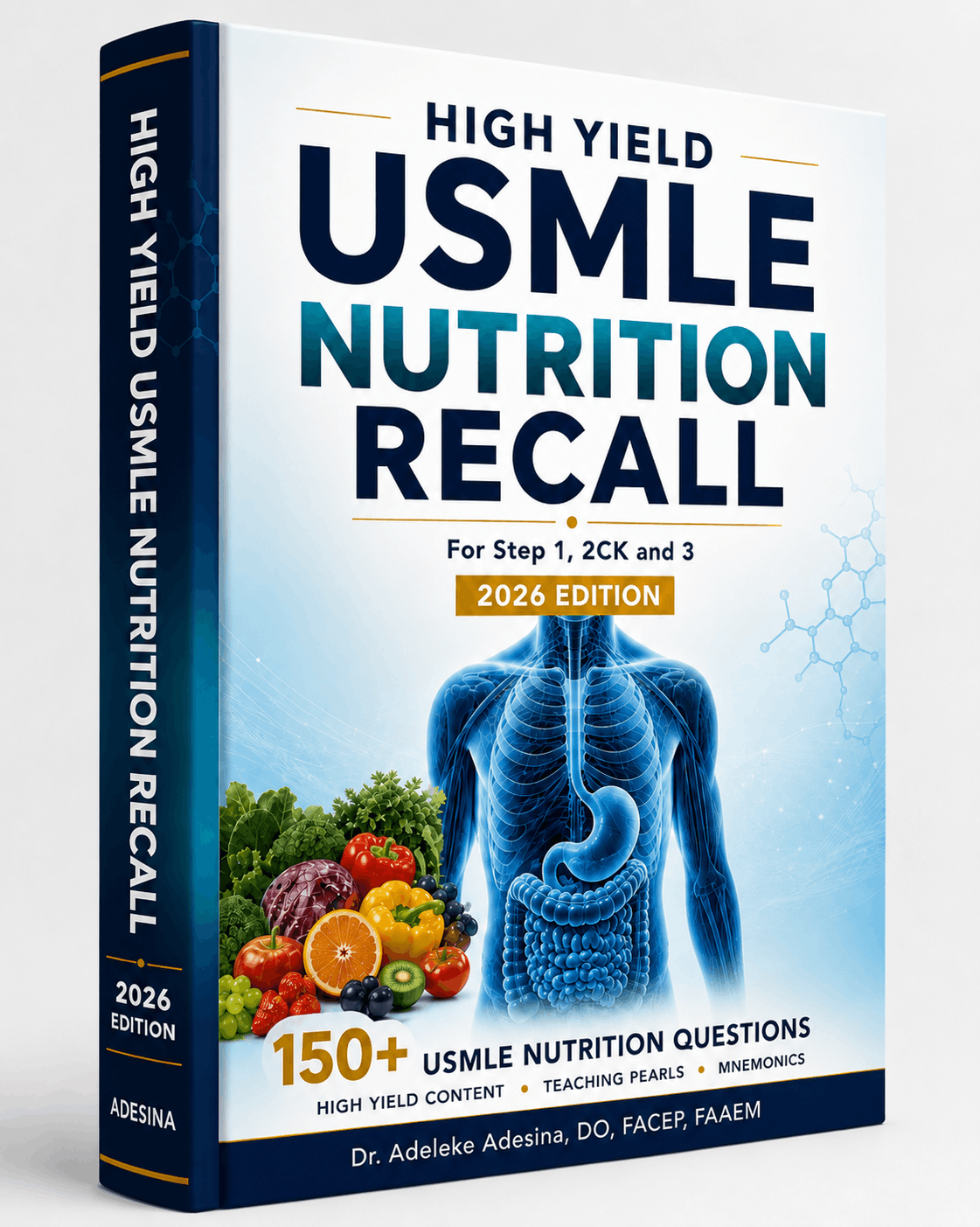
If nutrition feels scattered, that is because it is connected to almost every part of medicine. The High Yield USMLE Nutrition Recall Book helps students organize nutrition into exam-ready clinical patterns instead of random memorization lists.
This is especially useful for students preparing for the 2026 USMLE nutrition emphasis because the exam is not just testing whether you know a vitamin name. It is testing whether you can recognize the pattern inside a clinical vignette.
What Is Inside the High Yield USMLE Nutrition Recall Book?
- Vitamin deficiencies: high-yield symptoms, clinical clues, and common USMLE presentations.
- Mineral deficiencies: zinc, iron, iodine, copper, calcium, phosphate, and other exam-relevant patterns.
- Fat-soluble vitamins: vitamin A, D, E, and K deficiency and toxicity patterns.
- Water-soluble vitamins: B vitamins, folate, B12, vitamin C, and classic vignette clues.
- Malnutrition patterns: marasmus, kwashiorkor, cachexia, starvation, and protein-calorie malnutrition.
- Malabsorption connections: celiac disease, pancreatic insufficiency, bariatric surgery, chronic diarrhea, liver disease, and IBD.
- Metabolism links: cofactors, enzyme pathways, energy metabolism, and deficiency mechanisms.
- Clinical recall tables: fast review tables for repeated weak areas.
- USMLE-style associations: quick links between patient clues and the likely answer choice.
Why This Helps
If you keep missing questions about anemia, neuropathy, dermatitis, diarrhea, poor wound healing, growth failure, malabsorption, or refeeding syndrome, the underlying weakness may be nutrition. Group those misses together and rebuild the pattern.
How the Masterclass Nutrition Course Helps
The Masterclass Nutrition Course gives students a guided way to understand nutrition for USMLE-style questions. The book helps with recall and organization. The course helps with explanation, application, and clinical reasoning.
This is ideal for students who feel like they have memorized vitamin charts but still miss UWorld or NBME questions because they cannot recognize the clue inside a long vignette.
- Learn how nutrition appears in Step 1, Step 2 CK, and Step 3 questions.
- Connect symptoms to deficiencies, mechanisms, risk factors, and answer choices.
- Review high-yield nutrition in a structured sequence.
- Use the course alongside the book for stronger retention.
- Apply nutrition concepts to UWorld, NBME, CBSE, COMLEX, and USMLE-style questions.
High-Yield Nutrition Resource
High Yield USMLE Nutrition Recall Book
Strengthen your nutrition recall for USMLE-style questions with a focused resource built around vitamin deficiencies, malabsorption patterns, metabolic clues, and clinical associations.
- Review high-yield vitamin and mineral deficiencies
- Connect nutrition clues to clinical vignettes
- Use it with UWorld incorrects and NBME weak-area review
- Pair it with the Masterclass Nutrition Course for deeper understanding
How to Study Nutrition for the 2026 USMLE
1. Connect Each Nutrient to a Clinical Syndrome
For every vitamin or mineral, know the deficiency symptoms, toxicity symptoms, risk factors, mechanism, classic vignette clues, and management.
2. Study Nutrition by Organ System
Nutrition appears across GI, neuro, heme, endocrine, pediatrics, OB, renal, cardiovascular medicine, and inpatient care.
3. Learn the Patient Safety Version of Nutrition
Know dangerous situations: glucose before thiamine, rapid feeding after starvation, TPN catheter infection, bariatric surgery deficiencies, vitamin K deficiency with bleeding, and infant vitamin D deficiency.
4. Practice With Clinical Vignettes
Nutrition questions are usually stories. Identify the risk factor, deficiency pattern, mechanism, complication, and next best step.
5. Review Nutrition Weekly
Do not study nutrition once and forget it. Build a weekly review rhythm with vitamin deficiencies, malnutrition, obesity, metabolic syndrome, malabsorption, and TPN questions.
Student Success Story
⭐ 4.8 Google Rating | 120+ ReviewsSee How Elizabeth Passed Step 1
Elizabeth’s story shows how structured study, clinical reasoning, and a focused USMLE plan can help students move forward with confidence.
Want to learn the same clinical reasoning system used by SmashUSMLE students?
Join Free BootcampNeed Help Connecting Nutrition to USMLE Clinical Reasoning?
If you are struggling to connect nutrition, biochemistry, physiology, prevention, and clinical medicine, you are not alone.
SmashUSMLE Reviews helps students use structured clinical reasoning, high-yield review, NBME strategy, and one-on-one tutoring to prepare for Step 1, Step 2 CK, and Step 3.
FAQ: USMLE Nutrition Changes in 2026
Are nutrition topics increasing on the USMLE in 2026?
USMLE announced that nutrition science content will be enhanced across Step 1, Step 2 CK, and Step 3 beginning in June 2026. Nutrition content-area performance feedback is also being added to score reports.
Does this mean Step 1 will become mostly nutrition?
No. Nutrition is becoming more emphasized, but it remains integrated with other subjects and organ systems.
What nutrition topics are highest yield for Step 1?
High-yield Step 1 nutrition topics include vitamin deficiencies, vitamin toxicities, mineral deficiencies, protein-calorie malnutrition, obesity, metabolism, malabsorption, and enteral/parenteral nutrition.
What nutrition topics are highest yield for Step 2 CK?
For Step 2 CK, focus on obesity counseling, diabetes prevention, bariatric surgery deficiencies, pregnancy nutrition, pediatric growth, malnutrition, refeeding syndrome, and hospitalized patient nutrition.
Will Step 1 score reports show nutrition performance feedback?
Nutrition content-area feedback is scheduled for Step 1 score reports no later than July 8, 2026, but individuals who pass Step 1 will not see content-area feedback, consistent with current Step 1 reporting.
How should I study nutrition for the 2026 USMLE?
Study nutrition through clinical patterns, not isolated facts. Connect each nutrient to risk factors, mechanisms, symptoms, labs, complications, and management.
Ready to Improve Your USMLE Scores?
Nutrition is becoming more visible on the USMLE, but you do not need to panic. You need a system. Join thousands of students using SmashUSMLE’s clinical reasoning approach to prepare for Step 1, Step 2 CK, and Step 3.