USMLE Step 1 • UWorld Review Strategy
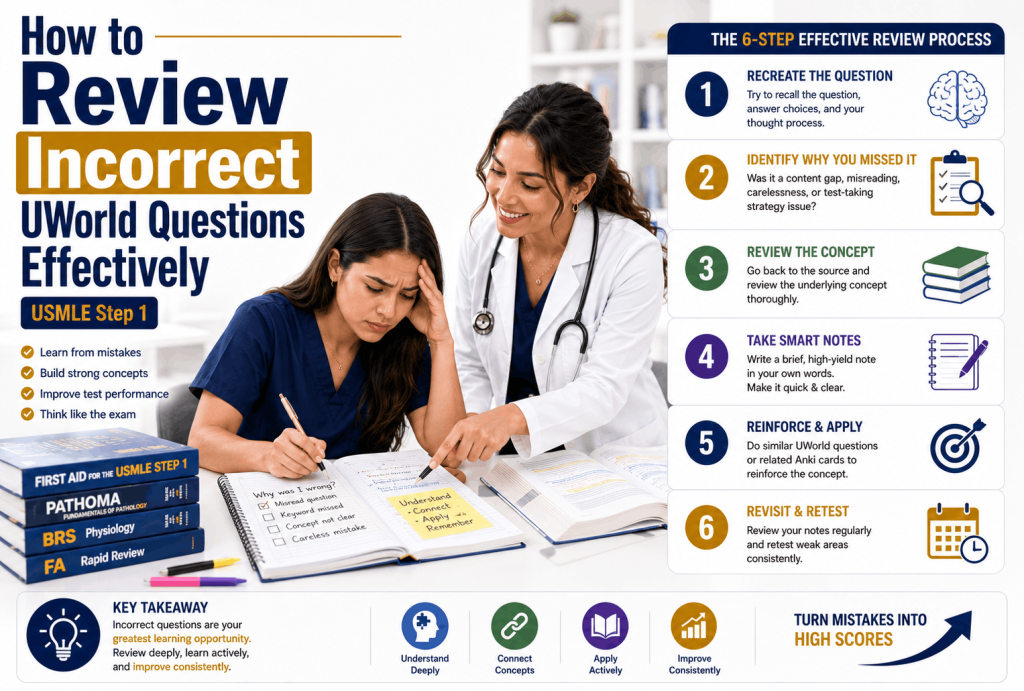
How to Review Incorrect UWorld Questions Effectively
Learn how to turn missed UWorld questions into better clinical reasoning, stronger NBME performance, and a smarter USMLE study system.

How to review incorrect UWorld questions effectively is one of the most important skills for USMLE Step 1, Step 2 CK, Step 3, CBSE, and COMLEX preparation because missed questions are not failures. They are your roadmap.
Many students review UWorld the wrong way. They read the explanation, highlight a few sentences, write long notes, and move on without identifying why they actually missed the question.
The goal is not to memorize every UWorld paragraph. The goal is to understand the clinical reasoning error, recognize the tested pattern, and build a system that prevents the same mistake from happening again.
This guide will show you how to review UWorld incorrects, organize your mistakes, take focused notes, and connect missed questions back to your Step 1 study plan.
Free USMLE Training
Free USMLE Step 1 Bootcamp
Join our free USMLE masterclass where we break down high-yield concepts, NBME strategies, and clinical reasoning systems used by medical students and IMGs.
Reserve My SpotWhy Incorrect UWorld Questions Matter
Incorrect UWorld questions are some of the highest-yield study material you have because they reveal the gap between what you recognize and what you can apply under test conditions.
A missed question can show you:
- You did not know the core concept.
- You knew the fact but could not apply it.
- You missed a key clue in the vignette.
- You chose a tempting distractor.
- You changed your answer because of anxiety.
- You ran out of time or lost focus.
The Big Rule
Do not review UWorld just to learn the right answer. Review UWorld to understand why your thinking broke down.
How to Review Incorrect UWorld Questions Effectively Without Wasting Time
The best UWorld review method is simple, repeatable, and focused. Every missed question should answer four questions.
| Step | Question to Ask | Purpose |
|---|---|---|
| Identify the tested concept | What was this question really testing? | Find the core mechanism instead of memorizing the whole explanation. |
| Diagnose the mistake | Why did I miss this? | Separate knowledge gaps from reasoning errors. |
| Extract one takeaway | What should I remember next time? | Create a short review point you can actually reuse. |
| Build a repair plan | What will I do to fix this weakness? | Turn the missed question into targeted action. |
This approach prevents your UWorld review from becoming too long, too passive, or too random. You do not need to rewrite the entire explanation. You need to capture the reason you missed the question and what you will do differently next time.
The 5 Types of UWorld Mistakes
Not all incorrect questions are the same. If you treat every missed question like a content gap, you will waste time rereading material you may already understand.
1. Content Gap
You did not know the diagnosis, pathway, organism, drug, side effect, enzyme, mechanism, or association being tested.
2. Application Gap
You knew the fact but could not apply it inside a clinical vignette. This is one of the most common reasons students struggle with USMLE-style questions.
3. Missed Clue
The question stem gave you the clue, but you skipped over the key phrase, lab value, demographic detail, timing clue, or physical exam finding.
4. Distractor Trap
You picked an answer that sounded familiar but did not fully match the patient presentation.
5. Timing, Fatigue, or Anxiety Error
You knew the concept but rushed, second-guessed yourself, changed the answer unnecessarily, or lost focus late in the block.
Clinical Reasoning Tip
A UWorld explanation tells you what the right answer is. Your review system should tell you why you did not choose it.
High-Yield Step 1 Resource
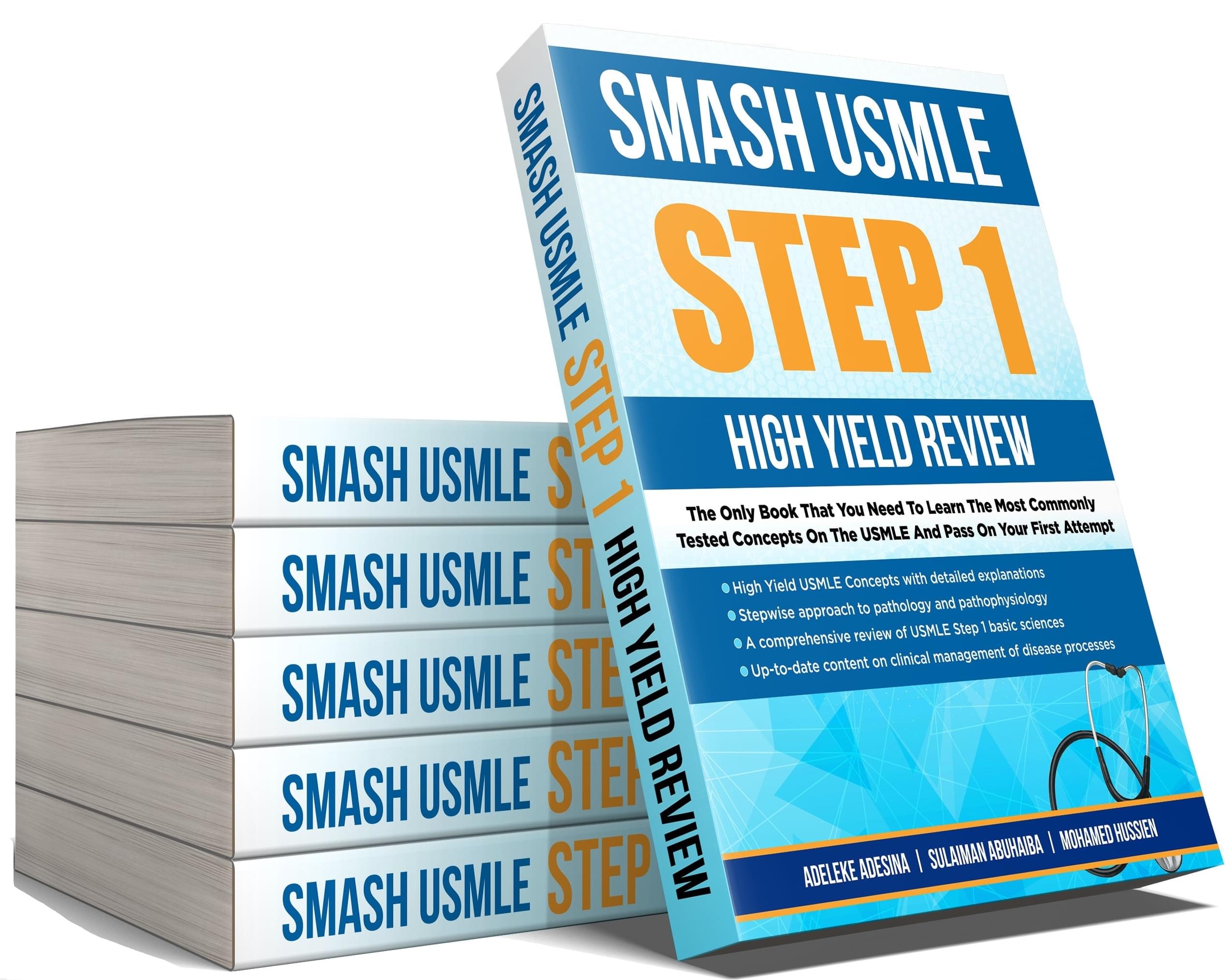
SmashUSMLE High Yield Step 1 Book
If your UWorld incorrects keep exposing weak Step 1 foundations, use the SmashUSMLE High Yield Step 1 Book to organize the concepts, mechanisms, and clinical reasoning points that matter most.
- Strengthen high-yield Step 1 foundations
- Review core systems more efficiently
- Connect missed questions to NBME-style reasoning
- Use alongside UWorld, NBME review, and SmashUSMLE coaching
The SmashUSMLE UWorld Review Template
Use this template for every incorrect UWorld question. It keeps your review active and prevents you from wasting time copying explanations.
Missed Question Review Template
- System: Which organ system was tested?
- Subject: Was it physiology, pathology, pharmacology, microbiology, biochemistry, anatomy, or behavioral science?
- Tested concept: What was the core idea?
- My wrong answer: What did I choose?
- Why I chose it: What clue or assumption pulled me there?
- Why the correct answer is right: What was the key reasoning step?
- One-line takeaway: What should I remember next time?
- Repair plan: What will I review or practice to fix this weakness?
Your one-line takeaway is the most important part. It should be short enough to review again quickly.
Weak note: “Review nephrotic syndrome.”
Strong note: “Minimal change disease causes selective albumin loss and edema after infection; EM shows podocyte foot process effacement.”
How to Take Notes From UWorld Incorrects
The biggest UWorld note-taking mistake is writing too much. Long notes feel productive, but most students never review them again.
Your notes should be short, active, and organized around your mistake pattern.
Good UWorld Notes Should Include
- The tested concept
- The clue you missed
- The reason your answer was wrong
- The one sentence you need to remember
- The resource you will use to fix the gap
Bad UWorld Notes Usually Look Like This
- Long paragraphs copied from the explanation
- Random screenshots with no summary
- Lists of facts without clinical context
- Notes that do not explain why you missed the question
- Notes you never return to
Note-Taking Rule
If your UWorld note does not help you answer a similar question correctly next time, it is not a useful note.
Download the Musculoskeletal & Dermatology Worksheet
Use this worksheet to organize high-yield musculoskeletal and dermatology concepts, strengthen weak-area review, and practice connecting clinical clues to diagnoses.
Even when your UWorld incorrects come from different systems, having structured worksheets helps you build the same skill: turning scattered facts into organized clinical reasoning.
What to Do When You Keep Missing the Same Topics
If you keep missing the same topic, do not just reread the same explanation. Repeated misses usually mean your study method is not fixing the real problem.
Ask yourself:
- Am I missing the same disease mechanism?
- Am I confusing two similar diagnoses?
- Am I ignoring the timeline in the question stem?
- Am I relying on memorized buzzwords instead of reasoning?
- Am I avoiding a weak system because it feels uncomfortable?
How to Fix Repeated UWorld Misses
Use a targeted repair cycle:
- Step 1: Identify the repeated topic.
- Step 2: Review the foundation using a trusted resource.
- Step 3: Do 10–20 focused practice questions on that topic.
- Step 4: Write one summary page or one short concept map.
- Step 5: Return to mixed blocks to test whether the weakness improved.
Repeat Miss Rule
If you miss a topic once, review it. If you miss it three times, rebuild it.
Helpful Study Tool
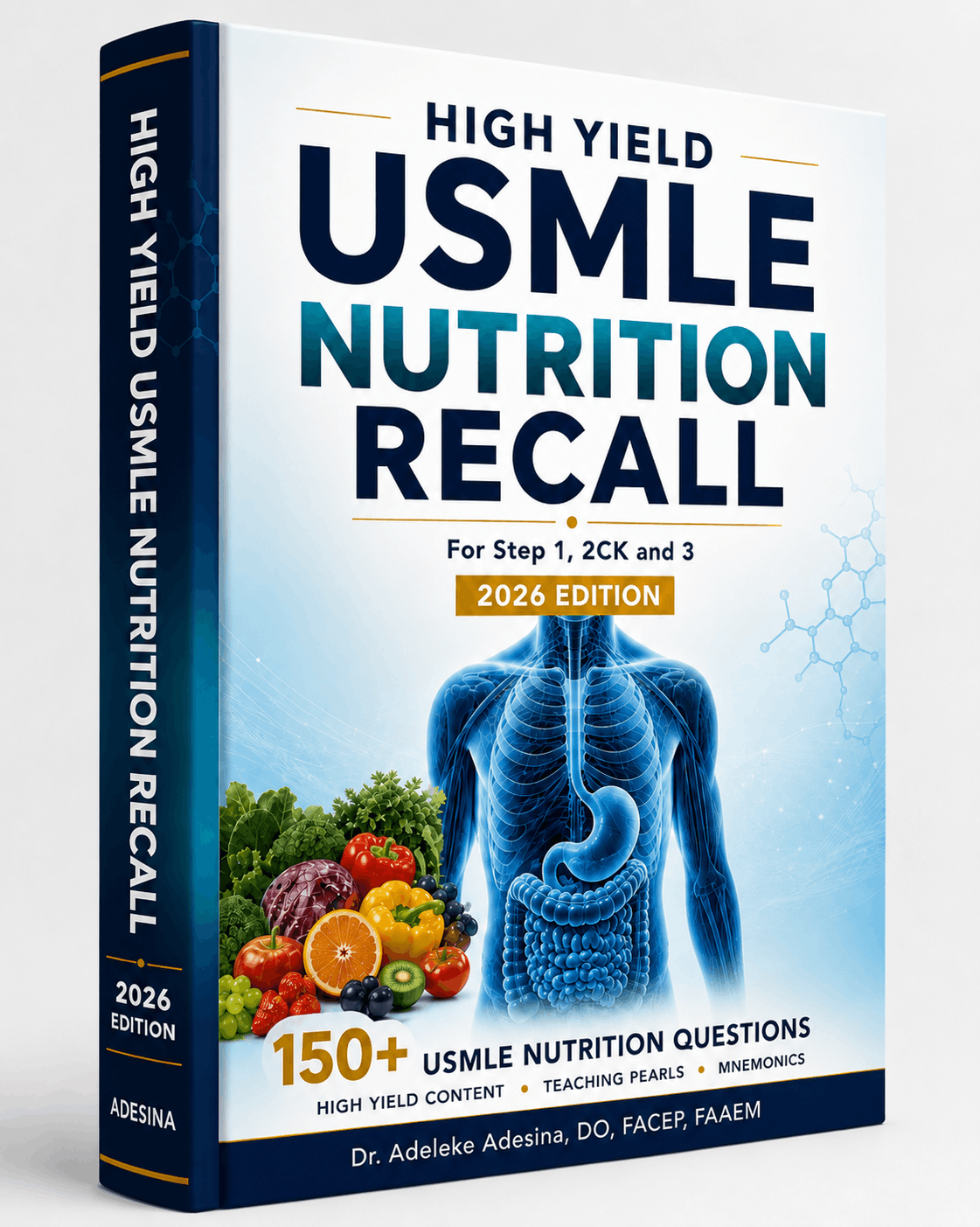
High Yield USMLE Nutrition Recall Book
Nutrition, vitamin deficiencies, metabolic pathways, and diet-related clinical patterns are common sources of missed USMLE questions. The High Yield USMLE Nutrition Recall Book can help you organize these topics more efficiently.
- Review nutrition concepts in a focused way
- Strengthen vitamin and deficiency patterns
- Use it when UWorld incorrects reveal nutrition gaps
A Daily UWorld Review System
Your daily UWorld review system should match your schedule, but it must include active review, targeted repair, and spaced reinforcement.
| Time | Task | Purpose |
|---|---|---|
| Morning | Timed UWorld block | Build pacing, stamina, and clinical reasoning. |
| Late morning | Review incorrect and marked questions | Identify mistake patterns and missed clues. |
| Afternoon | Targeted content repair | Fix the weak concepts exposed by the block. |
| Evening | Review short incorrects notebook | Reinforce your highest-yield misses. |
| Weekly | Analyze trends | See which systems keep causing mistakes. |
Should You Review Every UWorld Explanation?
You should review enough of the explanation to understand the tested concept and your mistake. But you do not need to memorize every line.
Spend more time on:
- Incorrect questions
- Questions you guessed correctly
- Questions where you narrowed it down to two choices
- Questions from weak systems
- Questions that reveal repeated reasoning errors
Spend less time on questions you answered confidently and can explain clearly.
How to Connect UWorld Incorrects to NBME Improvement
UWorld is a learning tool. NBME exams are readiness tools. Your UWorld review should help your NBME weak areas shrink over time.
After each NBME, compare your weak areas with your UWorld incorrect log.
- Are the same systems showing up?
- Are your UWorld misses predicting your NBME weak areas?
- Are you improving in systems you have already repaired?
- Are you still missing questions because of distractors?
- Do you need tutoring to identify the real issue?
NBME Strategy
If your UWorld review is working, your NBME performance should gradually show fewer repeated weak areas and fewer predictable mistakes.
Student Success Story
⭐ 4.8 Google Rating | 120+ ReviewsFolake Adekunle’s SmashUSMLE Success Story
Folake’s story shows how structured guidance, disciplined review, and a clear study system can help students move forward with confidence during USMLE preparation.
Want to learn the same clinical reasoning system used by SmashUSMLE students?
Join Free BootcampNeed Help Reviewing UWorld Incorrects the Right Way?
If you are doing UWorld every day but your NBME scores are not improving, the problem may not be effort. It may be your review system.
SmashUSMLE Reviews helps students use structured clinical reasoning, weak-area analysis, Step 1 course support, and one-on-one tutoring to build a smarter USMLE preparation plan.
FAQ: How to Review Incorrect UWorld Questions Effectively
How do I review incorrect UWorld questions effectively?
Review each incorrect question by identifying the tested concept, diagnosing why you missed it, writing one short takeaway, and creating a repair plan for that weakness.
Should I write notes for every UWorld incorrect?
Yes, but keep them short. Write one high-yield takeaway that explains the clinical reasoning error or missed concept. Avoid copying full explanations.
Should I review correct UWorld questions too?
Review correct questions if you guessed, narrowed it down to two answers, or could not explain why the correct answer was right. Confident correct answers need less time.
How long should it take to review a UWorld block?
It depends on your accuracy and baseline, but review should be focused. Incorrect and guessed questions deserve the most time. Avoid spending hours copying explanations.
What should I do if I keep missing the same UWorld topics?
Rebuild the topic instead of rereading explanations. Review the foundation, do focused questions, write a short concept map, and then return to mixed blocks.
Can SmashUSMLE tutoring help with UWorld review?
Yes. Tutoring can help identify whether your main issue is content knowledge, question interpretation, timing, distractors, test anxiety, or weak clinical reasoning.
Ready to Improve Your USMLE Scores?
USMLE preparation becomes easier when you stop reviewing questions passively and start using a system. Join thousands of medical students and IMGs using SmashUSMLE’s clinical reasoning system to prepare for Step 1, Step 2 CK, and Step 3.