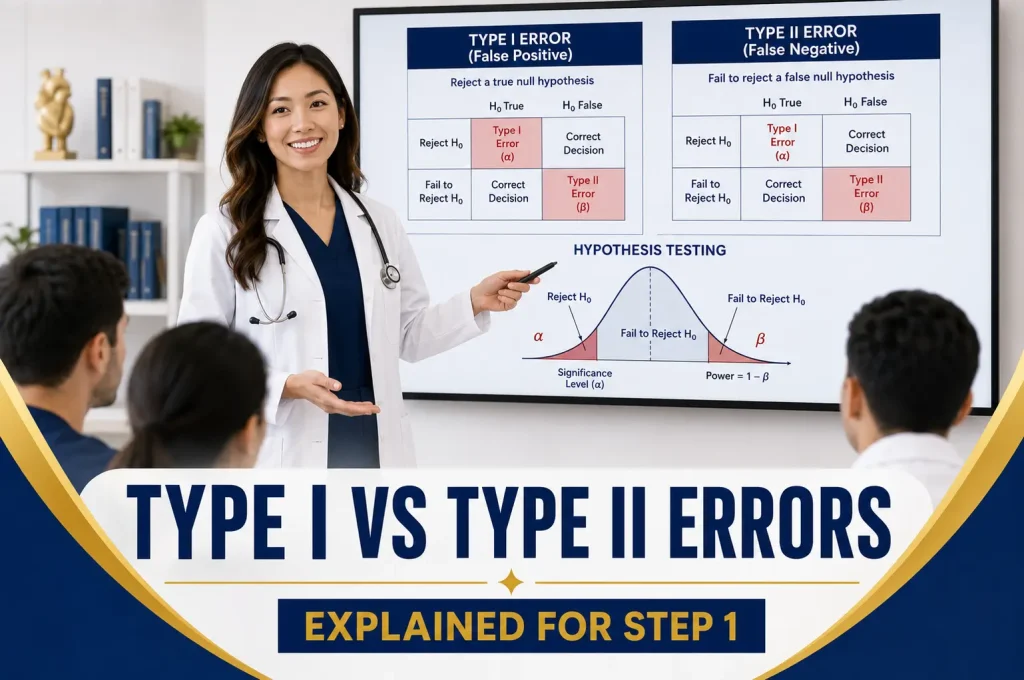

Type I vs Type II errors explained means understanding what can go wrong when a research study makes a conclusion about a treatment, exposure, screening test, or outcome.
On USMLE Step 1, Type I and Type II errors are usually tested through clinical research scenarios. The exam may ask whether a study falsely found a difference, missed a real difference, rejected the null hypothesis incorrectly, or failed to reject the null hypothesis when it should have.
The easiest way to remember it is this: Type I error is a false positive finding, while Type II error is a false negative finding.
This guide will show you how to recognize Type I and Type II errors, understand alpha, beta, power, p-values, and answer common USMLE biostatistics questions faster.
Free USMLE Training
Free USMLE Step 1 Bootcamp
Join our free USMLE masterclass where we break down high-yield concepts, NBME strategies, and clinical reasoning systems used by thousands of medical students and IMGs.
Reserve My SpotWhy Type I vs Type II Errors Matter on Step 1
Type I and Type II errors help you understand whether a study conclusion is wrong because it found something that is not real or missed something that truly exists.
Step 1 may give you a trial comparing two drugs, a screening test, a hypothesis test, a p-value, a confidence interval, or a study with too few participants.
- Type I error means the study falsely finds a difference.
- Type II error means the study misses a real difference.
- Alpha is the probability of Type I error.
- Beta is the probability of Type II error.
- Power is the ability to detect a true difference.
- Increasing sample size increases power and decreases Type II error.
The Big Rule
Type I error is a false alarm. Type II error is a missed finding.
The SmashUSMLE Type I vs Type II Framework
Use the same approach every time you see an error-type question.
| Step | Question to Ask | Why It Matters |
|---|---|---|
| Step 1 | What was the null hypothesis? | The null usually says there is no difference or no association. |
| Step 2 | Did the study reject the null? | Rejecting the null means the study found a statistically significant difference. |
| Step 3 | Was that conclusion actually correct? | This determines whether the error is false positive or false negative. |
| Step 4 | Did the study find something that was not real? | This is Type I error. |
| Step 5 | Did the study miss something real? | This is Type II error. |
What Is a Type I Error?
A Type I error happens when a study rejects the null hypothesis even though the null hypothesis is actually true.
In simple terms, the study says there is a difference, but in reality there is no true difference.
Type I Error Meaning
Type I error = false positive = finding a difference that is not really there.
Type I error is related to alpha.
Alpha
Alpha is the probability of making a Type I error.
If alpha is set at 0.05, that means the study accepts a 5% chance of falsely rejecting the null hypothesis.
What Is a Type II Error?
A Type II error happens when a study fails to reject the null hypothesis even though the null hypothesis is actually false.
In simple terms, the study says there is no difference, but in reality there is a true difference that the study failed to detect.
Type II Error Meaning
Type II error = false negative = missing a real difference.
Type II error is related to beta.
Beta
Beta is the probability of making a Type II error.
Type II error is more likely when a study is underpowered, has a small sample size, or the effect size is small.
Type I vs Type II Error Comparison Table
Learn this table cold. It is the foundation for most Step 1 error questions.
| Feature | Type I Error | Type II Error |
|---|---|---|
| Simple Meaning | False positive | False negative |
| Study Conclusion | Study finds a difference | Study finds no difference |
| Reality | No true difference exists | A true difference exists |
| Null Hypothesis | Incorrectly rejected | Incorrectly failed to reject |
| Associated Probability | Alpha | Beta |
| High-Yield Phrase | False alarm | Missed finding |
Alpha, Beta, and Power
Type I and Type II errors become easier when you connect them to alpha, beta, and power.
| Term | Meaning | USMLE Interpretation |
|---|---|---|
| Alpha | Probability of Type I error | Chance of a false positive result. |
| Beta | Probability of Type II error | Chance of a false negative result. |
| Power | 1 - beta | Ability to detect a true difference when one exists. |
| Increasing sample size | Increases power | Decreases the chance of Type II error. |
| Small sample size | Low power | Higher risk of Type II error. |
Power Rule
Higher power means a lower chance of missing a real effect.
How p-Values Fit In
A p-value helps determine whether the study rejects the null hypothesis.
If the p-value is less than alpha, the result is considered statistically significant, and the null hypothesis is rejected.
But a statistically significant result can still be wrong. That is where Type I error comes in.
- p-value less than alpha: Reject the null hypothesis.
- p-value greater than alpha: Fail to reject the null hypothesis.
- False significant result: Type I error.
- False nonsignificant result: Type II error.
p-Value Rule
A low p-value supports rejecting the null, but it does not prove the result is impossible to be wrong.
Classic Type I vs Type II Patterns on Step 1
Step 1 often tests Type I and Type II errors through short research scenarios.
| Question Stem Clue | Likely Concept | Reasoning |
|---|---|---|
| Study finds a statistically significant difference, but no true difference exists | Type I error | False positive finding. |
| Study finds no statistically significant difference, but a true difference exists | Type II error | False negative finding. |
| Question asks for probability of rejecting a true null hypothesis | Alpha | Alpha is the probability of Type I error. |
| Question asks for probability of failing to reject a false null hypothesis | Beta | Beta is the probability of Type II error. |
| Question asks how to reduce Type II error | Increase sample size or power | Higher power decreases beta. |
| Small study fails to show benefit despite true effect | Type II error | Underpowered studies can miss real differences. |
Common Type I vs Type II Mistakes
1. Confusing Type I With Type II
Type I is a false positive. Type II is a false negative. Keep that distinction simple.
2. Forgetting the Null Hypothesis
The null hypothesis usually says there is no difference. Type I incorrectly rejects it. Type II incorrectly fails to reject it.
3. Thinking Power Reduces Type I Error
Power is related to Type II error. Increasing power decreases the chance of missing a real effect.
4. Ignoring Sample Size
Small sample size increases the risk of Type II error because the study may not detect a real difference.
5. Treating p-Value as Proof
A statistically significant p-value does not prove the finding is true. It still carries a risk of Type I error.
Student Success Story
⭐ 4.8 Google Rating | 120+ ReviewsSee How SmashUSMLE Students Improve Their Scores
Learn how structured clinical reasoning, NBME-focused review, and disciplined preparation can help IMGs break through score plateaus.
Want to learn the same clinical reasoning system used by SmashUSMLE students?
Join Free BootcampNeed Help Mastering Biostatistics for Step 1?
If Type I errors, Type II errors, alpha, beta, power, p-values, confidence intervals, and 2x2 tables feel confusing, you do not need to memorize harder. You need a clear system for interpreting what the study is saying.
SmashUSMLE Reviews helps students use high-yield biostatistics, clinical reasoning, NBME analysis, QBank practice, and one-on-one tutoring to master difficult Step 1 topics.
FAQ: Type I vs Type II Errors Explained
What is a Type I error?
A Type I error is a false positive result. It happens when a study rejects a true null hypothesis and concludes there is a difference when no true difference exists.
What is a Type II error?
A Type II error is a false negative result. It happens when a study fails to reject a false null hypothesis and misses a real difference.
What is alpha?
Alpha is the probability of making a Type I error, which means the probability of a false positive finding.
What is beta?
Beta is the probability of making a Type II error, which means the probability of a false negative finding.
What is statistical power?
Statistical power is 1 - beta. It is the probability of detecting a true difference when one actually exists.
How do you reduce Type II error?
You reduce Type II error by increasing statistical power, often by increasing sample size or improving study design.
Ready to Improve Your USMLE Scores?
Type I and Type II errors become easier when you stop memorizing terms randomly and start recognizing whether a study created a false alarm or missed a real finding. Join thousands of medical students and IMGs using SmashUSMLE’s clinical reasoning system to prepare for Step 1, Step 2 CK, and Step 3.