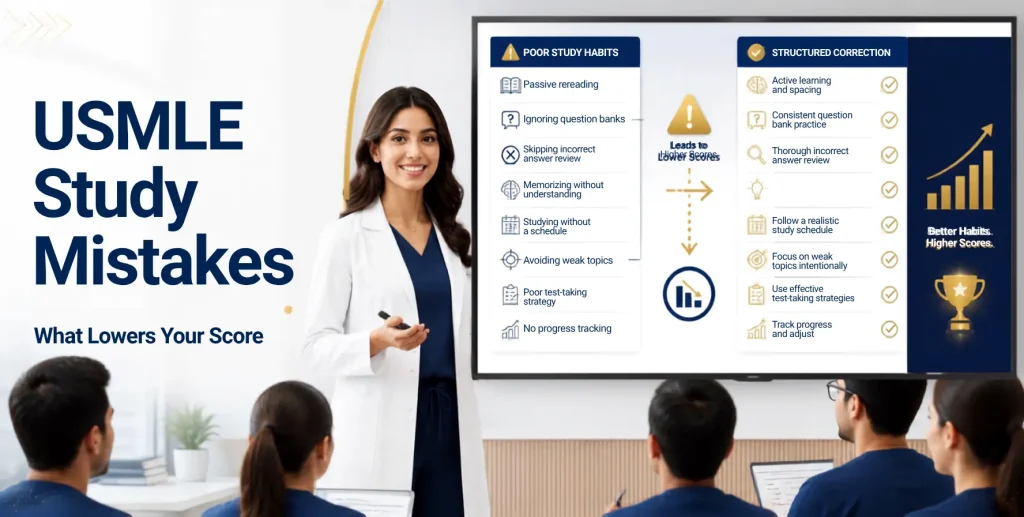

Most USMLE students do not fail because they are lazy. They fail because they use the wrong strategy for too long.
They study for hours, collect more resources, watch more videos, reset QBank blocks, reread notes, and still watch their NBME scores stay flat.
The USMLE rewards clinical reasoning, pattern recognition, disciplined review, and the ability to apply concepts inside long clinical vignettes. Passive studying alone is not enough.
This guide will show you the biggest USMLE study mistakes that lower scores, how to recognize them early, and how to replace them with a smarter system using SmashUSMLE Reviews, NBME weak-area analysis, QBank practice, and one-on-one coaching when needed.
Free USMLE Training
Free USMLE Bootcamp
Learn the clinical reasoning, NBME strategy, and study systems used by medical students and IMGs preparing for Step 1, Step 2 CK, and Step 3.
Reserve My SpotWhy USMLE Scores Drop or Stay Stuck
A stuck USMLE score usually means your study method is not fixing the real problem. The issue may be content, application, timing, anxiety, poor review, or weak clinical reasoning.
Your score may stay stuck if you:
- Study passively instead of actively testing yourself.
- Use too many resources without a clear system.
- Ignore NBME weak-area data.
- Do QBank questions without reviewing deeply.
- Memorize facts without understanding how they appear in clinical vignettes.
- Avoid assessments because you are afraid of the score.
- Repeat the same strategy even when it is not working.
The Big Rule
If your NBME score is not improving, do not just study harder. Study differently.
Mistake 1: Passive Studying
Passive studying feels productive, but it often does not improve scores. Watching videos, highlighting notes, and rereading chapters can give the illusion of mastery.
The problem is that the USMLE does not ask whether you recognize a paragraph. It asks whether you can apply a concept to a new clinical scenario.
Signs You Are Studying Passively
- You spend hours watching videos but avoid questions.
- You reread the same notes without testing yourself.
- You feel like you know topics until you see them in a QBank block.
- You highlight heavily but cannot explain concepts from memory.
- You delay NBME exams because you do not feel ready.
Fix It
After every lesson, do questions. After every missed question, write the reason you missed it. Active review beats passive exposure.
Mistake 2: Using Too Many Resources
Resource overload is one of the fastest ways to weaken USMLE preparation. Students jump between courses, videos, PDFs, flashcards, QBank explanations, and notes without building one reliable system.
More resources do not automatically create better scores. They often create confusion, duplication, and poor execution.
A smarter resource plan gives each tool a job:
- One main system for structure and content repair.
- One QBank for active practice.
- NBMEs for performance measurement.
- A missed-question notebook for repeated errors.
- Selective flashcards for facts you repeatedly forget.
Resource Rule
If you cannot explain why a resource is in your plan, it may be distracting you more than helping you.
Mistake 3: Ignoring NBME Weak Areas
NBME exams are not just score reports. They are diagnostic tools. They show you what needs to change.
Many students take an NBME, feel discouraged, look at the score, and move on. That is a mistake. The real value is in the weak-area pattern.
After every NBME, ask:
- Which organ systems are weak?
- Which subjects keep showing up in missed questions?
- Am I missing content or application?
- Am I choosing tempting distractors?
- Am I losing points because of timing or fatigue?
- What should change in my study plan this week?
NBME Rule
Your NBME should create your next study plan. Do not study everything equally when your weak areas are not equal.
Mistake 4: Doing Questions Without Deep Review
Doing questions is important, but questions only help when you review them correctly.
A common mistake is reading the explanation, saying “that makes sense,” and moving on. That does not always fix the thinking error that caused the miss.
Better QBank Review Method
- Identify why you missed the question.
- Write one short correction point.
- Explain why the correct answer is correct.
- Explain why your chosen answer was wrong.
- Track repeated missed topics.
- Return to weak systems with focused blocks.
QBank Rule
Your goal is not to finish questions. Your goal is to improve the way you think through questions.
Mistake 5: Memorizing Without Clinical Reasoning
Memorization matters, but it is not enough. The USMLE often tests whether you can connect a clinical clue to a mechanism, diagnosis, complication, next step, or treatment.
Students who rely only on memorization often recognize facts but miss questions when the presentation changes.
To build clinical reasoning, ask:
- What is the key clue in the question stem?
- What mechanism explains the finding?
- What diagnosis fits the whole vignette?
- What answer choice is tempting but wrong?
- What would change if the patient were older, pregnant, immunocompromised, or unstable?
Reasoning Rule
Do not stop at “I know the fact.” Train yourself to ask, “How will the USMLE test this fact?”
Mistake 6: Waiting Too Long to Take Assessments
Many students delay NBMEs because they are afraid of seeing a low score. That fear is understandable, but it can hurt your preparation.
If you wait too long to assess yourself, you may discover major weaknesses when there is not enough time to fix them.
Assessments should be used to guide your study plan, not to attack your confidence.
Assessment Rule
Take assessments early enough that the results can still change your study plan.
Mistake 7: Ignoring Timing and Test Strategy
Some students know enough content to improve, but they lose points because they run out of time, overthink questions, or keep changing correct answers.
Timing is a skill. It has to be practiced before exam day.
Timing Mistakes That Lower Scores
- Spending too long on the first half of the block.
- Changing answers without a clear reason.
- Reading every detail before identifying the question task.
- Getting stuck between two answers and losing time.
- Ignoring fatigue during long practice sessions.
Practice timed blocks regularly. Review not only what you missed, but how you used your time.
Common USMLE Mistakes for IMGs
IMGs often face unique challenges. Many are rebuilding basic science after years away from medical school, adjusting to NBME-style questions, and balancing work, family, or visa pressure.
IMG Mistakes That Hurt Scores
- Trying to memorize everything instead of focusing on high-yield patterns.
- Using too many resources from different systems.
- Waiting too long to take NBMEs.
- Studying alone for months despite no score improvement.
- Ignoring question interpretation and distractor traps.
- Comparing their timeline to students with different baselines.
For IMGs
Your plan should match your baseline, your timeline, and your weak areas. Do not copy another student’s study schedule blindly.
How to Fix a Low or Stuck USMLE Score
If your score is stuck, the answer is not always more hours. The answer is a better diagnosis of the problem.
Step 1: Identify the Real Weakness
Decide whether the problem is content, application, timing, fatigue, test anxiety, or poor review strategy.
Step 2: Rebuild With Structure
Use SmashUSMLE Reviews, the Masterclass with AI, the self-paced course, and targeted QBank blocks to rebuild weak systems.
Step 3: Review Questions by Error Type
Do not only write down the topic. Write why you missed the question and what you will do differently next time.
Step 4: Reassess Regularly
Use NBME-style assessments to confirm that your weak areas are improving.
Step 5: Get Coaching if You Are Stuck
If you have studied for weeks and your score is not moving, one-on-one coaching can help identify what you are missing.
USMLE Mistake Correction Table
Use this table to identify the mistake and choose the right correction.
| Mistake | Why It Lowers Scores | Better Strategy |
|---|---|---|
| Passive studying | You recognize material but cannot apply it. | Use active recall, QBank practice, and self-explanation. |
| Too many resources | You switch constantly and lose structure. | Use one main system with clear supporting tools. |
| Ignoring NBME data | You study everything equally instead of fixing weak areas. | Build each week around NBME weak-area analysis. |
| Poor QBank review | You repeat the same reasoning errors. | Review every miss by error type and write a correction point. |
| Memorization only | You struggle when questions test concepts in new ways. | Connect facts to mechanisms, clinical clues, and answer choices. |
| Delaying assessments | You discover weaknesses too late. | Take NBMEs early enough to adjust your plan. |
| Ignoring timing | You lose points even when you know the material. | Practice timed blocks and review pacing decisions. |
Student Success Story
⭐ 4.8 Google Rating | 120+ ReviewsSee How SmashUSMLE Students Improve Their Scores
Learn how structured clinical reasoning, NBME-focused review, and disciplined preparation can help IMGs break through score plateaus.
Want to learn the same clinical reasoning system used by SmashUSMLE students?
Join Free BootcampNeed Help Fixing Your USMLE Study Strategy?
If your NBME scores are stuck, your QBank scores are inconsistent, or your study plan feels scattered, you do not need more random resources. You need a smarter system.
SmashUSMLE Reviews helps students and IMGs use structured lessons, QBank practice, NBME weak-area analysis, and one-on-one coaching to identify mistakes and improve USMLE performance.
FAQ: The Biggest USMLE Study Mistakes That Lower Scores
Why are my USMLE scores not improving?
Your scores may be stuck because of content gaps, poor question review, weak clinical reasoning, timing issues, or studying without using NBME weak-area data.
Is doing more QBank questions enough to raise my score?
Not always. Questions help only if you review them deeply, identify why you missed them, and correct the repeated thinking pattern.
What is the biggest mistake students make while studying for Step 1?
One of the biggest mistakes is passive studying. Students watch videos and reread notes without enough active recall, questions, or NBME-based adjustment.
How often should I use NBMEs during USMLE preparation?
Many students benefit from regular NBME-style assessments during dedicated study so they can identify weak areas and adjust the plan before it is too late.
Can SmashUSMLE help if my score is stuck?
Yes. SmashUSMLE can help you identify whether your problem is content, clinical reasoning, timing, test anxiety, poor review strategy, or weak application of concepts.
Ready to Stop Making the Mistakes That Lower USMLE Scores?
USMLE improvement starts when you stop studying randomly and start using a system. Build your plan around weak-area analysis, clinical reasoning, QBank review, and steady NBME improvement.