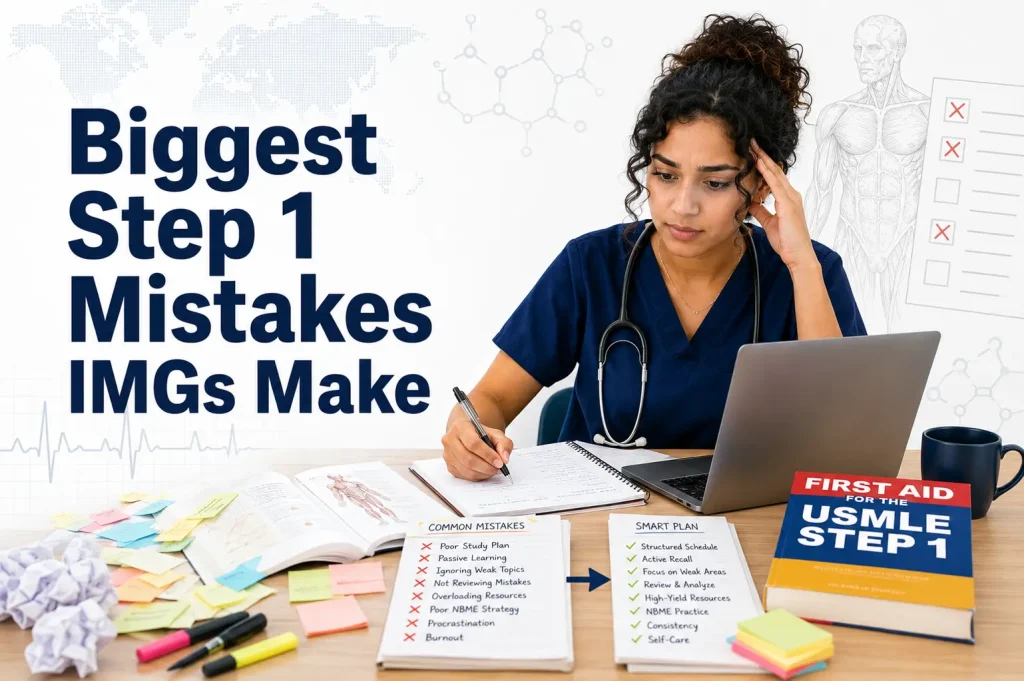

Step 1 mistakes IMGs make often have less to do with intelligence and more to do with strategy. Many international medical graduates work hard, study long hours, and still struggle because their preparation is not built around NBME-style reasoning.
Some IMGs spend months rereading notes, watching random videos, or doing questions without a clear plan. Unfortunately, effort without direction can create frustration instead of progress.
The good news is that most Step 1 mistakes are fixable. Once you identify what is holding your score back, you can rebuild your plan, target weak areas, and prepare more confidently.
This guide breaks down the biggest Step 1 mistakes IMGs make and shows you how to avoid them before they damage your NBME scores, confidence, or test-day performance.
Free USMLE Training
Free USMLE Step 1 Bootcamp
Join our free USMLE masterclass where we break down high-yield concepts, NBME strategy, and clinical reasoning systems used by medical students and IMGs.
Reserve My SpotMistake 1: Studying Randomly Without a System
One of the biggest Step 1 mistakes IMGs make is studying without a clear system. Random studying feels productive because you are always busy, but it does not guarantee improvement.
You may watch lectures one day, read First Aid the next day, do a few questions later, and then switch to another resource when anxiety rises. This creates motion, but not mastery.
What to Do Instead
- Start with a baseline assessment.
- Identify your weakest systems and disciplines.
- Create a weekly schedule based on weak areas.
- Use questions to confirm improvement.
- Adjust your plan based on NBME performance.
The Big Rule
Your Step 1 study plan should be built around your weaknesses, not around what feels comfortable to review.
Mistake 2: Waiting Too Long to Take an NBME
Many IMGs delay NBME exams because they are afraid of seeing a low score. That fear is understandable, but avoiding the truth can waste months.
An NBME is not just a practice test. It is a diagnostic tool that tells you whether your study plan is working.
How IMGs Should Use NBMEs
- Take a baseline NBME early.
- Review weak systems after every exam.
- Track repeated missed concepts.
- Use NBME data to plan the next 1–2 weeks.
- Do not schedule Step 1 until your practice data supports readiness.
NBME Rule
Avoiding an NBME does not protect you. It only delays the information you need to pass.
Mistake 3: Passive Reading Instead of Active Learning
Passive reading is one of the most common Step 1 mistakes IMGs make. Rereading notes can feel safe, but Step 1 does not reward comfort. It rewards application.
If you read a topic and feel like you understand it, that is not enough. You need to prove that understanding through questions.
Active Learning Methods That Work
- Answer questions after reviewing a topic.
- Explain mechanisms out loud.
- Write one-sentence summaries of diseases.
- Compare similar diseases side by side.
- Create a missed-concept notebook.
- Teach the concept as if explaining it to another student.
Mistake 4: Using Too Many Step 1 Resources
Resource overload is dangerous. Many IMGs believe that more resources will fix their weak areas, but too many resources usually create confusion.
The goal is not to collect resources. The goal is to use a small set of strong resources consistently.
| Resource Problem | Why It Hurts IMGs | Better Strategy |
|---|---|---|
| Too many video courses | You keep restarting instead of mastering. | Choose one main structured review system. |
| Too many question banks | You do questions without deep review. | Use focused blocks based on weak systems. |
| Too many books | You spend more time reading than applying. | Use one high-yield reference and one main study plan. |
| Too many flashcards | You memorize facts without improving reasoning. | Use flashcards selectively for repeated weak facts. |
Resource Rule
Pick a main system, use it consistently, and measure improvement with questions and NBMEs.
Mistake 5: Using UWorld the Wrong Way
UWorld is powerful, but it can be used incorrectly. Many students do questions, read the explanation quickly, and move on without changing how they think.
That is not review. That is exposure.
How to Review UWorld Correctly
- Ask why the correct answer is correct.
- Ask why your answer was wrong.
- Identify the clue you missed.
- Write down the mechanism being tested.
- Review the wrong answer choices.
- Track repeated traps and weak topics.
Question Review Rule
You do not improve by finishing more questions. You improve by changing the reason you miss questions.
High-Yield Step 1 Resource
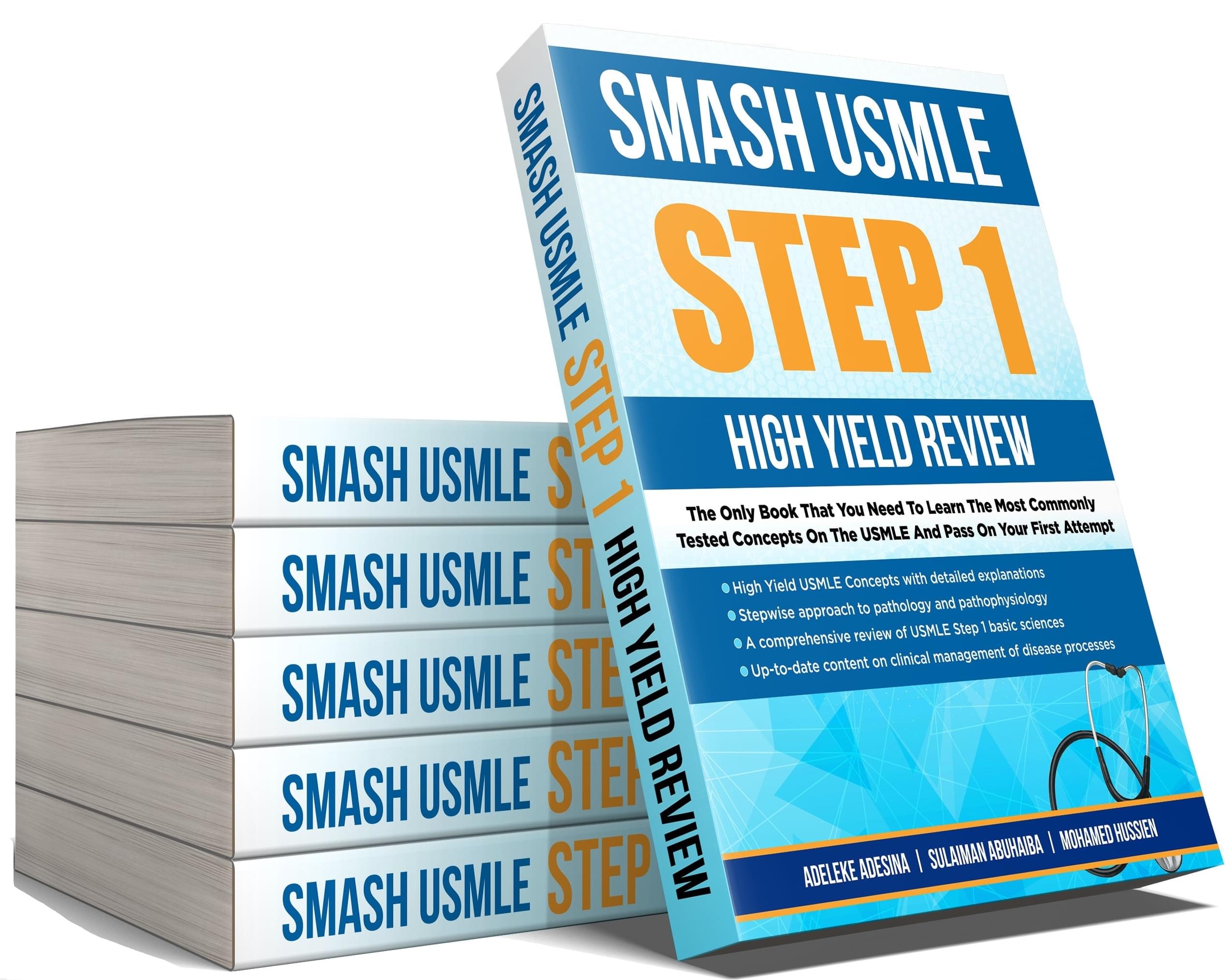
SmashUSMLE High Yield Step 1 Book
If you are an IMG preparing for Step 1, use the SmashUSMLE High Yield Step 1 Book to organize the concepts, mechanisms, and clinical reasoning points that matter most.
- Strengthen high-yield Step 1 foundations
- Review core systems more efficiently
- Connect concepts to NBME-style questions
- Use alongside SmashUSMLE, QBank practice, and NBME review
Mistake 6: Memorizing Without Clinical Reasoning
Step 1 is not only a memory exam. It tests whether you can connect clues, mechanisms, labs, pathology, and answer choices.
Many IMGs know the facts but miss questions because they cannot translate those facts into NBME-style reasoning.
How to Build Clinical Reasoning
- Read the last line first.
- Identify what the question is asking.
- Summarize the vignette in one sentence.
- Connect symptoms to mechanisms.
- Eliminate distractors intentionally.
- Explain the correct answer without looking at the explanation.
Clinical Reasoning Rule
If your review only helps you recognize facts, but not apply them, your NBME score may stay stuck.
Mistake 7: Ignoring Timing and Test Stamina
Some students know enough content but lose points because they run out of time, fatigue quickly, or panic when questions feel unfamiliar.
Step 1 preparation should include timed practice, stamina training, and test-day planning.
How to Improve Timing
- Practice timed blocks regularly.
- Review why slow questions slowed you down.
- Learn when to mark and move on.
- Build break strategy before exam day.
- Practice with mixed blocks before your final weeks.
Mistake 8: Waiting Too Long to Get Help
One of the most costly Step 1 mistakes IMGs make is waiting too long to ask for help. If your NBME scores are not improving, that is a signal.
A tutor or coach can help identify whether your problem is content, reasoning, timing, anxiety, poor review strategy, or a weak foundation.
When IMGs Should Get Step 1 Help
- Your NBME scores are stuck.
- You keep missing the same topics.
- You do many questions but do not improve.
- You do not know how to review effectively.
- Your study plan changes every week.
- You feel overwhelmed and need structure.
How SmashUSMLE Helps IMGs Avoid These Mistakes
SmashUSMLE Reviews helps IMGs prepare for Step 1 with structure, clinical reasoning, QBank practice, NBME weak-area analysis, high-yield review, and one-on-one tutoring support.
Instead of studying randomly, IMGs can use SmashUSMLE to create a plan around weak areas, targeted review, and measurable score improvement.
How IMGs Can Use SmashUSMLE
- Use the Masterclass with AI to rebuild high-yield foundations.
- Use the self-paced course for weak systems.
- Use the SmashUSMLE QBank for targeted practice.
- Use NBME reports to guide weekly study decisions.
- Use one-on-one tutoring when scores are stuck.
Student Success Story
⭐ 4.8 Google Rating | 120+ ReviewsSee How SmashUSMLE Students Avoid Step 1 Mistakes
This testimonial shows how structure, coaching, and clinical reasoning strategy can help students avoid common Step 1 preparation mistakes and move forward with confidence.
Want help avoiding the biggest Step 1 mistakes IMGs make?
Join Free BootcampNeed Help Avoiding Step 1 Mistakes?
If you are an IMG preparing for Step 1, you do not need more confusion. You need a clear system, honest score tracking, and a plan that helps you improve week by week.
SmashUSMLE Reviews helps IMGs rebuild foundations, improve NBME performance, strengthen clinical reasoning, and prepare for Step 1 with more confidence.
FAQ: Biggest Step 1 Mistakes IMGs Make
What are the biggest Step 1 mistakes IMGs make?
The biggest mistakes include studying randomly, delaying NBME exams, using too many resources, reviewing UWorld poorly, memorizing without clinical reasoning, and waiting too long to get help.
Why do IMGs struggle with Step 1 preparation?
Many IMGs struggle because they are rebuilding basic sciences while also learning NBME-style reasoning. Some also face time pressure, resource overload, or long gaps since preclinical coursework.
Should IMGs take an NBME early?
Yes. IMGs should take a baseline NBME early so they can identify weak areas and build a study plan based on data instead of guessing.
Is UWorld enough for IMGs preparing for Step 1?
UWorld is useful, but it may not be enough if your foundation is weak. IMGs should combine questions with structured review, NBME analysis, and focused weak-area repair.
When should IMGs get Step 1 tutoring?
IMGs should consider tutoring when NBME scores are stuck, question review feels ineffective, weak areas keep repeating, or the study plan lacks structure.
How can SmashUSMLE help IMGs avoid Step 1 mistakes?
SmashUSMLE helps IMGs with structured review, clinical reasoning, targeted QBank practice, NBME weak-area analysis, and one-on-one coaching.
Ready to Avoid the Biggest Step 1 Mistakes?
IMGs can improve Step 1 preparation when they stop studying randomly and start using a structured, measurable system. Build your plan around weak areas, clinical reasoning, NBME data, and the right support.