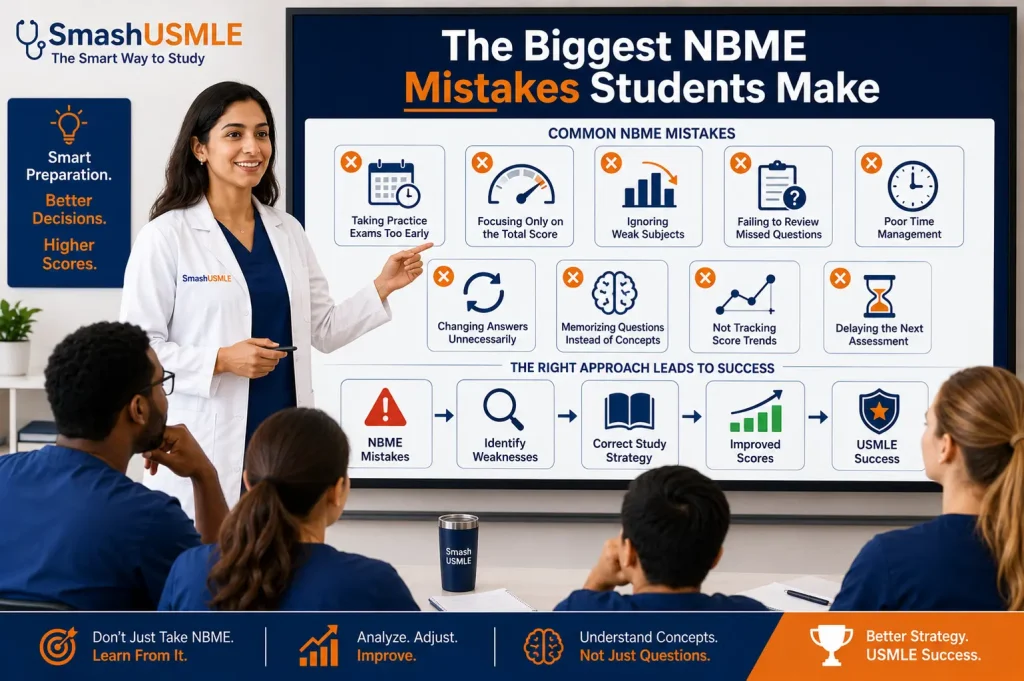

The biggest NBME mistakes students make usually happen after the exam, not during the exam.
Many students take an NBME, panic about the score, skim the explanations, and then go back to the same study routine that caused the problem. That is why scores plateau.
Your NBME is not just a score. It is a diagnostic tool. If you use it correctly, it tells you exactly what to fix next.
Free USMLE Training
Free USMLE Step 1 Bootcamp
Learn how to review NBME exams, fix weak areas, avoid distractors, and build the clinical reasoning system needed for Step 1.
Reserve My SpotMistake 1: Taking NBMEs Without a Plan
The first major mistake is taking NBME exams randomly. Some students take one because they are anxious. Others take one because a friend took one. That is not strategy.
Every NBME should have a purpose:
- Baseline diagnosis
- Weak-area tracking
- Midpoint progress check
- Final readiness confirmation
The Big Rule
Do not take an NBME unless you know what decision that score will help you make.
Mistake 2: Reviewing Too Passively
Passive review is one of the biggest reasons students keep missing the same question types.
Passive review sounds like this:
- “That makes sense.”
- “I knew that.”
- “I just forgot.”
- “I’ll remember it next time.”
Active review asks better questions.
| Passive Review | Active Review |
|---|---|
| Reading the explanation | Identifying the exact tested concept |
| Only checking the correct answer | Explaining why each wrong answer is wrong |
| Moving on after understanding | Writing the pattern you must recognize next time |
| Blaming memory | Classifying the miss as content, application, timing, or distractor trap |
Mistake 3: Ignoring Weak Systems
Many students avoid the exact topics their NBME proves are weak. They keep reviewing comfortable subjects because it feels productive.
That is a trap. Your score improves when you attack the systems costing you the most points.
- List your lowest NBME systems
- Pick the top 2 to 3 weakest areas
- Review targeted content
- Do focused QBank blocks
- Track whether accuracy improves
Weak-Area Rule
Study what your NBME proves is weak, not what feels easiest to review.
Mistake 4: Not Studying Distractors
Distractors are not random. They are designed to expose incomplete thinking.
If you only review the correct answer, you miss the lesson hidden in the wrong answer choices.
| Distractor Type | How It Tricks Students | How to Fix It |
|---|---|---|
| Familiar Fact | Sounds like something you memorized | Ask if it fits the full vignette |
| Partial Match | Fits one clue but not the whole case | Match all major clues before choosing |
| Wrong Mechanism | Diagnosis may fit, but mechanism does not | Read the last line carefully |
| True but Irrelevant | The statement is true but does not answer the question | Answer the exact question being asked |
Mistake 5: Retesting Too Soon
Another major mistake is taking another NBME before you have fixed anything from the last one.
Retesting too soon usually confirms the same problem and increases anxiety.
- Review the previous NBME deeply
- Fix the weakest systems
- Do targeted QBank blocks
- Check whether your accuracy improves
- Then take another NBME
Retest Rule
Do not retest because you are anxious. Retest because your preparation has changed.
How to Fix Your NBME Review
Use a structured review method after every NBME.
| Step | What to Do | Why It Works |
|---|---|---|
| Step 1 | Review your lowest systems | Find where most points are leaking |
| Step 2 | Classify missed questions | Separate content gaps from application errors |
| Step 3 | Study wrong answer choices | Prevents repeated distractor traps |
| Step 4 | Do focused QBank blocks | Turns weak areas into active practice |
| Step 5 | Retest after repair | Confirms whether your plan worked |
Student Success Story
⭐ 4.8 Google Rating | 120+ ReviewsSee How SmashUSMLE Students Improve Their Scores
Learn how structured clinical reasoning, NBME-focused review, and disciplined preparation can help students avoid repeated mistakes.
Want to learn the same clinical reasoning system used by SmashUSMLE students?
Join Free BootcampNeed Help Fixing Your NBME Mistakes?
If your NBME scores are stuck, the problem may not be effort. It may be your review method.
SmashUSMLE Reviews helps students use NBME data, QBank practice, clinical reasoning, and one-on-one tutoring to improve faster.
FAQ: The Biggest NBME Mistakes Students Make
What is the biggest NBME mistake students make?
The biggest mistake is taking NBME exams without using them to create a focused weak-area repair plan.
Should I review every NBME question?
Yes. You should review missed questions deeply and also review guessed questions or questions where you were unsure.
Should I take another NBME if my score is low?
Not immediately. First review the prior NBME, fix weak systems, and use targeted QBank practice before retesting.
Why do I keep making the same NBME mistakes?
You may be reviewing passively, ignoring distractors, or failing to classify why you missed each question.
Ready to Stop Repeating NBME Mistakes?
Step 1 preparation becomes easier when every NBME gives you a clear correction plan. SmashUSMLE can help you diagnose weak areas, avoid distractors, and build stronger clinical reasoning.