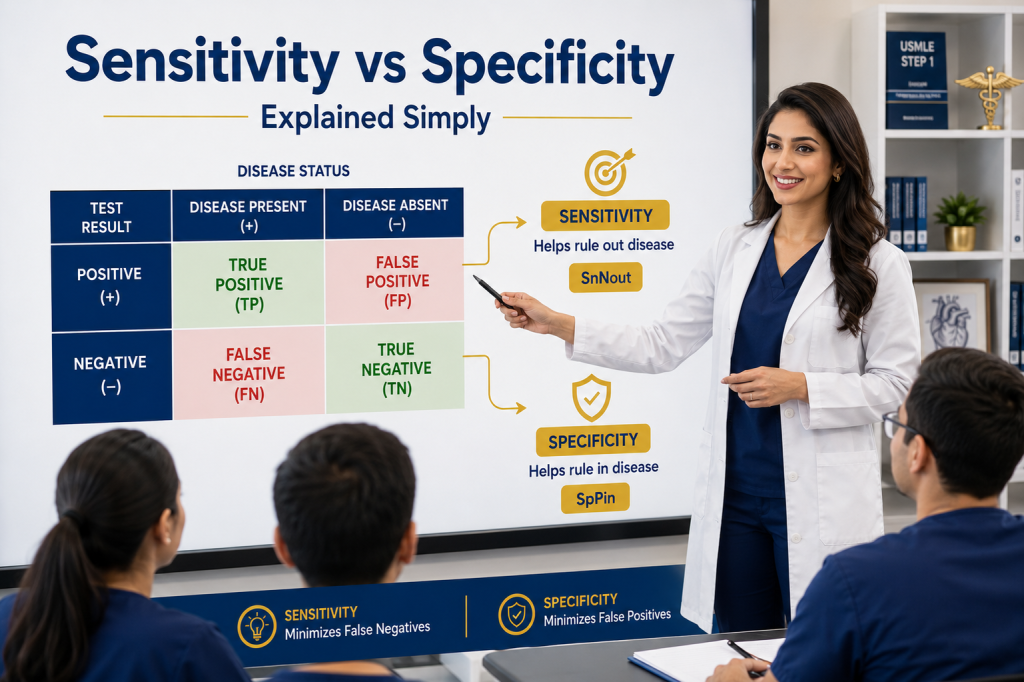

Sensitivity vs specificity explained simply is a high-yield USMLE Step 1 topic because biostatistics questions often test whether you understand what a diagnostic test can and cannot do.
Many students memorize formulas but still miss questions because they do not understand the clinical meaning behind the numbers.
Sensitivity tells you how good a test is at detecting disease when disease is truly present. Specificity tells you how good a test is at ruling out disease when disease is truly absent.
Once you understand that idea, USMLE questions about screening tests, confirmatory tests, false positives, false negatives, and predictive values become much easier.
Free USMLE Training
Free USMLE Step 1 Bootcamp
Join our free USMLE masterclass where we break down high-yield concepts, NBME strategies, and clinical reasoning systems used by thousands of medical students and IMGs.
Reserve My SpotWhy Sensitivity and Specificity Matter
Sensitivity and specificity help you understand diagnostic test performance.
Step 1 may ask whether a test is better for screening, confirmation, ruling out disease, ruling in disease, reducing false negatives, or reducing false positives.
- Sensitive tests are useful when missing disease would be dangerous.
- Specific tests are useful when a false positive would cause harm.
- High sensitivity helps rule out disease when the test is negative.
- High specificity helps rule in disease when the test is positive.
- Changing the cutoff affects sensitivity and specificity in opposite directions.
The Big Rule
Sensitivity is about catching disease. Specificity is about confirming disease absence in healthy people and ruling disease in when positive.
Simple Definitions
Here is the simplest way to think about it.
| Term | Simple Meaning | USMLE Memory Hook |
|---|---|---|
| Sensitivity | How well the test detects people who truly have the disease. | Sensitive test, when Negative, rules OUT. SnNOut. |
| Specificity | How well the test identifies people who truly do not have the disease. | Specific test, when Positive, rules IN. SpPIn. |
| False Negative | The patient has the disease, but the test says negative. | High sensitivity lowers false negatives. |
| False Positive | The patient does not have the disease, but the test says positive. | High specificity lowers false positives. |
Simple Shortcut
Use a sensitive test to screen. Use a specific test to confirm.
The SmashUSMLE Sensitivity vs Specificity Framework
Use this framework every time you see a diagnostic test question.
| Step | Question to Ask | Why It Matters |
|---|---|---|
| Step 1 | Is the question asking about disease present or disease absent? | Sensitivity focuses on diseased patients. Specificity focuses on non-diseased patients. |
| Step 2 | Is the goal screening or confirmation? | Screening favors sensitivity. Confirmation favors specificity. |
| Step 3 | Is the question worried about false negatives or false positives? | High sensitivity reduces false negatives. High specificity reduces false positives. |
| Step 4 | Did the cutoff change? | Lower cutoff usually increases sensitivity but decreases specificity. |
| Step 5 | Is prevalence being tested? | Prevalence affects predictive values, not sensitivity or specificity. |
High-Yield Formulas
You should know the formulas, but do not stop at memorization. Understand what the numerator and denominator mean.
| Measurement | Formula | Meaning |
|---|---|---|
| Sensitivity | TP / TP + FN | Among people with disease, how many tested positive? |
| Specificity | TN / TN + FP | Among people without disease, how many tested negative? |
| Positive Predictive Value | TP / TP + FP | Among positive tests, how many truly have disease? |
| Negative Predictive Value | TN / TN + FN | Among negative tests, how many truly do not have disease? |
Formula Rule
Sensitivity and specificity start with true disease status. Predictive values start with test result.
Screening vs Confirmatory Tests
One of the highest-yield USMLE patterns is knowing which test to use first.
Screening tests are usually sensitive because you do not want to miss disease. Confirmatory tests are usually specific because you do not want to incorrectly label someone with disease.
| Test Goal | Preferred Test Feature | Why |
|---|---|---|
| Screening | High sensitivity | Minimizes false negatives and catches most patients with disease. |
| Confirmation | High specificity | Minimizes false positives and confirms disease when positive. |
| Rule out dangerous disease | High sensitivity | A negative result makes disease less likely. |
| Rule in serious diagnosis | High specificity | A positive result makes disease more likely. |
Screening Rule
A screening test should miss as few true cases as possible. That is why sensitivity matters.
False Positives and False Negatives
False positives and false negatives are common distractor traps on USMLE biostatistics questions.
| Result Type | Meaning | How to Reduce It |
|---|---|---|
| False Negative | The patient has disease, but the test is negative. | Use a more sensitive test. |
| False Positive | The patient does not have disease, but the test is positive. | Use a more specific test. |
If the vignette says missing the disease would be dangerous, think high sensitivity. If the vignette says false diagnosis would cause harm, think high specificity.
Classic USMLE Question Patterns
Step 1 often tests sensitivity and specificity through short clinical or research-style scenarios.
| Question Pattern | Correct Thinking | Answer Direction |
|---|---|---|
| A new screening test should identify almost everyone with disease. | Need to reduce false negatives. | High sensitivity. |
| A positive result should strongly confirm disease. | Need to reduce false positives. | High specificity. |
| Lowering the cutoff makes more people test positive. | Catches more true positives but also more false positives. | Sensitivity increases, specificity decreases. |
| Raising the cutoff makes fewer people test positive. | Misses more true positives but reduces false positives. | Sensitivity decreases, specificity increases. |
| Disease prevalence increases. | More positive tests are true positives. | PPV increases, NPV decreases. |
| Disease prevalence decreases. | More negative tests are true negatives. | NPV increases, PPV decreases. |
Common Mistakes
1. Confusing Sensitivity With Positive Predictive Value
Sensitivity starts with people who truly have the disease. Positive predictive value starts with people who tested positive.
2. Confusing Specificity With Negative Predictive Value
Specificity starts with people who truly do not have the disease. Negative predictive value starts with people who tested negative.
3. Forgetting SnNOut and SpPIn
A highly sensitive test, when negative, helps rule out disease. A highly specific test, when positive, helps rule in disease.
4. Thinking Prevalence Changes Sensitivity or Specificity
Prevalence changes positive and negative predictive values. It does not directly change sensitivity or specificity.
5. Missing Cutoff Changes
Lowering a cutoff usually increases sensitivity and decreases specificity. Raising a cutoff usually decreases sensitivity and increases specificity.
Student Success Story
⭐ 4.8 Google Rating | 120+ ReviewsSee How SmashUSMLE Students Improve Their Scores
Learn how structured clinical reasoning, NBME-focused review, and disciplined preparation can help IMGs break through score plateaus.
Want to learn the same clinical reasoning system used by SmashUSMLE students?
Join Free BootcampNeed Help Mastering Biostatistics for Step 1?
If sensitivity, specificity, predictive values, and false positives feel confusing, you do not need to memorize harder. You need a simple framework that makes the question predictable.
SmashUSMLE Reviews helps students use clinical reasoning, high-yield biostatistics, NBME analysis, QBank practice, and one-on-one tutoring to master difficult Step 1 topics.
FAQ: Sensitivity vs Specificity Explained Simply
What is sensitivity in simple terms?
Sensitivity is how well a test detects people who truly have the disease. A highly sensitive test has fewer false negatives.
What is specificity in simple terms?
Specificity is how well a test identifies people who truly do not have the disease. A highly specific test has fewer false positives.
What does SnNOut mean?
SnNOut means a highly sensitive test, when negative, helps rule out disease.
What does SpPIn mean?
SpPIn means a highly specific test, when positive, helps rule in disease.
Does prevalence affect sensitivity and specificity?
No. Prevalence affects positive predictive value and negative predictive value, but it does not directly change sensitivity or specificity.
How can SmashUSMLE help with biostatistics?
SmashUSMLE Reviews helps students break down biostatistics questions using simple frameworks, QBank practice, NBME weak-area analysis, and tutoring support.
Ready to Improve Your USMLE Scores?
Biostatistics becomes easier when you stop memorizing formulas blindly and start understanding what each test characteristic means. Join thousands of medical students and IMGs using SmashUSMLE’s clinical reasoning system to prepare for Step 1, Step 2 CK, and Step 3.