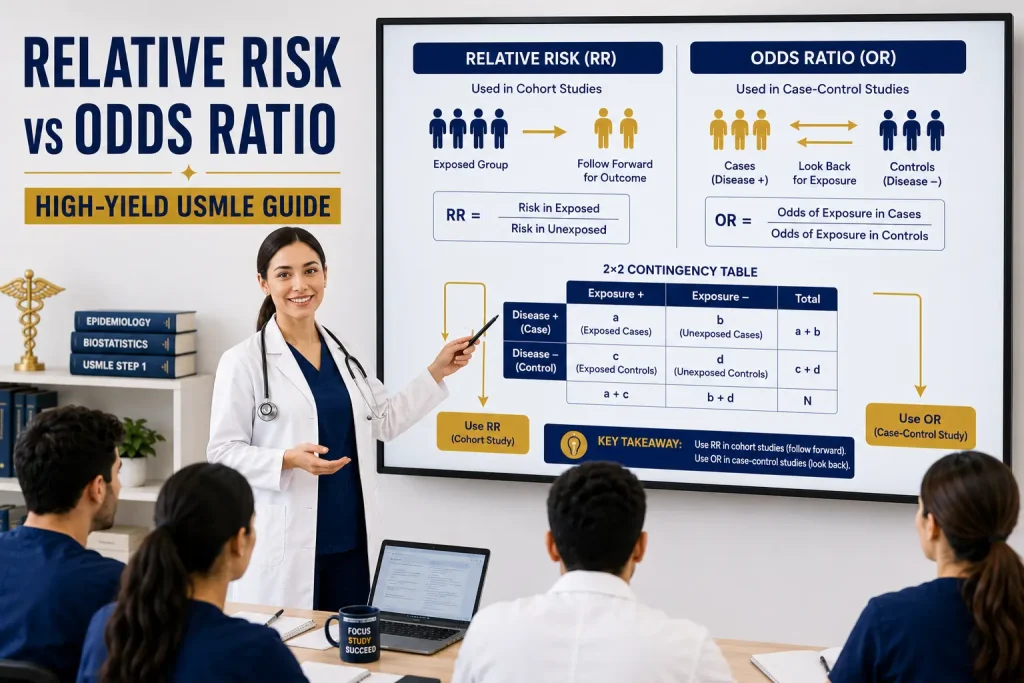

Relative Risk vs Odds Ratio for USMLE is a high-yield biostatistics topic because Step 1 often tests whether you can match each measure to the correct study design.
Once you identify the study design and understand what the question is asking, choosing the correct formula becomes much easier.
Free USMLE Training
Free USMLE Step 1 Bootcamp
Join our free USMLE masterclass where we break down high-yield concepts, NBME strategies, and clinical reasoning systems used by thousands of medical students and IMGs.
Reserve My SpotWhy Relative Risk and Odds Ratio Matter
Relative risk and odds ratio both measure association, but they are used in different study designs and interpreted differently.
Step 1 may ask you to calculate the value, choose the correct formula, interpret the result, or identify which measure is appropriate for the study.
- Relative risk is commonly used in cohort studies.
- Odds ratio is commonly used in case-control studies.
- Relative risk compares disease risk between exposed and unexposed groups.
- Odds ratio compares odds, not direct probability.
- Both can show whether an exposure is associated with increased or decreased disease.
The Big Rule
If the study starts with exposure and follows people forward to disease, think relative risk. If the study starts with disease status and looks backward for exposure, think odds ratio.
Simple Definitions
Here is the simplest way to understand the difference.
| Term | Simple Meaning | USMLE Memory Hook |
|---|---|---|
| Relative Risk | Compares the risk of disease in exposed people to the risk of disease in unexposed people. | Risk needs incidence, so think cohort study. |
| Odds Ratio | Compares odds between groups, often the odds of exposure among cases vs controls. | Odds ratio is the classic measure for case-control studies. |
| Risk | Probability that an event happens. | Disease / total people in that group. |
| Odds | Probability that an event happens divided by probability that it does not happen. | Event / no event. |
Simple Shortcut
Relative risk is about probability. Odds ratio is about odds.
The SmashUSMLE Relative Risk vs Odds Ratio Framework
Use this framework whenever a USMLE question asks about relative risk, odds ratio, or study design.
| Step | Question to Ask | Why It Matters |
|---|---|---|
| Step 1 | Does the study start with exposure or disease? | Starting point usually reveals the study design. |
| Step 2 | Can incidence be calculated? | If incidence can be calculated, relative risk may be appropriate. |
| Step 3 | Is this a cohort or case-control study? | Cohort usually uses relative risk. Case-control usually uses odds ratio. |
| Step 4 | Is the result above, below, or equal to 1? | This tells you whether exposure increases, decreases, or has no association with disease. |
| Step 5 | Is the confidence interval crossing 1? | If the confidence interval crosses 1, the association is not statistically significant. |
High-Yield Formulas
For USMLE, use the classic 2 by 2 table.
| Disease | No Disease | |
|---|---|---|
| Exposed | A | B |
| Unexposed | C | D |
| Measurement | Formula | Meaning |
|---|---|---|
| Relative Risk | [A / A + B] / [C / C + D] | Risk of disease in exposed group divided by risk of disease in unexposed group. |
| Odds Ratio | AD / BC | Odds of exposure or disease compared between groups. |
| Attributable Risk | [A / A + B] - [C / C + D] | Excess risk in exposed group due to exposure. |
Formula Rule
Relative risk uses division of risks. Odds ratio uses cross multiplication.
Cohort vs Case-Control Studies
Study design is the fastest way to decide whether the answer should be relative risk or odds ratio.
| Study Design | Starts With | Looks For | Common Measure |
|---|---|---|---|
| Cohort Study | Exposure status | Future disease outcome | Relative risk |
| Case-Control Study | Disease status | Prior exposure | Odds ratio |
| Randomized Controlled Trial | Assigned exposure or intervention | Outcome | Relative risk can be calculated |
| Cross-Sectional Study | Exposure and disease measured at one point in time | Prevalence | Prevalence ratio or association measures |
Study Design Rule
Cohort studies can measure incidence, so they can calculate relative risk. Case-control studies usually cannot measure incidence, so they use odds ratio.
How to Interpret Relative Risk and Odds Ratio
Relative risk and odds ratio are both interpreted around the number 1.
| Value | Interpretation | Example Meaning |
|---|---|---|
| RR or OR = 1 | No association | Exposure does not change disease risk or odds. |
| RR or OR greater than 1 | Positive association | Exposure is associated with increased disease risk or odds. |
| RR or OR less than 1 | Negative association | Exposure may be protective or associated with lower disease risk or odds. |
| Confidence interval includes 1 | Not statistically significant | The result may be due to chance. |
| Confidence interval does not include 1 | Statistically significant | The association is less likely due to chance. |
On Step 1, always check whether the confidence interval crosses 1 before calling the result significant.
Classic USMLE Question Patterns
USMLE questions often test relative risk and odds ratio using predictable wording.
| Question Pattern | Correct Thinking | Answer Direction |
|---|---|---|
| Researchers follow smokers and nonsmokers for 10 years to see who develops lung cancer. | Starts with exposure and follows for disease. | Cohort study, relative risk. |
| Researchers compare patients with pancreatic cancer to controls and ask about prior smoking history. | Starts with disease status and looks back for exposure. | Case-control study, odds ratio. |
| A trial assigns patients to a new drug or placebo and compares stroke rates. | Intervention assigned and outcomes measured. | Relative risk can be calculated. |
| OR is 2.5 with 95% CI 1.4 to 4.1. | Odds are increased and CI does not include 1. | Statistically significant positive association. |
| RR is 0.6 with 95% CI 0.3 to 1.2. | Point estimate suggests protection, but CI crosses 1. | Not statistically significant. |
Common Mistakes
1. Using Relative Risk for a Case-Control Study
Case-control studies start with disease status and usually cannot directly calculate incidence, so odds ratio is the classic measure.
2. Forgetting That Relative Risk Requires Risk
To calculate risk, you need to know how many people developed disease out of the total exposed or unexposed group.
3. Misinterpreting Values Less Than 1
A relative risk or odds ratio less than 1 suggests a negative association or protective effect, not increased risk.
4. Ignoring Confidence Intervals
If the confidence interval crosses 1, the result is not statistically significant.
5. Confusing Odds With Probability
Risk is probability. Odds compare event to no event. This difference becomes important when choosing the right formula.
Need Help Mastering Biostatistics for Step 1?
If relative risk, odds ratio, confidence intervals, and study designs feel confusing, you do not need to memorize harder. You need a simple framework that tells you what the question is really testing.
SmashUSMLE Reviews helps students use high-yield biostatistics, NBME analysis, QBank practice, and one-on-one tutoring to master difficult Step 1 topics.
FAQ: Relative Risk vs Odds Ratio for USMLE
What is relative risk in simple terms?
Relative risk compares the risk of disease in exposed people to the risk of disease in unexposed people.
What is odds ratio in simple terms?
Odds ratio compares odds between groups and is most commonly used in case-control studies.
When do I use relative risk on USMLE?
Use relative risk when the study can measure incidence, especially in cohort studies and randomized controlled trials.
When do I use odds ratio on USMLE?
Use odds ratio when the study is case-control, meaning it starts with disease status and looks backward for exposure.
What does RR or OR greater than 1 mean?
A value greater than 1 means the exposure is associated with increased disease risk or odds.
What does it mean if the confidence interval crosses 1?
If the confidence interval crosses 1, the association is not statistically significant.
Student Success Story
⭐ 4.8 Google Rating | 120+ ReviewsSee How SmashUSMLE Students Improve Their Scores
Learn how structured clinical reasoning, NBME-focused review, and disciplined preparation can help IMGs break through score plateaus.
Want to learn the same clinical reasoning system used by SmashUSMLE students?
Join Free Bootcamp