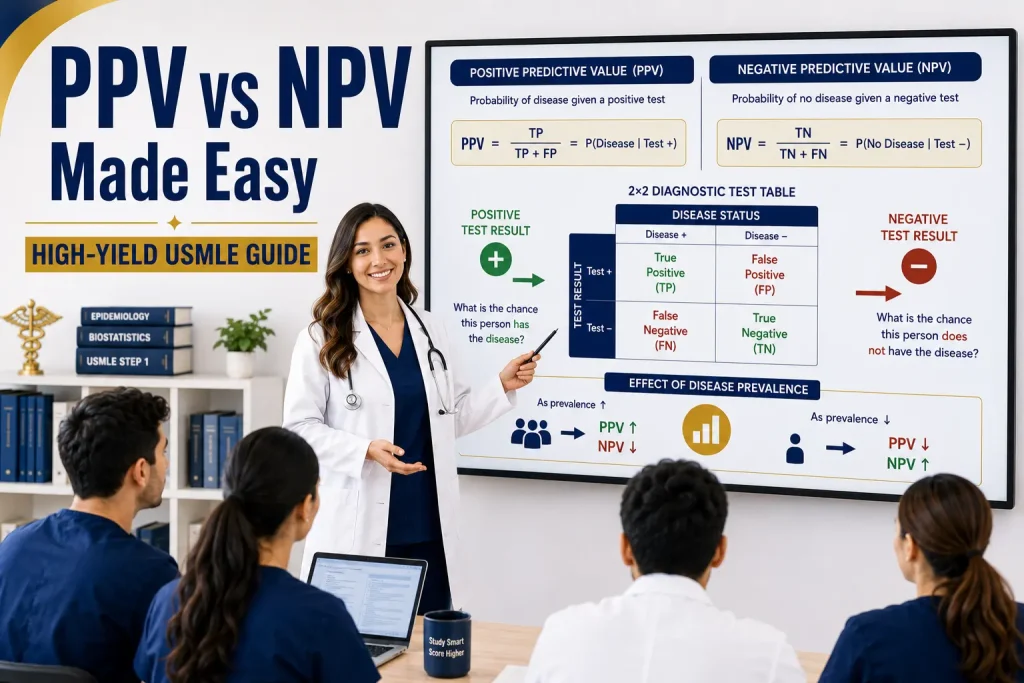

PPV vs NPV high-yield review is essential for USMLE Step 1 because predictive value questions test whether you understand what a positive or negative test result actually means for a patient.
Many students memorize sensitivity and specificity but get confused when the question asks about positive predictive value or negative predictive value.
The key difference is simple. PPV and NPV depend heavily on disease prevalence.
This guide will show you how to recognize PPV and NPV questions, use the formulas correctly, understand prevalence effects, avoid distractors, and answer biostatistics questions faster.
Free USMLE Training
Free USMLE Step 1 Bootcamp
Join our free USMLE masterclass where we break down high-yield concepts, NBME strategies, and clinical reasoning systems used by thousands of medical students and IMGs.
Reserve My SpotWhy PPV vs NPV Matters on Step 1
PPV and NPV questions test your ability to interpret test results in real clinical situations.
Step 1 may give you a screening test, diagnostic test, disease prevalence, sensitivity, specificity, or a 2x2 table and ask what a positive or negative result means.
- PPV tells you how likely disease is after a positive test.
- NPV tells you how likely no disease is after a negative test.
- PPV increases when disease prevalence increases.
- NPV increases when disease prevalence decreases.
- Predictive values change when the population changes.
The Big Rule
PPV and NPV are patient-centered test interpretations. They tell you what the test result means after the patient has already tested positive or negative.
The SmashUSMLE PPV vs NPV Framework
Use the same approach every time you see a predictive value question.
| Step | Question to Ask | Why It Matters |
|---|---|---|
| Step 1 | Is the test result positive or negative? | A positive result points toward PPV. A negative result points toward NPV. |
| Step 2 | Is the question asking about disease or no disease? | PPV asks disease after positive test. NPV asks no disease after negative test. |
| Step 3 | Is prevalence changing? | Prevalence strongly affects PPV and NPV. |
| Step 4 | Do I need the formula or the concept? | Some questions require calculation. Others only test directionality. |
| Step 5 | Can I identify true positives, false positives, true negatives, and false negatives? | This prevents formula mistakes in 2x2 tables. |
How to Understand Positive Predictive Value
Positive predictive value answers this question:
PPV Meaning
If the test is positive, what is the probability that the patient truly has the disease?
The formula is:
PPV Formula
PPV = True Positives / All Positive Tests
PPV = TP / (TP + FP)
PPV becomes more useful when disease prevalence is high because a positive test is more likely to represent true disease.
How to Understand Negative Predictive Value
Negative predictive value answers this question:
NPV Meaning
If the test is negative, what is the probability that the patient truly does not have the disease?
The formula is:
NPV Formula
NPV = True Negatives / All Negative Tests
NPV = TN / (TN + FN)
NPV becomes more useful when disease prevalence is low because a negative test is more likely to represent true absence of disease.
PPV vs NPV Comparison Table
Learn this table cold. It is the foundation for most predictive value questions.
| Feature | PPV | NPV |
|---|---|---|
| Full Name | Positive predictive value | Negative predictive value |
| Test Result | Positive test | Negative test |
| Question Asked | What is the chance the patient truly has disease? | What is the chance the patient truly does not have disease? |
| Formula | TP / (TP + FP) | TN / (TN + FN) |
| Prevalence Effect | Increases as prevalence increases | Increases as prevalence decreases |
| High-Yield Clue | Positive result, asks whether disease is truly present | Negative result, asks whether disease is truly absent |
How Prevalence Affects PPV and NPV
Prevalence is the key concept that separates PPV and NPV from sensitivity and specificity.
Sensitivity and specificity are usually treated as fixed characteristics of the test. PPV and NPV change depending on how common the disease is in the population being tested.
| Prevalence Change | Effect on PPV | Effect on NPV |
|---|---|---|
| Disease prevalence increases | PPV increases | NPV decreases |
| Disease prevalence decreases | PPV decreases | NPV increases |
Prevalence Rule
High prevalence makes positive results more believable. Low prevalence makes negative results more believable.
How to Use a 2x2 Table for PPV and NPV
Most calculation questions can be solved quickly if you label the 2x2 table correctly.
| Disease Present | Disease Absent | |
|---|---|---|
| Test Positive | True Positive | False Positive |
| Test Negative | False Negative | True Negative |
For PPV, stay in the positive test row.
For NPV, stay in the negative test row.
2x2 Table Shortcut
PPV uses the positive row. NPV uses the negative row.
Classic PPV vs NPV Patterns on Step 1
Step 1 often tests predictive values through population changes and screening scenarios.
| Clinical Scenario | Likely Concept | Reasoning |
|---|---|---|
| A test is used in a high-risk population where disease is common | PPV increases | Positive results are more likely to be true positives. |
| A test is used in a low-risk population where disease is rare | NPV increases | Negative results are more likely to be true negatives. |
| Screening expands to the general population | PPV decreases | Lower prevalence creates more false positives relative to true positives. |
| Testing is limited to patients with classic symptoms | PPV increases | Higher pretest probability increases the chance that a positive test is true. |
| Disease prevalence falls after vaccination or prevention | NPV increases, PPV decreases | Negative results become more reliable, while positive results are less likely to represent true disease. |
Common PPV vs NPV Mistakes
1. Confusing PPV With Sensitivity
Sensitivity starts with people who have disease and asks how many test positive. PPV starts with positive tests and asks how many truly have disease.
2. Confusing NPV With Specificity
Specificity starts with people who do not have disease and asks how many test negative. NPV starts with negative tests and asks how many truly do not have disease.
3. Forgetting Prevalence
PPV and NPV change when prevalence changes. This is one of the most tested concepts.
4. Using the Wrong Row in the 2x2 Table
PPV uses all positive tests. NPV uses all negative tests.
5. Thinking a Positive Test Always Means Disease
A positive test is more convincing when prevalence is high. In low-prevalence populations, false positives become more important.
Student Success Story
⭐ 4.8 Google Rating | 120+ ReviewsSee How SmashUSMLE Students Improve Their Scores
Learn how structured clinical reasoning, NBME-focused review, and disciplined preparation can help IMGs break through score plateaus.
Want to learn the same clinical reasoning system used by SmashUSMLE students?
Join Free BootcampNeed Help Mastering Biostatistics for Step 1?
If PPV, NPV, sensitivity, specificity, likelihood ratios, and 2x2 tables feel confusing, you do not need to memorize harder. You need a clear system for interpreting what each number means.
SmashUSMLE Reviews helps students use high-yield biostatistics, clinical reasoning, NBME analysis, QBank practice, and one-on-one tutoring to master difficult Step 1 topics.
FAQ: PPV vs NPV High-Yield Review
What is positive predictive value?
Positive predictive value is the probability that a patient truly has the disease given that the test result is positive.
What is negative predictive value?
Negative predictive value is the probability that a patient truly does not have the disease given that the test result is negative.
What is the formula for PPV?
PPV = TP / (TP + FP), meaning true positives divided by all positive test results.
What is the formula for NPV?
NPV = TN / (TN + FN), meaning true negatives divided by all negative test results.
How does prevalence affect PPV and NPV?
As prevalence increases, PPV increases and NPV decreases. As prevalence decreases, PPV decreases and NPV increases.
How can SmashUSMLE help with biostatistics?
SmashUSMLE Reviews helps students break down biostatistics questions using simple formulas, clinical reasoning, QBank practice, NBME weak-area analysis, and tutoring support.