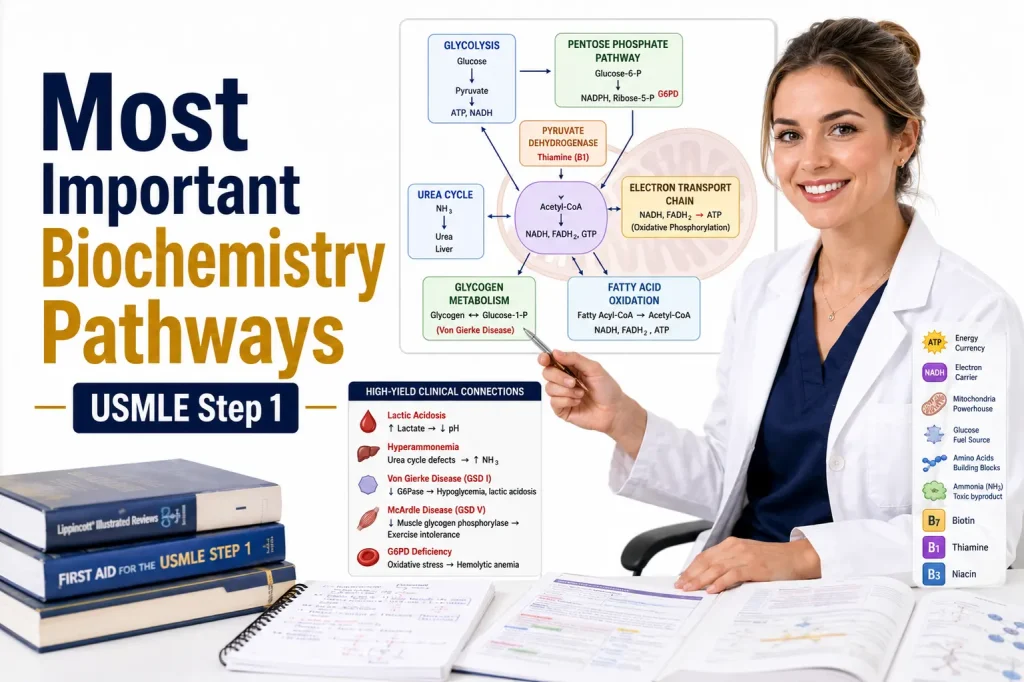

Biochemistry Pathways are one of the highest-yield areas for USMLE Step 1. If you understand where each pathway breaks, what builds up, and what the patient looks like, biochemistry becomes much easier to answer in clinical vignettes.
Many students struggle with biochemistry because they try to memorize every enzyme equally. However, Step 1 does not test every enzyme equally. Instead, the exam focuses on pathways that explain disease, lab abnormalities, inheritance patterns, vitamin deficiencies, and metabolic emergencies.
Therefore, your goal is not to become a biochemistry professor. Your goal is to recognize testable patterns. Once you learn these pathways clinically, Step 1 questions become much more predictable.
Free USMLE Training
Free USMLE Step 1 Bootcamp
Join our free USMLE masterclass where we break down high-yield concepts, NBME strategies, and clinical reasoning systems used by thousands of medical students and IMGs.
Reserve My SpotWhy Biochemistry Pathways Matter for Step 1
Biochemistry questions on Step 1 rarely ask you to draw a full pathway from memory. Instead, they usually give you a clinical vignette. Then they expect you to identify the enzyme defect, accumulated metabolite, missing product, vitamin cofactor, or metabolic consequence.
As a result, you should study each pathway as a disease map, not just a biochemical chart. For every pathway, ask three questions: What is the rate-limiting enzyme? What happens when it is deficient? What clinical presentation does it create?
The Big Rule
Do not study biochemistry as isolated arrows. Study it as clinical disease patterns that explain symptoms, labs, and Step 1 answer choices.
1. Glycolysis
Glycolysis is one of the most important biochemistry pathways for Step 1 because it explains how cells make ATP from glucose. It is especially important in red blood cells, which do not have mitochondria and depend completely on glycolysis for energy.
High-Yield Glycolysis Concepts
- Rate-limiting enzyme: Phosphofructokinase-1
- Key activator: AMP and fructose-2,6-bisphosphate
- Key inhibitor: ATP and citrate
- Important disease: Pyruvate kinase deficiency
Pyruvate kinase deficiency causes decreased ATP production in red blood cells. Consequently, RBC membranes become unstable, leading to chronic hemolytic anemia. On exams, look for jaundice, anemia, splenomegaly, and echinocytes.
2. TCA Cycle
The TCA cycle connects carbohydrate, fat, and amino acid metabolism. It also produces NADH and FADH2, which feed into the electron transport chain.
What Step 1 Wants You to Know
The TCA cycle happens in the mitochondrial matrix. Therefore, diseases or toxins that affect mitochondria can disrupt energy production. In addition, several B vitamins serve as cofactors for enzymes connected to the TCA cycle.
- Thiamine: Needed for pyruvate dehydrogenase and alpha-ketoglutarate dehydrogenase
- Niacin: Needed to make NAD+
- Riboflavin: Needed to make FAD
- Pantothenic acid: Needed for CoA
Because of this, vitamin deficiencies often show up as energy failure. For example, thiamine deficiency can cause lactic acidosis because pyruvate cannot efficiently enter the TCA cycle.
3. Electron Transport Chain
The electron transport chain is where most ATP is produced. It is located in the inner mitochondrial membrane and depends on oxygen as the final electron acceptor.
Classic ETC Inhibitors
- Complex I: Rotenone
- Complex III: Antimycin A
- Complex IV: Cyanide and carbon monoxide
- ATP synthase: Oligomycin
- Uncouplers: Aspirin overdose and 2,4-DNP
Cyanide poisoning is especially high yield. It blocks complex IV, preventing oxygen use. As a result, cells shift to anaerobic metabolism, causing severe lactic acidosis.
Step 1 Clue
If oxygen is present but cells cannot use it, think about cyanide poisoning and complex IV inhibition.
4. Pentose Phosphate Pathway
The pentose phosphate pathway is heavily tested because it produces NADPH. NADPH helps regenerate reduced glutathione, which protects red blood cells from oxidative damage.
G6PD Deficiency
The most important disease in this pathway is G6PD deficiency. Patients are vulnerable to oxidative stress after infections, fava beans, sulfa drugs, dapsone, primaquine, or nitrofurantoin.
On Step 1, look for episodic hemolytic anemia, jaundice, dark urine, bite cells, and Heinz bodies. This is one of the most testable biochemistry disorders because it connects metabolism, hematology, and pharmacology.
5. Urea Cycle
The urea cycle removes toxic ammonia by converting it into urea. This pathway is especially important in newborns and children with vomiting, lethargy, seizures, or unexplained neurologic symptoms.
Ornithine Transcarbamylase Deficiency
Ornithine transcarbamylase deficiency is the most common urea cycle disorder. It is X-linked and causes hyperammonemia with increased orotic acid.
The key distinction is that OTC deficiency causes increased orotic acid without megaloblastic anemia. In contrast, orotic aciduria causes increased orotic acid with megaloblastic anemia that does not improve with vitamin B12 or folate.
6. Glycogen Metabolism
Glycogen storage diseases are Step 1 favorites because each disease has a clear enzyme defect and clinical pattern. The highest-yield ones are Von Gierke disease, Pompe disease, Cori disease, McArdle disease, and Hers disease.
High-Yield Glycogen Storage Diseases
| Disease | Enzyme Defect | Classic Clue |
|---|---|---|
| Von Gierke disease | Glucose-6-phosphatase | Severe fasting hypoglycemia, lactic acidosis, hyperuricemia |
| Pompe disease | Lysosomal alpha-1,4-glucosidase | Cardiomegaly, hypotonia, hypertrophic cardiomyopathy |
| McArdle disease | Muscle glycogen phosphorylase | Exercise intolerance, cramps, myoglobinuria |
| Cori disease | Debranching enzyme | Milder Von Gierke-like presentation |
A helpful Step 1 strategy is to connect the organ to the symptom. Liver glycogen problems cause fasting hypoglycemia. Muscle glycogen problems cause exercise intolerance. Lysosomal glycogen problems can cause cardiomyopathy.
7. Fatty Acid Oxidation
Fatty acid oxidation becomes important during fasting. When glucose is low, the body uses fatty acids to make acetyl-CoA, NADH, and FADH2. The liver can then use acetyl-CoA to make ketone bodies.
MCAD Deficiency
Medium-chain acyl-CoA dehydrogenase deficiency is the classic Step 1 fatty acid oxidation disorder. Patients develop hypoketotic hypoglycemia during fasting or illness.
The key clue is low glucose with low ketones. This happens because the patient cannot break down fatty acids properly, so they cannot make enough ketone bodies during fasting.
8. Amino Acid Metabolism
Amino acid metabolism is high yield because many disorders present in infancy or childhood with neurologic symptoms, developmental delay, unusual odors, or dietary restrictions.
Classic Amino Acid Disorders
- Phenylketonuria: Phenylalanine hydroxylase deficiency or tetrahydrobiopterin deficiency
- Maple syrup urine disease: Branched-chain alpha-ketoacid dehydrogenase deficiency
- Homocystinuria: Cystathionine beta-synthase deficiency
- Alkaptonuria: Homogentisate oxidase deficiency
For Step 1, do not just memorize the enzyme. Also learn the presentation. For example, homocystinuria can look like Marfan syndrome, but it also causes thrombosis and downward lens dislocation.
9. Heme Synthesis
Heme synthesis is important because it connects biochemistry with anemia, toxicology, and neurologic symptoms. The two highest-yield topics are lead poisoning and acute intermittent porphyria.
Lead Poisoning
Lead inhibits ALA dehydratase and ferrochelatase. As a result, patients can develop abdominal pain, neurocognitive symptoms, peripheral neuropathy, and microcytic anemia with basophilic stippling.
Acute Intermittent Porphyria
Acute intermittent porphyria is caused by porphobilinogen deaminase deficiency. It presents with abdominal pain, psychiatric symptoms, peripheral neuropathy, and dark urine.
10. Vitamin Cofactors
Vitamin cofactors are one of the easiest ways Step 1 tests biochemistry. Instead of asking for the pathway directly, the exam may ask which vitamin is required for a specific enzyme reaction.
Must-Know Vitamin Associations
| Vitamin | High-Yield Role | Clinical Association |
|---|---|---|
| Thiamine B1 | Oxidative decarboxylation | Wernicke-Korsakoff, beriberi, lactic acidosis |
| Riboflavin B2 | FAD reactions | Cheilosis, corneal vascularization |
| Niacin B3 | NAD reactions | Pellagra: diarrhea, dermatitis, dementia |
| Biotin B7 | Carboxylation reactions | Deficiency after raw egg whites or antibiotics |
| Folate B9 | DNA synthesis | Megaloblastic anemia, neural tube defects |
| Cobalamin B12 | Myelin and DNA synthesis | Megaloblastic anemia, neurologic deficits |
High-Yield Step 1 Resource
SmashUSMLE High Yield Step 1 Book
If you need a focused Step 1 review resource, use the SmashUSMLE High Yield Step 1 Book to organize the concepts, patterns, and clinical reasoning points that matter most for Step 1.
- Strengthen high-yield Step 1 foundations
- Review core systems more efficiently
- Connect concepts to NBME-style reasoning
- Use alongside SmashUSMLE, NBME review, and QBank practice

How to Review Biochemistry Pathways Fast
First, focus on diseases. Then learn the enzyme defect. After that, connect the accumulated substrate, missing product, inheritance pattern, and clinical presentation.
Also, use practice questions early. Biochemistry becomes clearer when you see how the pathway is tested in a vignette. Otherwise, it is easy to spend hours memorizing details that do not move your score.
Step 1 Takeaway
The highest-yield biochemistry pathways are glycolysis, TCA cycle, electron transport chain, pentose phosphate pathway, urea cycle, glycogen metabolism, fatty acid oxidation, amino acid metabolism, heme synthesis, and vitamin cofactors.
Student Success Story
⭐ 4.8 Google Rating | 120+ ReviewsStudent Testimonial
See how SmashUSMLE Reviews helps students use structured clinical reasoning, focused review, and consistent preparation to move forward with confidence.
Want to learn the same clinical reasoning system used by SmashUSMLE students?
Join Free BootcampNeed Help Mastering Step 1 Biochemistry?
If biochemistry feels overwhelming, you are not alone. Most students do not need more random diagrams. They need a better system for connecting pathways to clinical vignettes.
SmashUSMLE Reviews helps students use structured lessons, QBank practice, NBME weak-area analysis, and one-on-one tutoring to master high-yield Step 1 topics faster.
FAQ: Most Important Biochemistry Pathways for Step 1
What are the most important biochemistry pathways for Step 1?
The most important pathways include glycolysis, TCA cycle, electron transport chain, pentose phosphate pathway, urea cycle, glycogen metabolism, fatty acid oxidation, amino acid metabolism, heme synthesis, and vitamin cofactors.
Do I need to memorize every enzyme in biochemistry?
No. Focus first on the enzymes that cause disease, create classic lab abnormalities, require vitamin cofactors, or explain common Step 1 clinical vignettes.
What is the best way to study biochemistry for Step 1?
Study each pathway as a clinical disease map. Learn the enzyme defect, accumulated substrate, missing product, inheritance pattern, and clinical presentation.
Why is G6PD deficiency so high yield?
G6PD deficiency connects the pentose phosphate pathway, NADPH, glutathione, oxidative stress, hemolytic anemia, pharmacology, and classic blood smear findings.
What biochemistry disorders are highest yield for Step 1?
High-yield disorders include G6PD deficiency, pyruvate kinase deficiency, MCAD deficiency, OTC deficiency, Von Gierke disease, Pompe disease, McArdle disease, PKU, maple syrup urine disease, homocystinuria, lead poisoning, and acute intermittent porphyria.
Ready to Improve Your USMLE Scores?
Step 1 preparation becomes easier when you stop studying randomly and start using a system. Join thousands of medical students and IMGs using SmashUSMLE’s clinical reasoning system to prepare for Step 1, Step 2 CK, and Step 3.