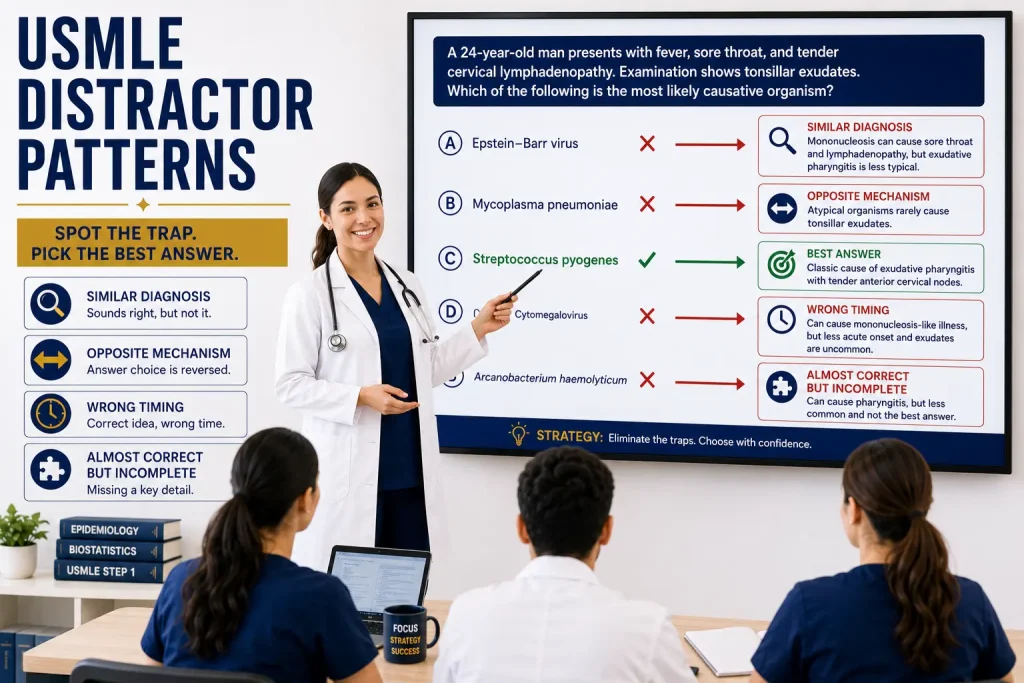

The most common USMLE distractor patterns are answer choices that look familiar, sound high-yield, or partially match the vignette but fail to explain the entire clinical picture.
Many students lose points not because they know nothing, but because they choose an answer that is close instead of correct.
USMLE distractors are designed to test whether you can separate similar diagnoses, mechanisms, drugs, organisms, labs, and management steps.
The best students do not just ask, “Could this answer be true?” They ask, “Does this answer fully explain the question stem better than every other option?”
This guide will show you the most common USMLE distractor patterns, how they appear in Step 1 vignettes, and how to avoid them during NBME and QBank review.
Free USMLE Training
Free USMLE Step 1 Bootcamp
Join our free USMLE masterclass where we break down high-yield concepts, NBME strategies, and clinical reasoning systems used by thousands of medical students and IMGs.
Reserve My SpotWhy Distractor Patterns Matter on USMLE
USMLE questions are not written to test whether one answer sounds familiar. They are written to test whether you can select the best answer after eliminating tempting alternatives.
Distractor pattern recognition helps you:
- Avoid answer choices that only partially fit the vignette.
- Separate similar diseases from each other.
- Recognize when the question is asking for mechanism, not diagnosis.
- Stop overreacting to single buzzwords.
- Improve your NBME review and QBank accuracy.
- Build stronger clinical reasoning under time pressure.
The Big Rule
A distractor usually has something true inside it. Your job is to find why it does not fully answer this specific question.
The SmashUSMLE Distractor Framework
When you are stuck between two answers, use a structured elimination system.
| Question to Ask | Why It Matters | What It Helps You Avoid |
|---|---|---|
| Does this answer explain the entire vignette? | The correct answer should fit the full clinical picture. | Partial-match distractors. |
| Is the question asking diagnosis, mechanism, treatment, or next step? | Many wrong answers are correct facts answering the wrong question. | Wrong-task distractors. |
| Does the timeline fit? | Acute, chronic, recurrent, and postinfectious patterns matter. | Wrong-timeline distractors. |
| Does the lab pattern support it? | Labs often separate similar diseases. | Similar-diagnosis distractors. |
| What clue made me consider this answer? | This reveals whether you are reacting to one word or the whole pattern. | Buzzword traps. |
Similar Diagnosis Distractors
Similar diagnosis distractors are among the most common USMLE traps. These answer choices look close because they share symptoms with the correct diagnosis.
The exam wants to know whether you can identify the feature that separates them.
| Common Trap | How to Separate Them | High-Yield Clue |
|---|---|---|
| Crohn disease vs ulcerative colitis | Crohn is transmural and can affect any part of the GI tract. UC is continuous and limited to colon. | Skip lesions, fistulas, granulomas point to Crohn. |
| Iron deficiency anemia vs anemia of chronic disease | Iron deficiency has low ferritin and high TIBC. Chronic disease has normal or high ferritin and low TIBC. | Ferritin and TIBC separate the diagnosis. |
| Nephritic syndrome vs nephrotic syndrome | Nephritic has hematuria and RBC casts. Nephrotic has heavy proteinuria and edema. | RBC casts point to nephritic disease. |
| Hyperthyroidism vs pheochromocytoma | Both can cause palpitations and sweating, but pheochromocytoma is episodic with catecholamine surges. | Paroxysmal headache, sweating, tachycardia, hypertension. |
| Meningitis vs encephalitis | Meningitis emphasizes fever, neck stiffness, photophobia. Encephalitis emphasizes altered mental status and seizures. | Behavior change or seizures point toward encephalitis. |
Step 1 Tip
When two diagnoses look similar, find the one clue that separates them. That clue is usually why the question was written.
Wrong Mechanism Distractors
Step 1 often gives you the diagnosis in the vignette but asks for the mechanism. This is where many students fall into a distractor.
A wrong mechanism distractor may be related to the disease category but not the specific mechanism being tested.
- Correct diagnosis, wrong pathophysiology: You recognized the disease but chose the wrong mechanism.
- Correct organ system, wrong process: The answer belongs to the same system but not the condition in the stem.
- Correct symptom, wrong cause: The symptom is real, but the mechanism does not explain it.
- Correct pathway, wrong step: You chose a nearby enzyme, receptor, cytokine, or hormone instead of the one being tested.
Mechanism Rule
If the last line asks for mechanism, do not stop at the diagnosis. Translate the diagnosis into the specific physiologic or pathologic process being tested.
Partial Match Distractors
Partial match distractors are dangerous because they contain one true clue from the vignette.
The problem is that they do not explain the entire case.
| Distractor Pattern | Why It Feels Tempting | How to Beat It |
|---|---|---|
| Answer matches one symptom only | You recognize one familiar symptom and jump too fast. | Check whether it explains the full symptom cluster. |
| Answer matches one lab value only | One abnormal value points you toward it. | Interpret the entire lab pattern, not one number. |
| Answer matches one risk factor only | The history seems familiar. | Confirm that the presentation and timeline also fit. |
| Answer is true but incomplete | The fact is correct in general. | Choose the answer that best explains this patient. |
On USMLE, a true statement can still be the wrong answer.
Wrong Timeline Distractors
Timeline is a major clue on USMLE questions. Some distractors are wrong because they do not fit the timing of the disease.
| Timeline Clue | Likely Pattern | Distractor Trap |
|---|---|---|
| Sudden onset chest pain radiating to the back | Aortic dissection | Choosing a chronic cause of chest pain. |
| Progressive exertional dyspnea over months | Chronic cardiac or pulmonary disease | Choosing an acute embolic process without supporting clues. |
| Weakness after diarrheal illness | Guillain-Barré syndrome | Choosing a primary muscle disease. |
| Fever and murmur weeks after untreated strep throat | Rheumatic fever | Choosing acute bacterial endocarditis. |
| Symptoms minutes after allergen exposure | Anaphylaxis | Choosing a slower inflammatory or infectious cause. |
Timeline Rule
Before choosing an answer, ask whether the disease develops in the same timeframe described in the vignette.
Wrong Test or Next Step Distractors
Some USMLE distractors are not wrong because they are useless. They are wrong because they are not the best next step.
This is especially common on Step 2 CK and Step 3, but Step 1 can also test the same logic through diagnosis and mechanism questions.
- Definitive test too early: The answer may be useful later but not first.
- Treatment before stabilization: The patient needs airway, breathing, circulation, or emergency management first.
- Screening test vs confirmatory test: The question may ask what comes next after a screening result.
- Wrong population: The test may be correct for another age group or risk group.
- Wrong severity: Mild disease and severe disease may require different next steps.
Next Step Rule
The best next step depends on stability, disease severity, timing, and what information is already given.
Buzzword Trap Distractors
Buzzwords can help, but they can also hurt you when you stop thinking.
Modern USMLE-style questions often test classic diseases without using the classic phrase. They may also include a familiar phrase that points to a distractor.
Be careful when you see:
- A single buzzword that does not match the rest of the vignette.
- A classic phrase used in an unusual clinical context.
- A familiar symptom paired with labs that point elsewhere.
- A disease name you recognize but cannot justify with the full stem.
Buzzword Rule
Use buzzwords as clues, not as shortcuts. The correct answer still has to fit the full clinical pattern.
How to Review Distractors During QBank Practice
Most students review why the correct answer is correct. That is not enough.
To improve faster, you must also review why your chosen answer was wrong and why the other distractors were tempting.
After every missed question, ask:
- What made the wrong answer attractive?
- Which clue did I overvalue?
- Which clue did I ignore?
- Was this a similar diagnosis, wrong mechanism, partial match, or timeline trap?
- What rule would help me avoid this mistake next time?
QBank Rule
The fastest improvement often comes from studying your wrong answer pattern, not just reading the explanation.
Need Help Avoiding USMLE Distractors?
If you keep narrowing questions down to two answers and choosing the wrong one, you do not need to “study harder.” You need to diagnose your reasoning pattern.
SmashUSMLE Reviews helps students use clinical reasoning, NBME weak-area analysis, QBank review, and one-on-one tutoring to identify distractor traps and improve USMLE performance.
Common Distractor Mistakes
1. Choosing an Answer Because It Sounds Familiar
Familiar does not mean correct. The answer must fit the full vignette and the exact question being asked.
2. Ignoring the Last Line
The last line tells you the task. Diagnosis, mechanism, next step, risk factor, and adverse effect questions require different thinking.
3. Overvaluing One Clue
One clue can point you toward an answer, but the full clinical picture should confirm it.
4. Not Reviewing Wrong Answer Patterns
If you do not study why you chose the wrong answer, you will keep repeating the same mistake.
5. Rushing When Down to Two Choices
When you are stuck between two options, compare them against the strongest clues in the stem. Do not guess based on comfort.
Student Success Story
⭐ 4.8 Google Rating | 120+ ReviewsSee How SmashUSMLE Students Improve Their Scores
Learn how structured clinical reasoning, NBME-focused review, and disciplined preparation can help IMGs break through score plateaus.
Want to learn the same clinical reasoning system used by SmashUSMLE students?
Join Free BootcampFAQ: The Most Common USMLE Distractor Patterns
What are USMLE distractors?
USMLE distractors are tempting wrong answer choices designed to test whether you can separate similar diagnoses, mechanisms, labs, treatments, or clinical patterns.
Why do I keep choosing the wrong answer between two choices?
This usually happens when you overvalue one clue, ignore the full vignette, misunderstand the last line, or fail to compare both choices against the strongest evidence.
How do I avoid distractors on Step 1?
Read the last line carefully, identify what the question is asking, match the answer to the full clinical pattern, and review why every wrong answer is wrong.
Are buzzwords reliable on USMLE?
Buzzwords can be helpful, but they are not enough. The correct answer must fit the complete vignette, not just one familiar phrase.
How should I review wrong answers?
Identify why your chosen answer was tempting, what clue you missed, what clue you overvalued, and what rule would help you avoid the same mistake next time.
How can SmashUSMLE help with distractor patterns?
SmashUSMLE Reviews helps students break down question stems, recognize distractor traps, strengthen clinical reasoning, and improve NBME and QBank performance through structured courses and tutoring.