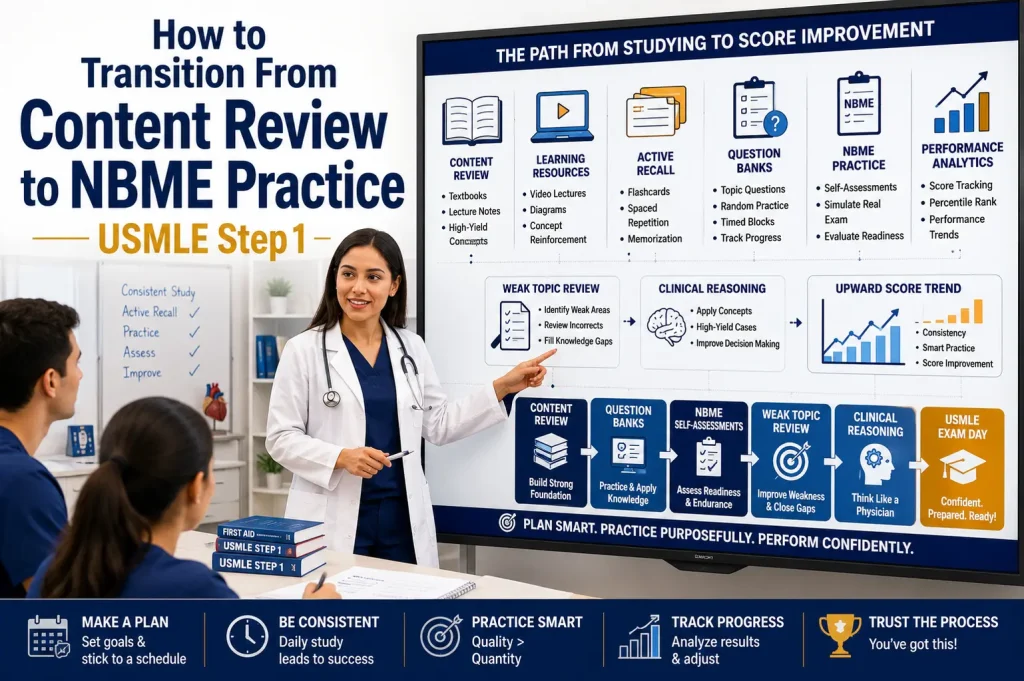

Learning how to transition from content review to NBME practice is one of the most important steps in Step 1 preparation.
Many students stay in content review too long because it feels safe. They keep watching videos, rereading notes, and reviewing flashcards, but they delay the one thing that actually proves readiness: NBME-style application.
Content review builds your foundation. NBME practice shows whether you can use that foundation under exam conditions.
Free USMLE Training
Free USMLE Step 1 Bootcamp
Learn how to move from content review into NBME practice, identify weak areas, and build the clinical reasoning system needed for Step 1.
Reserve My SpotWhy the Transition Matters
Content review alone does not prove Step 1 readiness. You may understand a topic while watching a video, but still miss it inside a long NBME-style vignette.
NBME practice forces you to:
- Recognize concepts inside clinical stems
- Apply mechanisms instead of only recalling facts
- Handle distractors
- Manage timing
- Identify weak systems honestly
- Build confidence under exam-like conditions
The Big Rule
You are not ready for Step 1 because you finished content. You are ready when you can apply content correctly.
Signs You Are Ready for NBME Practice
You do not need to know everything before starting NBME practice. Waiting for perfect confidence usually delays improvement.
| Readiness Sign | What It Means | Next Step |
|---|---|---|
| You finished one structured pass of major systems | You have enough foundation to test application | Start focused NBME-style questions. |
| You can explain high-yield mechanisms | You are moving beyond memorization | Practice applying mechanisms to vignettes. |
| Your QBank review has repeated patterns | You have identifiable weak areas | Use those patterns to guide NBME practice. |
| You feel stuck despite more content review | Passive review is no longer enough | Shift into application and assessment. |
Readiness Rule
Start NBME practice before you feel completely ready. The data will show you what to fix.
How to Start NBME Practice
Do not jump from passive review into random full-length practice without a plan. Start with a controlled transition.
- Begin with timed NBME-style question blocks
- Review missed questions by system and error type
- Use focused QBank blocks for weak areas
- Take a baseline NBME when you need objective data
- Use the NBME result to build your next 7 to 14 day plan
Transition Rule
Move from learning mode to testing mode gradually, then let your weak-area data guide the next phase.
Sample Weekly Transition Plan
This schedule helps you move from content review into NBME practice without abandoning content completely.
| Day | Main Task | Purpose |
|---|---|---|
| Day 1 | Timed mixed question block | Test application and timing. |
| Day 2 | Deep review of missed questions | Classify content, application, distractor, and timing errors. |
| Day 3 | Focused content repair | Rebuild the weakest topic from the block. |
| Day 4 | Focused QBank block | Apply the repaired weak area immediately. |
| Day 5 | Timed mixed block | Check whether the weak area is improving in mixed practice. |
| Day 6 | NBME-style review and notes | Write repeated patterns and distractor traps. |
| Day 7 | Rest, light review, or tutoring | Reset and adjust the next week’s plan. |
How to Review NBME-Style Questions
The review is where the transition becomes powerful. Do not simply check whether you got the question right.
For every missed or guessed question, ask:
- What was the tested concept?
- What clue did I miss?
- Was this a content gap or application gap?
- Why was my answer tempting but wrong?
- What pattern should I recognize next time?
Review Rule
NBME practice only improves your score if your review changes how you answer the next question.
Common Transition Mistakes
1. Waiting Until You Feel Perfectly Ready
You will never feel fully ready before NBME practice. Start when you have a foundation and use the data to improve.
2. Abandoning Content Review Completely
You still need content repair, but it should now be driven by missed questions and weak systems.
3. Taking an NBME Without Reviewing It Deeply
A practice exam without deep review is a wasted opportunity.
4. Doing Only Random Blocks
Random blocks build stamina, but focused blocks repair weak areas faster.
5. Ignoring Timing
Timed practice matters because Step 1 tests decision-making under pressure.
Student Success Story
⭐ 4.8 Google Rating | 120+ ReviewsSee How SmashUSMLE Students Improve Their Scores
Learn how structured clinical reasoning, NBME-focused review, and disciplined preparation can help students move from passive review to exam readiness.
Want to learn the same clinical reasoning system used by SmashUSMLE students?
Join Free BootcampNeed Help Moving Into NBME Practice?
If you are stuck in content review and unsure when to start NBME practice, you do not need more guessing. You need a clear transition plan.
SmashUSMLE Reviews helps students use content review, QBank practice, NBME analysis, clinical reasoning, and one-on-one tutoring to prepare smarter.
FAQ: How to Transition From Content Review to NBME Practice
When should I start NBME practice?
Start once you have completed one structured pass of major systems or when more passive content review is no longer improving your question performance.
Should I finish all content review before taking an NBME?
No. Waiting until everything feels perfect can delay progress. Use NBME practice to find what still needs repair.
Should I still do content review after starting NBME practice?
Yes, but your content review should be targeted to weak systems and missed concepts from questions.
What is the biggest mistake during this transition?
The biggest mistake is taking practice exams without using the results to build a focused weak-area repair plan.
Ready to Move From Content Review to NBME Readiness?
Step 1 preparation improves when you stop hiding in passive review and start using NBME-style data. SmashUSMLE can help you transition into practice, repair weak areas, and build stronger clinical reasoning.