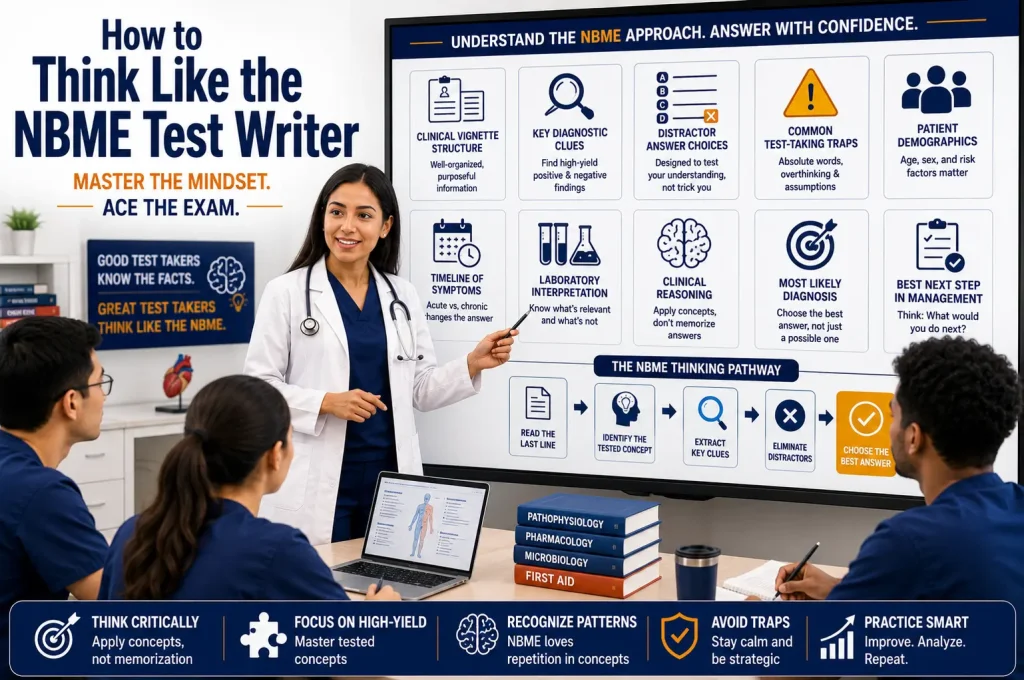

Learning how to think like the NBME test writer helps you stop reacting emotionally to hard questions and start seeing how the exam is constructed.
NBME questions are not random. They are built around a tested concept, a clinical setup, key clues, distractors, and one best answer. Once you understand that structure, Step 1 questions become less mysterious.
The goal is not to outsmart the exam. The goal is to understand what the question is really testing.
Free USMLE Training
Free USMLE Step 1 Bootcamp
Learn how to break down NBME-style questions, avoid distractors, and build the clinical reasoning system needed for Step 1.
Reserve My SpotHow NBME Test Writers Think
NBME test writers usually start with a concept they want to test. Then they build a clinical scenario that forces you to apply that concept instead of simply recognizing a memorized fact.
- They choose one high-yield concept
- They create a clinical vignette around it
- They include clues that point to the diagnosis or mechanism
- They add distractors that sound familiar but do not fully fit
- They make one answer the best answer, not just a possible answer
The Big Rule
NBME questions are designed to test reasoning, not just recognition.
How NBME Question Stems Are Built
Most NBME question stems contain a predictable structure. When you learn that structure, you can read faster and with more purpose.
| Stem Part | What It Does | How to Use It |
|---|---|---|
| Patient Age and Sex | Frames the likely diagnosis or risk factor | Ask what conditions fit this patient type. |
| Chief Complaint | Defines the clinical problem | Identify the main issue before reading details. |
| Timeline | Separates acute, subacute, and chronic disease | Use timing to narrow the differential. |
| Physical Exam | Provides confirmatory clues | Look for findings that point to one mechanism. |
| Labs or Imaging | Locks in the tested concept | Connect abnormalities to pathophysiology. |
| Last Line | Reveals what the question is actually asking | Always read it carefully before answering. |
How to Find the Key Clues
Not every detail in the stem matters equally. NBME writers include important clues, neutral details, and distractor details.
Key clues usually answer one of these questions:
- What is the diagnosis?
- What mechanism explains the presentation?
- What risk factor matters most?
- What complication is being tested?
- What is the next best step?
Clue Rule
The best clue is the detail that changes your answer.
Why Distractors Feel Tempting
Distractors are wrong answers designed to attract students who recognize a word but miss the deeper concept.
| Distractor Type | How It Tricks You | How to Avoid It |
|---|---|---|
| Familiar Fact | Sounds like something you memorized | Ask if it fits the entire vignette. |
| Wrong Disease | Fits one symptom but not the full case | Match all major clues, not one clue. |
| Wrong Mechanism | Diagnosis is right, but mechanism is wrong | Read the last line carefully. |
| Overly Aggressive Answer | Feels decisive but is not appropriate | Choose the safest next step for the patient. |
| True but Irrelevant | The statement is true but does not answer the question | Answer the exact question asked. |
How to Read Answer Choices Like a Test Writer
The answer choices tell you what the NBME is really comparing. Do not read them passively.
- If answers are mechanisms, identify the pathophysiology
- If answers are diagnoses, summarize the case first
- If answers are drugs, identify the mechanism or adverse effect
- If answers are next steps, assess stability and urgency
- If answers are lab findings, connect the disease to the expected abnormality
Answer Choice Rule
The answer choices reveal the category of thinking the NBME wants from you.
The SmashUSMLE Test Writer Strategy
Use this simple system when reviewing NBME-style questions.
| Step | Question to Ask | Purpose |
|---|---|---|
| Step 1 | What is the last line asking? | Identify the task. |
| Step 2 | What is the one-sentence summary? | Find the core diagnosis or concept. |
| Step 3 | What clue changes the answer? | Separate key information from noise. |
| Step 4 | Why are the distractors wrong? | Prevent repeated mistakes. |
| Step 5 | What pattern should I recognize next time? | Turn the miss into future points. |
Common Mistakes Students Make
1. Reading the Stem Without a Goal
Passive reading causes students to drown in details. Read to identify the tested concept.
2. Picking Familiar Answers Too Quickly
Familiar does not mean correct. The answer must fit the entire vignette and the last line.
3. Ignoring the Last Line
Many students identify the diagnosis but answer the wrong question because they miss what the last line asks.
4. Not Reviewing Distractors
If you do not understand why the wrong answers were tempting, you may fall for them again.
5. Memorizing Without Mechanisms
Step 1 rewards mechanism-based thinking. Memorization alone breaks down on harder NBME questions.
Student Success Story
⭐ 4.8 Google Rating | 120+ ReviewsSee How SmashUSMLE Students Improve Their Scores
Learn how structured clinical reasoning, NBME-focused review, and disciplined preparation can help students answer questions with more confidence.
Want to learn the same clinical reasoning system used by SmashUSMLE students?
Join Free BootcampNeed Help Thinking Like the NBME?
If you keep missing questions even after reviewing the content, your issue may be reasoning, distractors, or question interpretation.
SmashUSMLE Reviews helps students use NBME data, QBank practice, clinical reasoning, and one-on-one tutoring to improve faster.
FAQ: How to Think Like the NBME Test Writer
How do NBME test writers create questions?
They usually start with a tested concept, build a clinical vignette around it, add key clues, include tempting distractors, and make one answer the best answer.
Why do NBME distractors feel so tempting?
Distractors often contain familiar facts or partially correct ideas, but they do not fully answer the question being asked.
What should I read first in an NBME question?
Many students improve by reading the last line carefully, then reading the stem with a clear goal.
How can I get better at NBME-style reasoning?
Review missed questions by identifying the tested concept, key clue, wrong-answer trap, and pattern you should recognize next time.
Ready to Think Through NBME Questions Better?
Step 1 preparation becomes easier when you stop guessing and start understanding how NBME questions are built. SmashUSMLE can help you build that reasoning system.