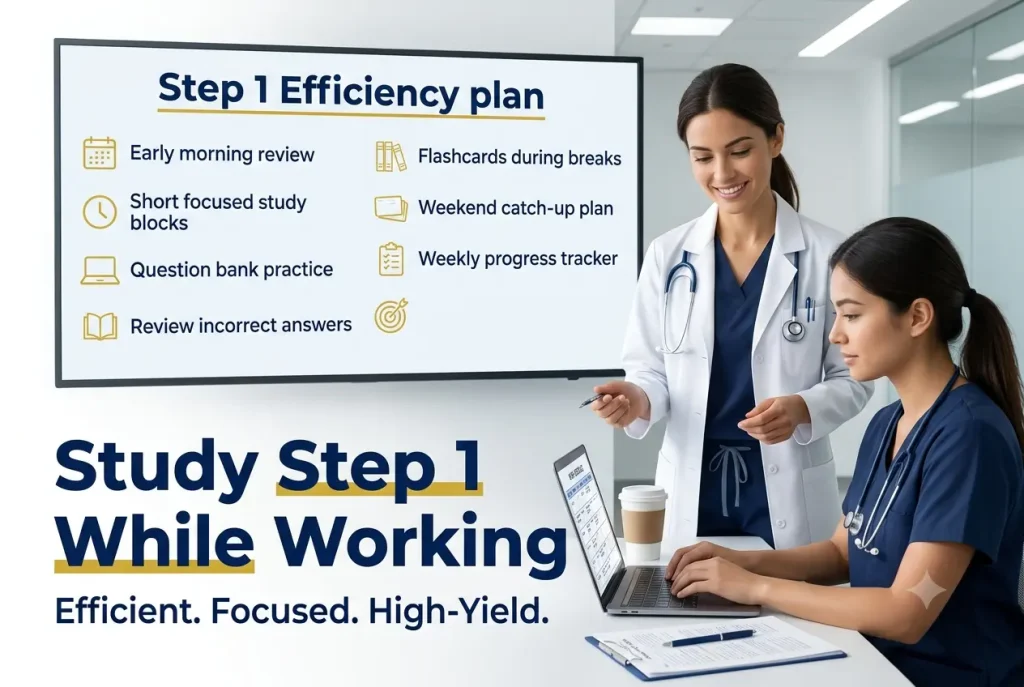

Studying for Step 1 while working is hard, but it is possible with the right system. You cannot study like someone with unlimited dedicated time. You need a focused plan that protects your limited hours and turns every study block into measurable progress.
Many working students and IMGs lose time because they try to study everything, use too many resources, avoid assessments, and review questions too passively.
The goal is not to copy a full-time dedicated schedule. The goal is to build a realistic Step 1 plan around NBME weak areas, high-yield review, QBank practice, spaced repetition, and disciplined weekly adjustments.
This guide will show you how to study efficiently for Step 1 while working, how to organize weekdays and weekends, how to use QBank blocks when time is limited, and when to use SmashUSMLE coaching for structure and accountability.
Free USMLE Training
Free USMLE Bootcamp
Learn the clinical reasoning, NBME strategy, and study systems used by medical students and IMGs preparing for Step 1, Step 2 CK, and Step 3.
Reserve My SpotWhy Step 1 Feels Harder When You Are Working
Working while studying for Step 1 creates a different challenge. You are not only fighting content gaps. You are fighting fatigue, limited study windows, inconsistent schedules, and less recovery time.
Working students often struggle because:
- They have fewer uninterrupted study hours.
- They are tired after work and study less efficiently.
- They try to use too many resources at once.
- They delay NBMEs because they feel unprepared.
- They do questions but do not review deeply.
- They have trouble maintaining consistency week after week.
The Big Rule
When you are working, your Step 1 plan must be focused. You cannot afford random studying.
Start With a Baseline Assessment
If your study time is limited, guessing your weak areas is too expensive. You need a baseline assessment to show what deserves your attention first.
A baseline NBME-style assessment helps you decide whether your biggest problem is content, clinical reasoning, timing, fatigue, or question interpretation.
After your baseline, ask:
- Which systems are weakest?
- Which subjects are costing me the most points?
- Am I missing facts or application?
- Am I running out of time?
- Which topics should I prioritize this week?
- What can I safely stop studying for now?
Baseline Rule
A baseline assessment saves time because it tells you what not to study.
Build a Limited-Time Step 1 Study Plan
A working student needs a plan that is simple, repeatable, and realistic. You should know exactly what to do when you sit down to study.
Your plan should include four core activities:
- Targeted content review: Rebuild weak foundations using structured lessons.
- QBank practice: Apply concepts in Step 1-style questions.
- Deep question review: Identify why you missed questions.
- Weekly reassessment: Adjust the plan based on performance.
Limited-Time Rule
Every study block should have a purpose before it begins.
Weekday Study Strategy While Working
On workdays, your goal is not to do everything. Your goal is to protect one or two high-quality study blocks.
Short, focused study sessions are better than long exhausted sessions where you retain nothing.
| Time Window | Best Task | Why It Works |
|---|---|---|
| Before Work | High-yield review or weak-area lesson | Your mind may be fresher before the workday drains you. |
| Lunch Break | Flashcards or quick missed-concept review | Small review blocks help with spaced repetition. |
| After Work | Short QBank block and review | Questions keep your study active even when time is limited. |
| Evening | One-page weak-area summary | Short reinforcement prevents overload before sleep. |
Weekend Study Strategy While Working
Weekends are where many working students make the biggest gains. But weekends should not become chaotic catch-up days.
Use weekends for deeper work that is hard to complete during the week.
Best Weekend Tasks
- Longer QBank blocks
- NBME or practice assessment review
- Deep review of weak systems
- Weekly missed-question cleanup
- Planning the next week’s study priorities
- One recovery block to prevent burnout
Weekend Rule
Do not use weekends only to catch up. Use them to diagnose, correct, and plan.
How to Use QBank Practice Efficiently
If you are working, QBank practice must be focused. You may not have time to do long blocks every day, but you can still use questions intelligently.
Efficient QBank Method
- Use focused blocks for weak systems during early prep.
- Use smaller blocks on workdays if energy is limited.
- Review every missed question by error type.
- Write one short takeaway per missed question.
- Save longer mixed timed blocks for weekends.
- Track repeated mistakes weekly.
QBank Rule
A short block reviewed well is better than a long block reviewed poorly.
How to Use NBMEs Without Wasting Time
NBMEs are essential when you are working because they prevent you from guessing your readiness.
Do not take an NBME, panic about the score, and move on. Use it to build the next version of your study plan.
After every NBME, identify:
- Your lowest-performing systems.
- Your repeated missed concepts.
- Your timing problems.
- Your distractor traps.
- Your fatigue pattern.
- Your top three priorities for the next week.
NBME Rule
Your NBME should decide what you study next, especially when time is limited.
Best Resources When Study Time Is Limited
When you are working, resource overload is dangerous. You need fewer resources and better execution.
| Resource | Purpose | How to Use It Efficiently |
|---|---|---|
| SmashUSMLE Reviews | Structured Step 1 content and clinical reasoning | Use lessons to target weak systems instead of studying randomly. |
| SmashUSMLE QBank | Focused question practice | Use smaller blocks on workdays and deeper review on weekends. |
| NBME Exams | Readiness and weak-area diagnosis | Use score reports to guide the next week of study. |
| UWorld | Question application and pattern recognition | Use as a learning tool, not just a percentage tracker. |
| Flashcards | Memory reinforcement | Use only for repeated weak facts and high-yield details. |
| Missed-Question Notebook | Error correction | Write one sentence explaining why you missed each repeated error. |
Resource Rule
When time is limited, fewer resources used consistently beat many resources used randomly.
Step 1 Strategy for Working IMGs
Working IMGs often carry extra pressure. Many are balancing jobs, family responsibilities, finances, long gaps from basic science, and the pressure to pass Step 1.
The biggest mistake is trying to copy a full-time study plan that does not match your life.
Working IMG Priorities
- Start with a baseline assessment.
- Build a weekly plan around your actual work schedule.
- Use SmashUSMLE Reviews to rebuild weak foundations.
- Use focused QBank blocks for weak systems.
- Reserve weekends for deeper review and assessment work.
- Avoid resource overload.
- Get coaching if your score is stuck.
For Working IMGs
Your plan does not need to look perfect. It needs to be consistent, focused, and realistic enough to survive your schedule.
Sample Step 1 Work-Study Schedule
This sample schedule can be adjusted based on your job, family responsibilities, and test date.
| Day | Study Focus | Goal |
|---|---|---|
| Monday | Weak-system lesson plus short QBank block | Start the week with targeted review. |
| Tuesday | QBank review and missed-concept notes | Correct errors from Monday’s block. |
| Wednesday | Second weak-system lesson plus flashcards | Reinforce high-yield weak points. |
| Thursday | Short focused QBank block | Apply the week’s content. |
| Friday | Light review or rest block | Prevent fatigue from destroying weekend productivity. |
| Saturday | Longer QBank block or NBME review | Use deeper time for assessment and correction. |
| Sunday | Weekly reset and next-week planning | Review weak areas, adjust the plan, and prepare the next week. |
Common Mistakes to Avoid
1. Trying to Follow a Full-Time Dedicated Schedule
If you are working, your schedule must match your reality. A plan you cannot follow will not help you pass.
2. Studying Passively After Work
Watching videos while exhausted may feel productive, but active QBank practice and targeted review usually produce better results.
3. Using Too Many Resources
Resource overload wastes time. Choose a system and execute it consistently.
4. Avoiding NBMEs
You need assessments to know whether your limited study time is actually working.
5. Ignoring Burnout
Working and studying can drain you quickly. Build recovery into the schedule before exhaustion forces you to stop.
Student Success Story
⭐ 4.8 Google Rating | 120+ ReviewsSee How SmashUSMLE Students Improve Their Scores
Learn how structured clinical reasoning, NBME-focused review, and disciplined preparation can help IMGs break through score plateaus.
Want to learn the same clinical reasoning system used by SmashUSMLE students?
Join Free BootcampNeed Help Studying for Step 1 While Working?
If you are balancing work, family, and Step 1 preparation, you do not need a random study plan. You need a focused system that fits your actual schedule.
SmashUSMLE Reviews helps students and IMGs use structured lessons, QBank practice, NBME weak-area analysis, and one-on-one coaching to prepare more efficiently.
FAQ: How to Study Efficiently for Step 1 While Working
Can I pass Step 1 while working?
Yes, but you need a focused and realistic plan. Your preparation should be built around weak-area analysis, QBank practice, NBME review, and consistent weekly execution.
How many hours should I study for Step 1 while working?
The right number depends on your schedule and baseline. Many working students do better with shorter focused weekday blocks and longer weekend review blocks.
Should I study before or after work?
If possible, use your freshest time for difficult review or QBank practice. Some students do better before work, while others protect a focused evening block.
How often should I take NBMEs if I work full time?
Many students use NBMEs every few weeks depending on their timeline. The key is to take them early enough that the results can guide your study plan.
Can SmashUSMLE help if I have limited study time?
Yes. SmashUSMLE can help you identify weak areas, organize your study schedule, improve clinical reasoning, and use your limited time more efficiently.
Ready to Study Smarter for Step 1 While Working?
Working while preparing for Step 1 requires discipline, but it also requires strategy. Build your plan around weak-area analysis, focused QBank practice, NBME review, recovery, and consistent execution.