Failure does not automatically end your residency dream. But pretending it did not happen, giving vague explanations, or applying again without a stronger strategy can hurt your chances.
Whether you failed Step 1, Step 2 CK, Step 3, a clinical rotation, a shelf exam, or did not Match, your next move matters. Residency programs want to see maturity, accountability, improvement, and evidence that the problem has been corrected.
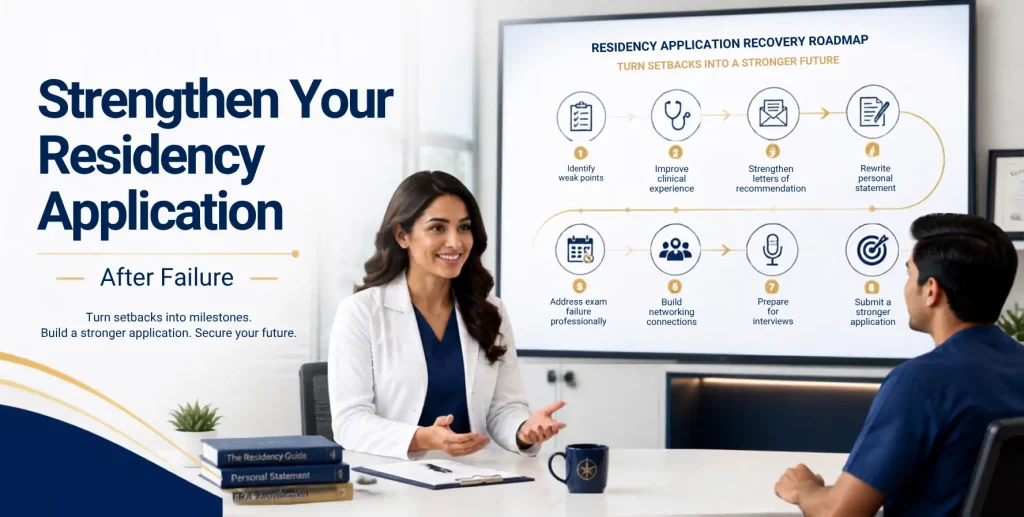
The goal is not to hide failure. The goal is to turn it into a clear recovery story backed by stronger scores, better clinical performance, better letters, meaningful experiences, and a more strategic application.
This guide will show you how to rebuild your residency application after failure, how to explain red flags, how to strengthen your ERAS profile, and when to use SmashUSMLE coaching to create a realistic comeback plan.
Free USMLE Training
Free USMLE Bootcamp
Learn the clinical reasoning, NBME strategy, and study systems used by medical students and IMGs preparing for Step 1, Step 2 CK, and Step 3.
Reserve My SpotWhy Failure Does Not Have to End Your Residency Journey
A failed exam or failed Match cycle is serious, but it is not the same as being unqualified forever. Programs know students can recover. What they want to see is whether you learned from the setback and became a safer, stronger, more prepared applicant.
Your job is to show three things:
- You understand why the failure happened.
- You corrected the problem with a specific plan.
- You now have evidence that your performance is stronger.
The Big Rule
Do not build your application around excuses. Build it around proof of growth.
Identify the Real Reason Behind the Failure
Before you rebuild your application, you need to diagnose the failure honestly. Most students skip this step and immediately start studying again or reapplying with the same weak strategy.
Ask yourself:
- Was the failure due to content gaps?
- Was it poor question interpretation?
- Was it timing, fatigue, or test anxiety?
- Was it a weak clinical knowledge base?
- Was it poor advising or poor application strategy?
- Did I apply too narrowly or too competitively?
- Were my letters, personal statement, or interviews weak?
Honest Diagnosis Matters
If you do not know why you failed, you are at risk of repeating the same pattern.
How to Recover After a USMLE Failure
If your failure involved Step 1, Step 2 CK, or Step 3, your comeback must include a stronger exam plan. A passing retake alone helps, but a strategic recovery plan is better.
Step 1: Stop Studying Randomly
Do not restart with the same pile of resources. Use your prior score report, NBME performance, and missed-question patterns to identify exactly what failed.
Step 2: Rebuild Weak Foundations
Use SmashUSMLE Reviews, the Masterclass with AI, the self-paced course, and QBank practice to rebuild weak systems in a structured way.
Step 3: Use NBME-Style Data
Your next study plan should be driven by performance data. Track weak systems, missed concepts, timing problems, and repeated distractor traps.
Step 4: Get Coaching if Scores Are Stuck
If your NBME scores are not moving, you need someone to diagnose the issue. Repeating more questions without fixing the thinking process usually does not work.
How to Address Red Flags in Your Residency Application
A red flag should be addressed with maturity, not panic. The strongest explanation is brief, honest, and focused on correction.
| Red Flag | Weak Response | Stronger Response |
|---|---|---|
| USMLE failure | Blaming the exam, school, or circumstances | Explain the issue briefly and show improved preparation, passing retake, and stronger clinical readiness. |
| Failed rotation | Avoiding the topic | Show insight, remediation, stronger evaluations, and improved professionalism. |
| Unmatched cycle | Reapplying the same way | Improve application strategy, specialty fit, clinical experience, letters, and interview preparation. |
| Gap in training | Leaving the gap unexplained | Show productive use of time through US clinical experience, research, exams, volunteering, or clinical growth. |
Strengthen Your Clinical Experience
After failure, programs need reassurance that you can perform clinically. Strong clinical experience can help rebuild confidence in your application.
Focus on experiences that produce real evidence:
- US clinical experience when possible
- Sub-internships or observerships with strong performance
- Hands-on clinical roles if available
- Recent specialty-relevant exposure
- Updated letters from physicians who directly observed your work
Clinical Proof Beats Explanation
A strong letter from a physician who saw you perform well can do more than a long paragraph explaining what went wrong.
Get Stronger Letters of Recommendation
Weak or generic letters can hurt an applicant with a red flag. You need letters that clearly support your readiness for residency.
A strong letter should show:
- Clinical reliability
- Work ethic
- Medical knowledge improvement
- Professionalism
- Team communication
- Resilience after difficulty
Do not ask for a letter from someone who barely knows you. Ask physicians who can write specifically about your growth, patient care, clinical reasoning, and readiness for residency.
Write a Better Personal Statement After Failure
Your personal statement should not become a confession letter. It should still focus on your specialty fit, clinical growth, motivation, and readiness.
If you mention failure, keep it controlled:
- Briefly state what happened.
- Take ownership without oversharing.
- Explain what changed.
- Show evidence of improvement.
- Return the focus to residency readiness.
Personal Statement Rule
Do not make failure the main character. Make growth, readiness, and specialty fit the main story.
Prepare for Residency Interviews After a Red Flag
If you have a failure on your application, assume you may be asked about it. Your answer should be calm, direct, and mature.
A Strong Interview Answer Has Four Parts
- Ownership: Acknowledge what happened without blaming others.
- Insight: Explain what you learned about the cause.
- Correction: Describe the specific steps you took.
- Evidence: Show how your performance improved afterward.
Practice your answer until it sounds natural. Do not sound defensive. Do not overexplain. Programs want maturity, not a courtroom argument.
Special Strategy for IMGs After Failure
IMGs often face extra pressure after a USMLE failure or an unmatched cycle. The answer is not to panic apply everywhere. The answer is to build a smarter, more credible profile.
IMG Priorities After Failure
- Pass the failed exam with a stronger, structured study plan.
- Strengthen Step 2 CK or Step 3 if available and appropriate.
- Gain recent US clinical experience.
- Secure strong US-based letters of recommendation.
- Apply broadly but intelligently.
- Target IMG-friendly programs with realistic specialty strategy.
- Prepare a polished explanation for interviews.
For IMGs
Your application must show that the failure is behind you, not still defining you.
Residency Comeback Plan After Failure
A comeback plan gives structure to your recovery. It helps you avoid random effort and focus on the things that actually improve your application.
| Phase | Main Goal | Action Steps |
|---|---|---|
| Phase 1 | Diagnose the failure | Review score reports, NBME data, application weaknesses, interview performance, and advisor feedback. |
| Phase 2 | Fix the academic weakness | Use SmashUSMLE courses, QBank practice, NBME review, and tutoring to correct weak areas. |
| Phase 3 | Build clinical proof | Gain stronger clinical experience, improve evaluations, and secure better letters. |
| Phase 4 | Rebuild ERAS | Update your personal statement, experiences, program list, and red flag explanation. |
| Phase 5 | Prepare for interviews | Practice clear answers about failure, growth, specialty fit, and readiness. |
Common Mistakes to Avoid After Failure
1. Reapplying Without Changing the Application
If the same application did not work before, do not send the same version again. Improve the weak areas first.
2. Overexplaining the Failure
Long explanations can sound defensive. Be honest, brief, and focused on growth.
3. Studying the Same Way Again
If your old study strategy led to failure, repeating it harder is not a plan.
4. Getting Generic Letters
Generic letters do not repair confidence. You need letters that clearly show clinical readiness and improvement.
5. Applying Too Narrowly
After a red flag, your program list must be realistic, broad, and strategic.
Student Success Story
⭐ 4.8 Google Rating | 120+ ReviewsSee How SmashUSMLE Students Improve Their Scores
Learn how structured clinical reasoning, NBME-focused review, and disciplined preparation can help IMGs break through score plateaus.
Want to learn the same clinical reasoning system used by SmashUSMLE students?
Join Free BootcampNeed Help Rebuilding After a USMLE Failure?
If you failed Step 1, Step 2 CK, Step 3, or feel stuck after an unsuccessful Match cycle, you do not need more confusion. You need a recovery plan.
SmashUSMLE Reviews helps students and IMGs use structured review, QBank practice, NBME weak-area analysis, and one-on-one coaching to rebuild confidence and improve performance.
FAQ: Strengthening Your Residency Application After Failure
Can I still match after failing a USMLE exam?
Yes, but your strategy must improve. You need to pass the retake, strengthen the rest of your application, explain the failure maturely, and apply strategically.
Should I mention my failure in my personal statement?
Only if it helps explain your growth. Keep it brief and focus on what changed, what you learned, and how your performance improved.
How do I explain a failed exam during residency interviews?
Be direct. Acknowledge the failure, explain what caused it, describe the corrective plan, and show evidence that you are now stronger.
What is the best way to strengthen my application after not matching?
Improve your clinical experience, letters, exam profile, personal statement, program list, and interview skills before reapplying.
Can SmashUSMLE help after failure?
Yes. SmashUSMLE can help you identify weak areas, rebuild your USMLE strategy, improve question interpretation, and create a structured recovery plan.
Ready to Rebuild Your USMLE and Residency Plan?
Failure is painful, but it does not have to be the end of your journey. With the right strategy, stronger preparation, better advising, and a clear comeback plan, you can move forward with confidence.