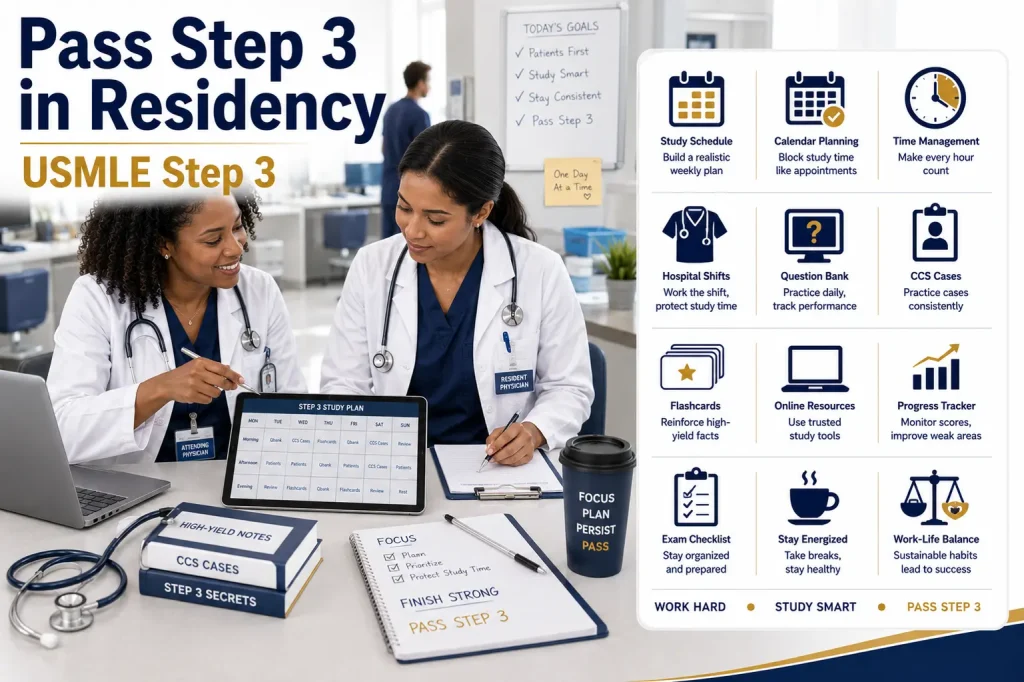

Passing Step 3 while in residency is possible, but it requires a different strategy than studying as a medical student. You are tired, your schedule changes, your clinical duties are real, and your study time is limited.
The mistake many residents make is waiting for a “perfect time” to study. That time usually never comes. The better approach is to build a simple, repeatable study system that fits around wards, nights, clinic, ICU, electives, and post-call fatigue.
Step 3 rewards practical clinical reasoning. If you can combine your residency experience with targeted QBank practice, CCS preparation, biostatistics review, and a realistic weekly schedule, you can prepare efficiently without burning out.
Free USMLE Training
Free USMLE Step 3 Bootcamp
Join our free USMLE training where we break down Step 3 clinical reasoning, CCS cases, time management, and high-yield exam strategy for busy residents.
Reserve My SpotWhy Step 3 Feels Hard During Residency
Step 3 is not hard only because of content. It is hard because residents are studying while working long hours, switching rotations, answering pages, writing notes, and recovering from call.
The biggest challenges are:
- Inconsistent study time
- Fatigue after clinical shifts
- Weak biostatistics foundation
- Forgetting outpatient pediatrics, OB/GYN, psychiatry, and preventive care
- Underestimating CCS cases
- Waiting too long to schedule the exam
- Trying to study randomly without a plan
The Big Rule
Do not build a Step 3 plan for the resident you wish you were. Build one for the schedule you actually have.
Best Timeline for Taking Step 3 in Residency
Many residents take Step 3 during intern year or early PGY-2, especially if their program, license, fellowship plans, or visa situation requires it. The best timing depends on your rotation schedule and how much protected study time you can realistically create.
| Timing Option | Best For | Strategy |
|---|---|---|
| Early Intern Year | Residents with lighter early rotations or visa/licensing pressure | Use a short, focused plan and start CCS early. |
| Middle of Intern Year | Residents who want clinical experience before testing | Use real inpatient/outpatient exposure to reinforce management questions. |
| End of Intern Year | Residents with a lighter elective or clinic block | Schedule exam around a lower-intensity rotation. |
| Early PGY-2 | Residents who delayed because of heavy intern year workload | Do not delay indefinitely. Set a firm date and build a 6 to 8 week plan. |
Timing Rule
The best Step 3 test date is usually the one attached to a realistic study window, not the one attached to wishful thinking.
Realistic Step 3 Study Plan for Residents
Residents need a study plan that works on bad days, not just ideal days. Your plan should include small daily actions and a few longer sessions when your schedule allows.
6-Week Step 3 Plan for Busy Residents
| Week | Main Goal | Resident-Friendly Study Focus |
|---|---|---|
| Week 1 | Baseline and setup | Start timed mixed questions, review weak areas, and learn the CCS software format. |
| Week 2 | Core medicine review | Focus on hospital medicine, outpatient medicine, emergency management, and common chronic disease cases. |
| Week 3 | CCS foundation | Do CCS cases daily or near-daily. Practice orders, reassessment, prevention, and discharge planning. |
| Week 4 | Biostatistics and ethics | Review formulas, study design, bias, screening tests, medical errors, and quality improvement. |
| Week 5 | Mixed timed practice | Increase timed blocks and continue CCS review. Identify repeated misses and weak systems. |
| Week 6 | Final review and exam readiness | Review high-yield notes, weak topics, CCS patterns, test-day timing, and break strategy. |
How Residents Should Use QBank Questions
As a resident, you do not have unlimited time. Your QBank strategy must be efficient.
Best QBank Strategy for Residents
- Use timed mixed blocks once your foundation is started
- Review explanations for patterns, not trivia
- Keep a short missed-concept notebook
- Prioritize questions on weak areas and common Step 3 presentations
- Do smaller blocks on workdays and longer blocks on lighter days
- Do not spend hours rewriting full explanations
QBank Rule
Your goal is not to complete questions perfectly. Your goal is to improve your decision-making before exam day.
How to Study CCS Cases While Busy
CCS cases can make or break your Step 3 confidence. The good news is that residents already think clinically. You just need to practice the format.
For each CCS case, build the same rhythm:
- Assess stability first
- Choose the correct setting of care
- Order essential diagnostic tests
- Start time-sensitive treatment
- Advance time carefully
- Reassess the patient’s response
- Add preventive care and counseling
- Plan disposition and follow-up
CCS Rule
Do not just place orders. Reassess, adjust, prevent complications, and close the case safely.
High-Yield Topics to Prioritize
Step 3 is broad, but residents should prioritize the topics most likely to appear in real clinical decision-making.
| Topic Area | High-Yield Examples | Why It Matters |
|---|---|---|
| Hospital Medicine | Sepsis, pneumonia, heart failure, COPD, DKA, AKI, GI bleed | Common inpatient management and CCS cases. |
| Outpatient Medicine | Hypertension, diabetes, lipids, depression, back pain, headaches | Step 3 frequently tests follow-up, screening, and medication adjustment. |
| Emergency Medicine | Chest pain, stroke, PE, altered mental status, trauma, shock | Tests stability, urgent workup, and life-saving treatment. |
| Biostatistics | Sensitivity, specificity, NNT, ARR, bias, study design | Easy points if reviewed consistently. |
| Ethics and Safety | Medical errors, consent, capacity, handoffs, QI | Frequently tested and often pattern-based. |
| OB/GYN and Pediatrics | Prenatal care, contraception, vaccines, fever, asthma, development | Common weak areas for non-OB and non-peds residents. |
How to Study Around Busy Rotations
The best Step 3 plan changes based on your rotation. You should not use the same schedule during ICU nights and an outpatient elective.
| Rotation Type | Study Goal | Best Approach |
|---|---|---|
| ICU or Wards | Maintain momentum | Do short QBank sets, audio/video review, and light CCS review. Avoid unrealistic marathon sessions. |
| Nights | Protect sleep | Study before the shift only if alert. Use post-shift time for sleep, not guilt-driven studying. |
| Clinic | Build outpatient reasoning | Review preventive medicine, chronic disease management, and ambulatory cases. |
| Elective | Push volume | Increase timed blocks, CCS practice, and full review sessions. |
| Vacation Block | Final exam push | Use focused study without burning the entire break. Keep sleep and exam-day rhythm stable. |
Rotation Rule
Heavy rotations are for maintenance. Light rotations are for progress.
Common Step 3 Mistakes Residents Make
1. Waiting for a Perfect Study Month
Residency rarely gives you a perfect study window. Schedule the exam around a realistic window and build from there.
2. Underestimating CCS Cases
Clinical experience helps, but CCS has its own format. You must practice the software and case flow.
3. Ignoring Biostatistics
Many residents avoid biostatistics until the final week. That is a bad trade. These are high-yield points.
4. Studying Only After Exhausting Shifts
If you are too tired to think, studying becomes low quality. Use short review instead of forcing poor retention.
5. Forgetting Non-Core Specialty Topics
OB/GYN, pediatrics, psychiatry, dermatology, preventive medicine, and ethics still matter on Step 3.
Student Success Story
⭐ 4.8 Google Rating | 120+ ReviewsSee How SmashUSMLE Students Improve Their Scores
Learn how structured clinical reasoning, realistic study planning, and high-yield review can help busy residents prepare for Step 3 with confidence.
Want to learn the same clinical reasoning system used by SmashUSMLE students?
Join Free BootcampNeed Help Passing Step 3 During Residency?
If you are exhausted, busy, and unsure how to fit Step 3 into residency, you are not alone. You do not need a perfect schedule. You need a realistic system.
SmashUSMLE Reviews helps residents prepare for Step 3 using clinical reasoning, high-yield review, QBank practice, CCS strategy, and one-on-one tutoring.
FAQ: How to Pass Step 3 While in Residency
Can I pass Step 3 while working full-time in residency?
Yes. Many residents pass Step 3 while working full-time, but they need a realistic study plan, consistent QBank practice, CCS preparation, and a test date that fits their rotation schedule.
How long should residents study for Step 3?
Many residents use 6 to 8 weeks of focused preparation, but the right timeline depends on baseline knowledge, rotation schedule, prior exam performance, and comfort with CCS cases.
When is the best time to take Step 3 during residency?
The best time is usually during or after a lighter rotation, elective, clinic block, or planned study window. Avoid scheduling during your hardest ICU, wards, or night rotation if possible.
Do residents still need to study CCS cases?
Yes. Clinical experience helps, but CCS has its own format. Residents should practice case flow, order timing, reassessment, prevention, and disposition.
What should busy residents prioritize for Step 3?
Prioritize timed mixed questions, CCS practice, hospital medicine, outpatient medicine, emergency management, biostatistics, ethics, patient safety, OB/GYN, and pediatrics.
Ready to Pass Step 3 During Residency?
Step 3 becomes easier when you stop waiting for the perfect schedule and start using a realistic system. SmashUSMLE can help you master clinical reasoning, CCS cases, outpatient medicine, hospital medicine, biostatistics, ethics, and patient safety.