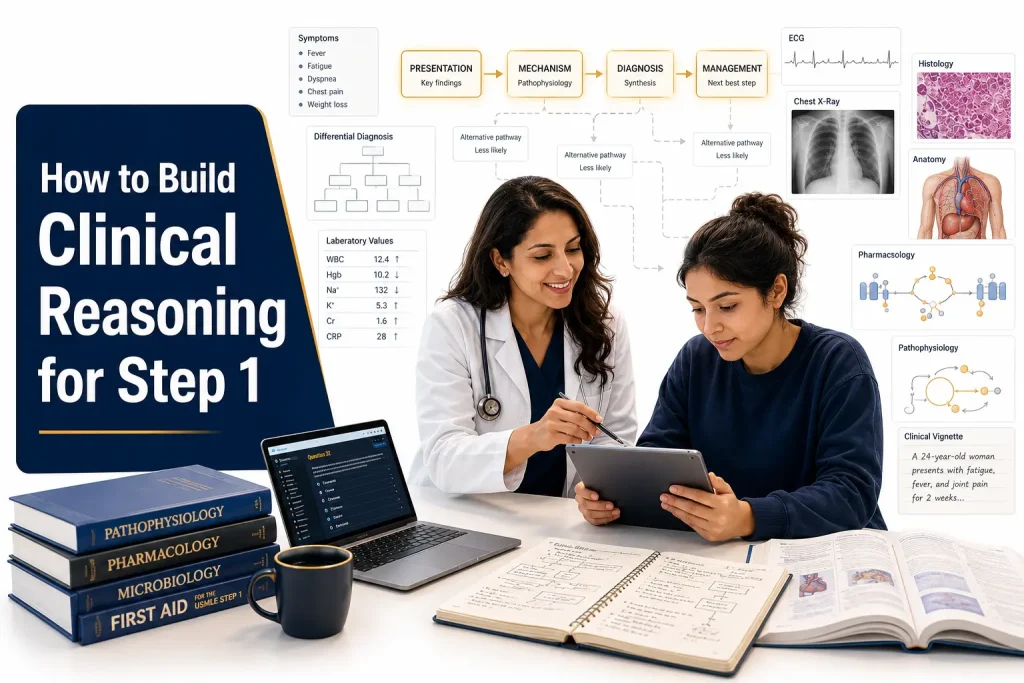

Clinical reasoning for Step 1 can feel difficult when you know many facts but still cannot determine what a question is really asking.
Many students study diseases, drugs, and pathways as isolated lists. When those facts appear inside a long NBME-style vignette, every answer choice can seem reasonable.
The solution is to build a repeatable reasoning process. You must learn how to identify the important clues, connect them to a mechanism, predict what should happen next, and eliminate answers that do not explain the entire case.
This guide explains how to build clinical reasoning for Step 1 using mechanism-based learning, question analysis, pattern recognition, and structured review.
Free USMLE Training
Free USMLE Step 1 Bootcamp
Learn how to approach NBME-style questions, connect foundational science to clinical vignettes, and improve your Step 1 reasoning with a structured system.
Reserve My SpotHow to Build Clinical Reasoning for Step 1
Clinical reasoning is the process of moving from patient information to the most likely mechanism, diagnosis, or physiologic explanation.
On Step 1, this usually means connecting foundational sciences to a clinical presentation. The question may give you symptoms, vital signs, laboratory values, imaging, pathology, or medication history. Your job is to determine which mechanism explains the complete pattern.
The Big Rule
Do not ask, “What fact do I remember?” Ask, “What process explains everything happening in this patient?”
Strong clinical reasoning helps you recognize what matters, ignore distracting information, and compare answer choices more efficiently.
Why Students Struggle With Clinical Reasoning for Step 1
They Memorize Facts Without Building Connections
A student may know that a disease causes a particular laboratory abnormality but still miss the question because they do not understand why the abnormality occurs.
Mechanisms make knowledge easier to retrieve. When you understand the chain from cause to pathophysiology to symptoms, you are less dependent on buzzwords.
They Treat Every Clue as Equally Important
Not every sentence in a vignette carries the same weight. Age, timing, exposure, a specific laboratory result, or one physical finding may be far more useful than the rest.
They Choose Answers That Match Only One Clue
Wrong answers often explain part of the case. The correct answer usually explains the entire presentation.
Common Step 1 Trap
A familiar disease may match one symptom, but another diagnosis may better explain the symptoms, laboratory values, time course, and mechanism together.
The Step 1 Clinical Reasoning Framework
Use the same framework for every question until it becomes automatic.
| Step | Question to Ask | Purpose |
|---|---|---|
| 1 | What is the question asking? | Identify whether you need a diagnosis, mechanism, drug, complication, or next finding. |
| 2 | Who is the patient? | Use age, sex, risk factors, exposures, and clinical setting. |
| 3 | What are the most important clues? | Separate decisive findings from background information. |
| 4 | What mechanism connects the clues? | Build a physiologic or pathologic explanation. |
| 5 | Which answer explains the whole case? | Compare choices and eliminate partial matches. |
A 24-year-old woman develops weakness after several days of vomiting. Laboratory testing shows hypokalemia and metabolic alkalosis. Which physiologic process most directly contributes to her potassium loss?
A. Decreased aldosterone secretion
B. Increased distal sodium delivery
C. Reduced hydrogen ion secretion
D. Reduced renal potassium excretion
Correct Answer: B. Increased distal sodium delivery
Vomiting causes volume depletion and metabolic alkalosis. Volume depletion activates the renin-angiotensin-aldosterone system. Increased distal sodium delivery and aldosterone activity increase renal potassium secretion.
The reasoning chain is more useful than memorizing that vomiting causes hypokalemia.
Build Clinical Reasoning by Studying Mechanisms First
For every important disease, build a short mechanism chain.
Mechanism Chain
Cause → pathophysiology → symptoms → laboratory findings → complications → treatment.
Consider nephrotic syndrome. Instead of memorizing proteinuria, edema, hyperlipidemia, and thrombosis as unrelated facts, connect them:
- Glomerular damage causes heavy protein loss.
- Protein loss causes hypoalbuminemia.
- Low oncotic pressure contributes to edema.
- The liver increases lipoprotein synthesis.
- Loss of anticoagulant proteins increases thrombosis risk.
Once the mechanism is clear, several Step 1 findings become predictable.
Clinical Reasoning Worksheet
General Pathology Masterclass Worksheet
Use this worksheet to organize mechanisms, inflammation, cellular injury, hemodynamic disorders, neoplasia, and pathology patterns that support Step 1 clinical reasoning.
- Connect mechanisms to clinical findings
- Organize high-yield pathology patterns
- Practice cause-and-effect reasoning
- Use alongside your QBank and NBME review
How to Reason Through Step 1 Questions
Read the Last Line First
The final sentence tells you the task. You may be asked for the diagnosis, mechanism, enzyme, drug effect, complication, or expected laboratory finding.
Create a One-Sentence Summary
Reduce the vignette to one sentence containing the patient type, main problem, time course, and most important clues.
Example Summary
Young adult with episodic muscle weakness after carbohydrate-rich meals and low potassium.
A concise summary makes it easier to recognize the disease pattern without rereading the entire stem.
Predict Before Looking at the Answers
Before reading every option, decide what type of answer you expect. This reduces the chance that a well-written distractor will pull you away from the case.
Compare Answers by Mechanism
Ask which choice explains the greatest number of findings with the fewest contradictions.
Use Wrong Answers to Improve Clinical Reasoning
A missed question is useful only when you identify why you missed it.
| Error Type | What Happened | How to Fix It |
|---|---|---|
| Content gap | You did not know the tested concept. | Review the mechanism and create a brief note. |
| Application gap | You knew the fact but could not use it in the vignette. | Practice explaining how the clues connect. |
| Distractor error | You chose an answer that matched only one clue. | Compare every answer against the full case. |
| Question-reading error | You answered a different question than the one asked. | Read the final line first and define the task. |
| Timing error | You rushed or spent too long on one question. | Practice timed blocks and concise summaries. |
Wrong-Answer Review Checklist
- What was the question really asking?
- Which clue was most important?
- What mechanism explains the presentation?
- Why was my answer tempting but wrong?
- What pattern should I recognize next time?
Recommended Step 1 Resource
High Yield Step 1 Review Book
The High Yield Step 1 Review Book can help you organize mechanisms, classic presentations, and board-style patterns without getting buried in low-yield details.
Explore the High Yield Step 1 Book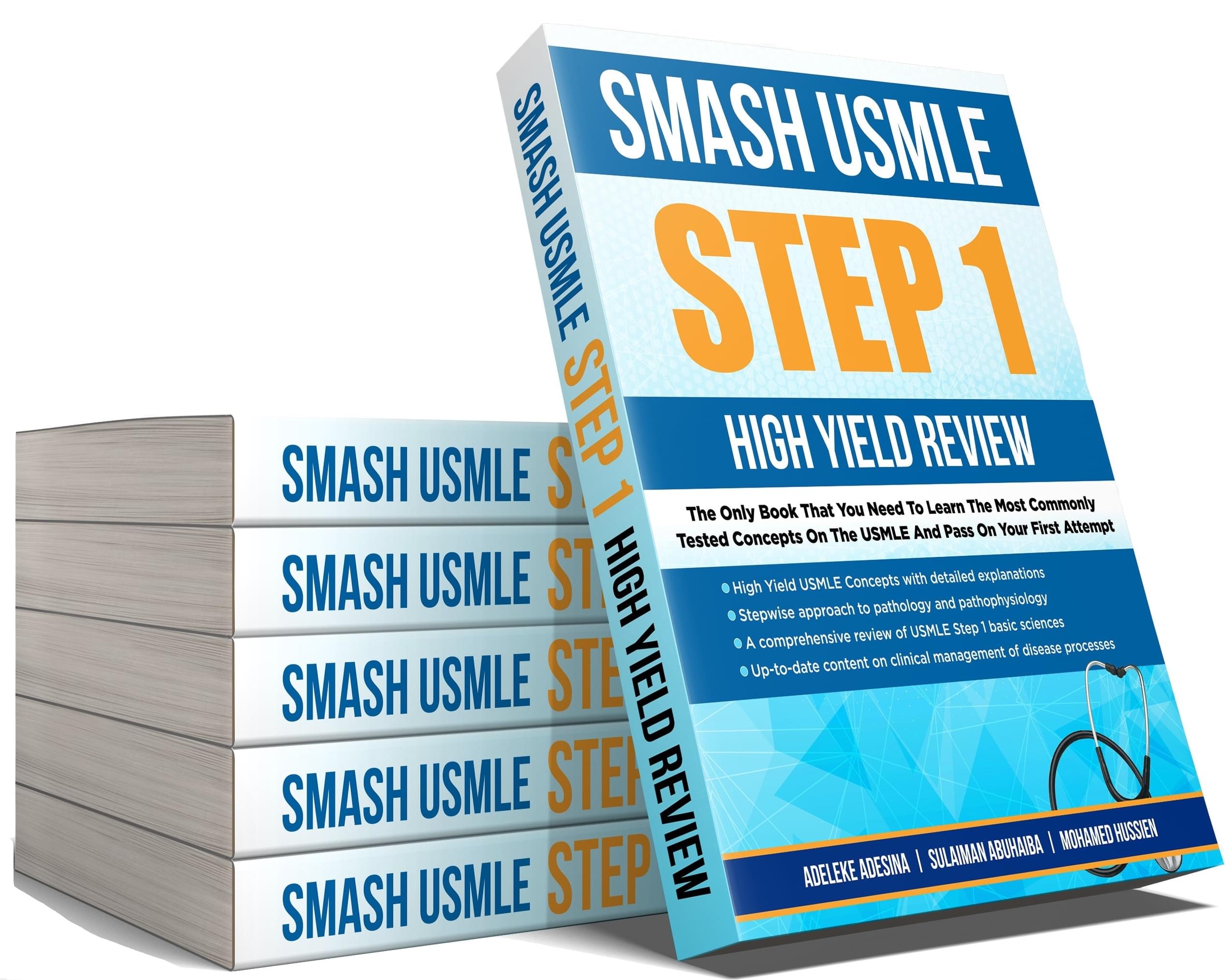
Daily Plan to Build Clinical Reasoning for Step 1
Clinical reasoning improves through deliberate repetition. A simple daily plan is more useful than waiting until dedicated study to practice.
| Activity | Time | Reasoning Goal |
|---|---|---|
| Mechanism review | 30–45 minutes | Connect foundational science to disease patterns. |
| Focused question block | 20–40 questions | Practice identifying clues and mechanisms. |
| Deep question review | 60–90 minutes | Analyze why every answer is right or wrong. |
| Reasoning notebook | 15 minutes | Record repeated errors and high-yield patterns. |
| Mixed recall | 15–30 minutes | Strengthen retrieval without replacing question practice. |
The goal is not to complete the largest number of questions. The goal is to improve how you think through each question.
Student Success Story
⭐ 4.8 Google Rating | 120+ ReviewsSee How Structured Reasoning Supports USMLE Success
This student success story shows how structured preparation, focused question review, and clinical reasoning can help students move forward with greater confidence.
Want to learn the same clinical reasoning system used by SmashUSMLE students?
Join Free BootcampBuild Step 1 Reasoning With a Structured Study System
When your NBME scores are not improving, the problem may not be effort. You may need a clearer way to connect content, clinical clues, and answer choices.
SmashUSMLE courses and tutoring can help you identify weak areas, review mechanisms, and practice Step 1 questions with a more organized approach.
FAQ: How to Build Clinical Reasoning for Step 1
How do I build clinical reasoning for Step 1?
Build clinical reasoning for Step 1 by connecting clues to mechanisms, summarizing vignettes in one sentence, predicting the answer before reviewing choices, and analyzing why wrong answers are wrong.
Why do I know the content but still miss Step 1 questions?
You may have an application gap. This happens when you recognize facts during review but cannot connect them to the patient presentation or identify the most important clue.
Should I read the last line of the question first?
Reading the last line first can help you identify whether the question is asking for a diagnosis, mechanism, drug, complication, or expected finding.
How should I review missed Step 1 questions?
Identify the error type, explain the mechanism, determine which clue you missed, and write one brief takeaway that will help you recognize the pattern next time.
Are flashcards enough to improve clinical reasoning?
Flashcards can support memory, but they should not replace question practice, mechanism-based learning, NBME analysis, and detailed review of distractors.
How many questions should I complete each day?
The right number depends on your study phase. Focus on completing a manageable number that still allows deep review and correction of repeated reasoning errors.
Ready to Improve Your USMLE Scores?
Step 1 preparation becomes easier when you stop memorizing facts in isolation and start using a structured clinical reasoning system.