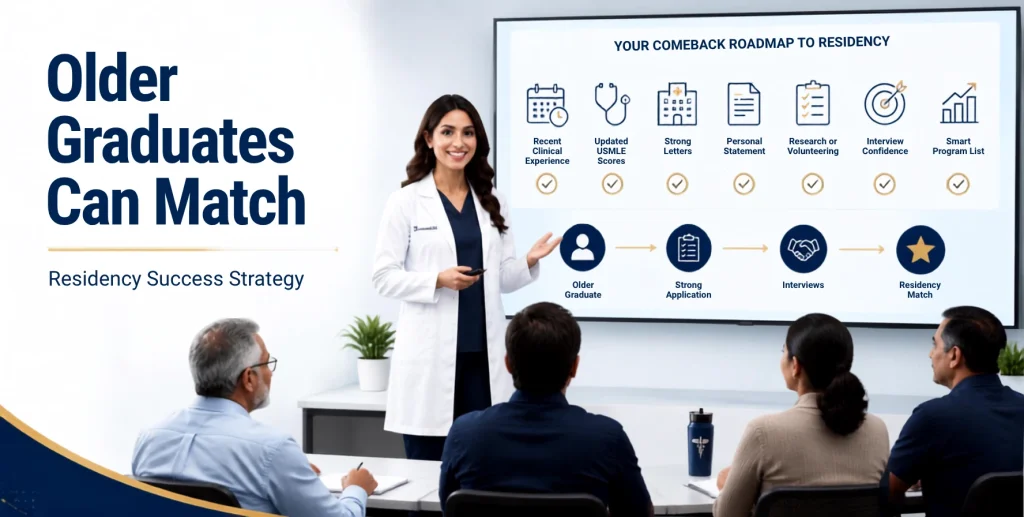
Older medical graduates can still match into residency, but they need a smarter strategy than simply applying broadly and hoping programs overlook the graduation year.
Programs may have concerns about clinical freshness, USMLE performance, recent patient care experience, letters of recommendation, and whether the applicant is ready for residency training now.
Your job is to remove doubt. You need to show recent competence, strong exam readiness, clinical commitment, maturity, and a clear reason why you are ready for residency today.
Free USMLE Training
Free USMLE Bootcamp for IMGs
Learn how to strengthen your USMLE strategy, rebuild weak areas, improve NBME performance, and prepare for residency with a focused plan.
Reserve My SpotWhy Older Graduates Face Extra Scrutiny
Older graduates are often evaluated differently because programs want to know whether the applicant is clinically current and ready to handle residency responsibilities.
Common concerns include:
- Long gap since medical school graduation
- Limited recent clinical experience
- Older or weaker USMLE scores
- Lack of recent U.S. clinical exposure
- Letters that are outdated or too generic
- Unclear explanation for time away from medicine
- Concern about adapting to residency workload
The Big Rule
Older graduation year is not the whole story. Your job is to prove recent readiness.
How to Repair Your Residency Profile
If you are an older graduate, you need to build a profile that answers the program’s concerns before they ask.
| Concern | What Programs May Wonder | How to Strengthen Your Profile |
|---|---|---|
| Graduation gap | Are you still clinically current? | Add recent hands-on clinical exposure, observerships, externships, or supervised patient care. |
| Exam history | Can you pass boards and handle academic pressure? | Prepare seriously for Step exams and aim for the strongest score possible. |
| Weak letters | Does anyone recent trust your clinical ability? | Earn strong, recent letters from U.S. physicians when possible. |
| Unclear story | Why now? | Write a clear personal statement that explains your path without sounding defensive. |
| Low visibility | Do you have mentors or advocates? | Network professionally and seek mentorship in your target specialty. |
USMLE Strategy for Older Graduates
Strong USMLE performance can help older graduates reduce concern about academic readiness.
Your exam strategy should be structured, not random.
- Use NBME exams to diagnose weak areas
- Rebuild foundational gaps before rushing into test day
- Use QBank blocks to improve application, not just memorization
- Track repeated misses by system and reason
- Consider tutoring if scores are stuck
- Do not take Step exams before your data supports readiness
USMLE Rule
Older graduates cannot afford careless exam attempts. Prepare until your NBME data supports the test date.
Recent Clinical Experience Matters
Recent clinical exposure is one of the most important ways older graduates can rebuild credibility.
Programs want evidence that you can function in a clinical environment now.
- U.S. clinical experience when possible
- Externships or hands-on clinical roles
- Observerships with meaningful physician interaction
- Research with clinical relevance
- Volunteer work connected to patient care
- Work as a medical assistant, scribe, clinical coordinator, or similar role when appropriate
Clinical Freshness Rule
Recent clinical activity helps programs see you as a current applicant, not just an older graduate.
Letters of Recommendation
Older graduates need strong, recent letters. A generic letter from many years ago is usually not enough.
Strong letters should show:
- Recent clinical performance
- Professionalism
- Work ethic
- Clinical reasoning
- Communication skills
- Ability to work with a team
- Commitment to the specialty
Letter Rule
A recent specific letter beats an old generic letter.
How to Explain Your Gap
Your personal statement should explain your journey clearly without sounding apologetic or defensive.
Focus on:
- What happened
- What you learned
- What you did to stay connected to medicine
- Why you are ready now
- Why this specialty makes sense
- What strengths your path gives you
Story Rule
Do not hide the gap. Frame it with maturity, accountability, and evidence of readiness.
Application Strategy for Older Graduates
Older graduates need a realistic and targeted application strategy.
| Application Area | What to Do | Why It Matters |
|---|---|---|
| Specialty choice | Target specialties where your profile is competitive | Increases realistic interview chances |
| Program list | Research IMG-friendly and older-graduate-friendly programs | Prevents wasting applications on programs unlikely to review you |
| Networking | Build real physician relationships through clinical work and mentorship | Advocacy can help overcome screening concerns |
| Application timing | Apply early and complete | Late applications hurt applicants with existing concerns |
| Interview prep | Prepare clear answers about gaps, goals, and readiness | Older graduates must control their story confidently |
Common Mistakes Older Graduates Make
1. Avoiding the Graduation Gap
Programs will notice the gap. Address it clearly and professionally.
2. Applying Without Recent Clinical Experience
Recent clinical exposure helps show that you are ready now.
3. Rushing USMLE Exams
A rushed poor score can hurt more than a delayed strong attempt.
4. Using Generic Personal Statements
Older graduates need a personal statement that explains the journey and proves readiness.
5. Applying Too Narrowly
You need a realistic program list based on specialty competitiveness, IMG friendliness, graduation year filters, and your full profile.
Student Success Story
⭐ 4.8 Google Rating | 120+ ReviewsSee How SmashUSMLE Students Move Forward
Learn how structured clinical reasoning, USMLE strategy, and disciplined preparation can help students rebuild confidence and strengthen their residency path.
Want to learn the same clinical reasoning system used by SmashUSMLE students?
Join Free BootcampNeed Help Strengthening Your Residency Path?
If you are an older graduate, your strategy needs to be focused. You need strong USMLE preparation, recent clinical credibility, and a clear application story.
SmashUSMLE Reviews helps students and IMGs improve exam readiness, rebuild weak areas, and prepare with a structured plan.
FAQ: How Older Graduates Can Still Match Into Residency
Can older medical graduates still match into residency?
Yes. Older graduates can still match, but they need to show recent clinical readiness, strong USMLE preparation, good letters, and a clear explanation of their path.
Does year of graduation matter for residency?
Yes, some programs screen by year of graduation. That makes recent clinical experience, strong letters, and strategic program selection even more important.
How can older graduates improve their match chances?
They can improve their chances by strengthening USMLE scores, gaining recent clinical experience, earning strong letters, applying strategically, and preparing a clear interview story.
Should older graduates take more clinical rotations?
Recent clinical exposure can help, especially if it leads to strong letters and proves current readiness.
Ready to Strengthen Your Residency Application?
Older graduates can still build a strong path forward. SmashUSMLE can help you improve USMLE readiness, rebuild weak areas, and prepare with a smarter strategy.