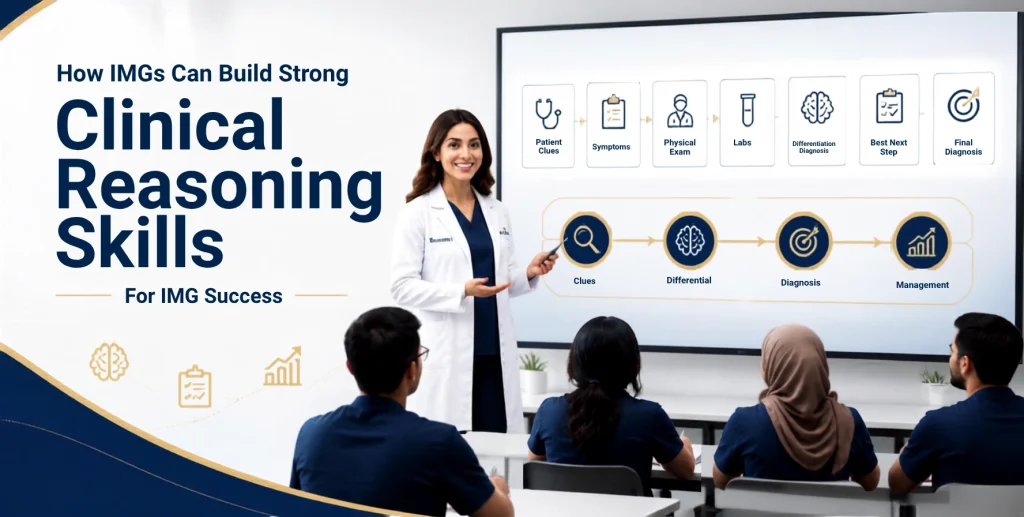

IMGs can build strong clinical reasoning skills by learning how to connect basic science, clinical clues, mechanisms, diagnosis, and next-best-step thinking inside USMLE-style questions.
Many international medical graduates know a lot of medicine, but struggle when NBME questions ask indirectly. The exam rarely rewards memorizing isolated facts. It rewards students who can recognize patterns, interpret clues, avoid distractors, and apply concepts under pressure.
Clinical reasoning is not magic. It is a skill you can train.
Free USMLE Training
Free USMLE Bootcamp for IMGs
Learn how to improve clinical reasoning, rebuild weak foundations, and answer NBME-style questions with a clear system.
Reserve My SpotWhy Clinical Reasoning Matters for IMGs
Clinical reasoning is the ability to take a patient presentation, identify the key clues, connect them to a disease process, and choose the best answer.
For IMGs, this skill is especially important because USMLE questions may test medicine differently than prior school exams.
- Questions are longer and more indirect
- Answer choices may all sound familiar
- The exam often tests mechanisms, not diagnosis alone
- Distractors punish partial understanding
- NBME questions reward pattern recognition plus logic
The Big Rule
Strong clinical reasoning means you do not just know facts. You know when and how to use them.
How NBME Questions Test Reasoning
NBME-style questions are built to test applied thinking. The stem gives you clues, the last line tells you the task, and the answer choices reveal what kind of reasoning is required.
| NBME Question Type | What It Tests | How to Think |
|---|---|---|
| Diagnosis Question | Pattern recognition | Summarize the case in one sentence before choosing. |
| Mechanism Question | Pathophysiology | Ask what process explains the presentation. |
| Risk Factor Question | Cause and association | Identify the most important clue in the stem. |
| Next Best Step Question | Clinical management | Assess stability, urgency, and safest action. |
| Lab or Imaging Question | Expected findings | Connect disease mechanism to measurable abnormality. |
The IMG Clinical Reasoning Framework
Use a repeatable framework for every USMLE-style question.
| Step | Question to Ask | Purpose |
|---|---|---|
| Step 1 | What is the last line asking? | Identify the task before answering. |
| Step 2 | What is the one-sentence summary? | Find the core clinical pattern. |
| Step 3 | What clue changes the answer? | Separate key findings from noise. |
| Step 4 | What mechanism explains this? | Connect clinical findings to science. |
| Step 5 | Why are the distractors wrong? | Prevent repeated traps. |
Reasoning Rule
Do not jump from stem to answer. Move from clue to mechanism to best answer.
How to Connect Basic Science to Clinical Cases
Many IMGs struggle because they study basic science separately from clinical medicine. Step 1 does not test them separately. It combines them.
When reviewing a topic, ask:
- What is the mechanism?
- How does the mechanism create symptoms?
- What labs or imaging should change?
- What complication should I expect?
- What treatment targets the mechanism?
Basic Science Rule
If you cannot connect the mechanism to the patient presentation, you have not fully learned the concept yet.
How to Use QBank Questions to Build Reasoning
QBank questions should train your thinking, not just test your memory.
After each missed question, classify the miss:
- Content gap: You did not know the concept.
- Application gap: You knew it but could not apply it.
- Distractor trap: You picked a familiar but wrong answer.
- Timing error: You rushed or overthought.
Then write one short takeaway that changes how you answer the next similar question.
Common Clinical Reasoning Mistakes IMGs Make
1. Memorizing Without Applying
Memorization helps, but it is not enough. You must apply facts inside clinical vignettes.
2. Ignoring the Last Line
Many students identify the disease but answer the wrong task because they miss what the question is asking.
3. Choosing Familiar Answers
Familiar does not mean correct. The answer must fit the whole case.
4. Not Reviewing Distractors
Distractors reveal how the exam tricks incomplete reasoning.
5. Avoiding Feedback
If your scores are stuck, tutoring can help identify the hidden reasoning problem faster.
Student Success Story
⭐ 4.8 Google Rating | 120+ ReviewsSee How SmashUSMLE Students Improve Their Scores
Learn how structured clinical reasoning, NBME-focused review, and disciplined preparation can help IMGs prepare with confidence.
Want to learn the same clinical reasoning system used by SmashUSMLE students?
Join Free BootcampNeed Help Building Clinical Reasoning as an IMG?
If you know the content but keep missing NBME-style questions, your issue may be application, distractors, timing, or question interpretation.
SmashUSMLE Reviews helps IMGs build clinical reasoning, rebuild weak foundations, improve NBME performance, and prepare with a focused system.
FAQ: How IMGs Can Build Strong Clinical Reasoning Skills
Why do IMGs struggle with clinical reasoning on USMLE exams?
Many IMGs know medicine but are not used to how NBME-style questions test clues, mechanisms, distractors, and application.
How can IMGs improve clinical reasoning?
Use a consistent framework: read the last line, summarize the case, identify key clues, connect the mechanism, and review distractors.
Is doing more QBank questions enough?
Not by itself. QBank questions help only when you review why you missed each question and convert mistakes into better reasoning.
When should an IMG get help with clinical reasoning?
Consider tutoring if your NBME scores are stuck, you keep missing the same question types, or you cannot identify why your answers are wrong.
Ready to Build Stronger Clinical Reasoning?
USMLE preparation becomes easier when you stop memorizing randomly and start thinking through questions with a system. SmashUSMLE can help you build that system.