
Board-Certified Emergency Medicine Physician | Founder, SmashUSMLE Reviews
⭐ 4.8 Google Rating | 120+ ReviewsI hope you enjoy reading this article. If you need USMLE help, schedule a one-on-one free consult below.
Book a USMLE Advising CallMany students feel overwhelmed by the Highest Yield Cardiology Topics for USMLE Step 1 because cardio questions often combine physiology, pathology, pharmacology, murmurs, pressure-volume loops, and ECG interpretation into one clinical vignette.
The problem is not that cardiology is impossible. The problem is that most students memorize facts separately. They learn murmurs in one place, congenital defects in another place, drugs somewhere else, and ECG changes at the end. Then the NBME gives one patient and expects you to integrate all of it.
The solution is clinical reasoning. Instead of asking, “What fact do I remember?” ask, “What is the mechanism, what changed in pressure or flow, and what clue points to the diagnosis?”
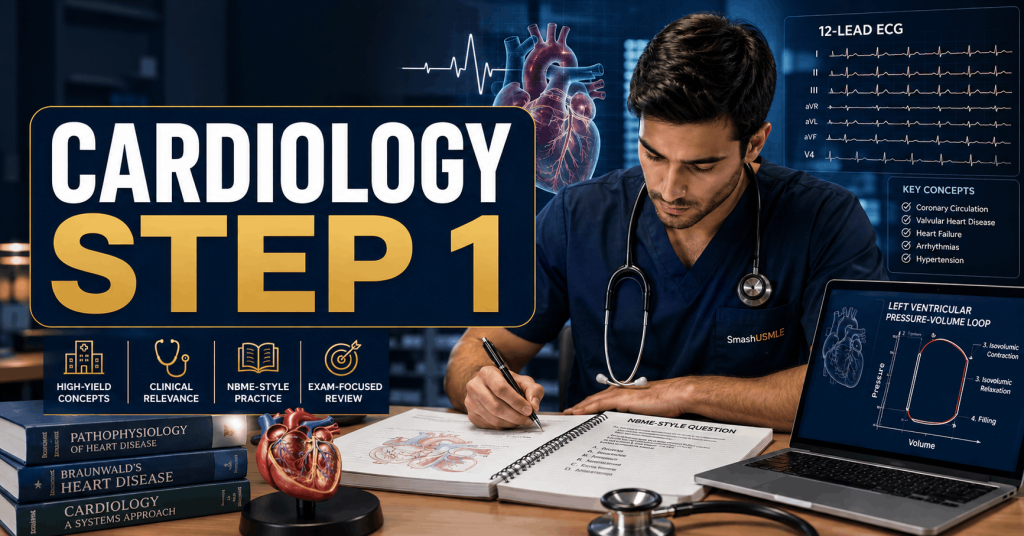
In this article, we will break down the cardio topics that matter most for Step 1, how they are tested, and how to think through them like a physician.
Table of Contents
Free USMLE Step 1 Bootcamp
Join our free USMLE masterclass where we break down high-yield concepts, NBME strategies, and clinical reasoning systems used by thousands of medical students and IMGs.
Reserve My SpotHighest Yield Cardiology Topics for USMLE Step 1 You Must Master
For Step 1, cardiology is not just a list of diseases. It is a pressure-flow system. When you understand preload, afterload, contractility, resistance, and chamber remodeling, many questions become much easier.
| Topic | What Step 1 Tests | Key Clue |
|---|---|---|
| Murmurs | Timing, radiation, maneuvers | Squatting, standing, handgrip, inspiration |
| PV loops | Preload, afterload, contractility changes | Loop width, height, end-systolic volume |
| Heart failure | Compensation, remodeling, RAAS activation | Low EF, pulmonary edema, S3 |
| Congenital heart disease | Cyanotic vs acyanotic defects | Timing of cyanosis and shunt direction |
| Ischemic heart disease | Coronary anatomy and infarct complications | ECG leads, papillary muscle rupture, free wall rupture |
| Cardio pharmacology | Drug mechanism and adverse effects | ACE inhibitors, beta blockers, calcium channel blockers, nitrates |
Heart Murmurs: The Most Testable Cardiology Pattern
Heart murmurs are high-yield because they test anatomy, physiology, auscultation, and bedside maneuvers in one question.
Aortic Stenosis
Aortic stenosis is a systolic ejection murmur that radiates to the carotids. Think older patient with exertional syncope, angina, or dyspnea. The left ventricle faces pressure overload, so it develops concentric hypertrophy.
Mitral Regurgitation
Mitral regurgitation is a holosystolic murmur at the apex that radiates to the axilla. Blood flows backward from the left ventricle into the left atrium during systole.
Mitral Stenosis
Mitral stenosis is a diastolic rumble often associated with rheumatic heart disease. The high-yield clue is an opening snap followed by a low-pitched diastolic murmur.
Hypertrophic Obstructive Cardiomyopathy
HOCM becomes louder with standing or Valsalva because decreased preload worsens obstruction. It becomes softer with squatting because increased preload expands the ventricular cavity.
USMLE-Style Question #1
A 19-year-old athlete has a systolic murmur that becomes louder when he stands and softer when he squats. Which condition is most likely?
A. Aortic stenosis
B. Mitral regurgitation
C. Hypertrophic obstructive cardiomyopathy
D. Tricuspid regurgitation
Correct Answer: C. Hypertrophic obstructive cardiomyopathy
Standing decreases preload, making the left ventricular cavity smaller and worsening outflow obstruction. That makes the murmur louder.
High-yield pearl: HOCM and mitral valve prolapse are the two classic murmurs that get louder with decreased preload.
Pressure-Volume Loops: Understand the Axes, Then the Question
Pressure-volume loops scare students because they look abstract. But Step 1 usually tests three changes: preload, afterload, and contractility.
Increased Preload
Increased preload means more filling. End-diastolic volume increases, stroke volume often increases, and the loop becomes wider.
Increased Afterload
Increased afterload means the heart must pump against higher resistance. End-systolic volume increases, stroke volume decreases, and the loop becomes taller and narrower.
Increased Contractility
Increased contractility means the ventricle ejects more effectively. End-systolic volume decreases and stroke volume increases.
Download the Cardiology Masterclass Worksheet
Use this worksheet to organize murmurs, PV loops, congenital defects, ECG patterns, and cardio pharmacology into one high-yield Step 1 review system.
Get the Cardiology WorksheetCongenital Heart Disease: Cyanotic vs Acyanotic Logic
Do not memorize congenital heart disease randomly. First decide whether the defect causes left-to-right shunting, right-to-left shunting, or obstruction.
Acyanotic Defects
VSD, ASD, and PDA usually start as left-to-right shunts. Over time, pulmonary hypertension may develop and reverse the shunt, causing Eisenmenger syndrome.
Cyanotic Defects
The classic cyanotic defects include Tetralogy of Fallot, transposition of the great arteries, truncus arteriosus, tricuspid atresia, and total anomalous pulmonary venous return.
USMLE-Style Question #2
A newborn becomes cyanotic shortly after birth. Imaging shows the aorta arising from the right ventricle and the pulmonary artery arising from the left ventricle. Which additional finding is required for survival?
A. Closed ductus arteriosus
B. No septal defect
C. Mixing through PDA, ASD, or VSD
D. Increased systemic vascular resistance only
Correct Answer: C. Mixing through PDA, ASD, or VSD
Transposition of the great arteries creates parallel circulations. Survival requires mixing between systemic and pulmonary blood.
High-yield pearl: Prostaglandin E1 keeps the ductus arteriosus open in ductal-dependent lesions.
ECG and Ischemia Patterns
For Step 1, ECG questions often focus on localization and complications. Learn which coronary artery supplies which region and what happens when that region infarcts.
| Finding | Likely Vessel | High-Yield Complication |
|---|---|---|
| ST elevation in II, III, aVF | Right coronary artery | AV block, right ventricular infarct |
| ST elevation in V1–V4 | Left anterior descending artery | Ventricular septal rupture, anterior wall MI |
| ST elevation in I, aVL, V5–V6 | Left circumflex artery | Lateral wall infarct |
USMLE-Style Question #3
A patient develops acute shortness of breath and a new holosystolic murmur several days after an inferior myocardial infarction. Which structure was most likely damaged?
A. Aortic valve
B. Posteromedial papillary muscle
C. Interventricular septum
D. Left atrial appendage
Correct Answer: B. Posteromedial papillary muscle
The posteromedial papillary muscle has single blood supply, usually from the right coronary artery, making it vulnerable after inferior MI. Rupture causes acute mitral regurgitation.
High-yield pearl: Acute MR after MI causes pulmonary edema and a new holosystolic murmur.
Cardiology Pharmacology: Mechanism First
Cardio pharmacology becomes easier when you connect the drug to the hemodynamic problem.
ACE Inhibitors and ARBs
These reduce angiotensin II effects, decrease aldosterone, lower afterload, and protect the heart and kidneys in the right clinical context. Watch for cough, hyperkalemia, angioedema, and contraindication in pregnancy.
Beta Blockers
Beta blockers decrease heart rate, decrease contractility, and reduce renin release. They are high-yield in heart failure, ischemic heart disease, arrhythmias, and hyperthyroid symptom control.
Nitrates
Nitrates primarily venodilate, decrease preload, and reduce myocardial oxygen demand. The classic adverse effect is headache, and the dangerous interaction is with PDE-5 inhibitors.
Calcium Channel Blockers
Dihydropyridines mainly affect vessels. Non-dihydropyridines affect the heart and can decrease AV nodal conduction.
Student Success Story
⭐ 4.8 Google Rating | 120+ ReviewsElizabeth Passed Step 1
Cardiology improves when students stop memorizing isolated facts and start using a clinical reasoning framework. Watch this Step 1 success story from a student who used SmashUSMLE support during preparation.
Need help turning high-yield cardiology into NBME-ready reasoning?
Join the Free BootcampNeed a Structured Step 1 Review Plan?
If cardiology feels scattered, a guided course can help you connect physiology, pathology, pharmacology, and NBME-style reasoning in the right order.
Explore Step 1 CoursesHow to Study Cardiology for Step 1
Start with physiology, then add pathology, then pharmacology. This prevents the common mistake of memorizing disease names without understanding pressure, volume, resistance, and flow.
USMLE-Style Question #4
A medication decreases preload and improves chest pain by reducing myocardial oxygen demand. Which adverse effect is most expected?
A. Dry cough
B. Headache
C. Hyperkalemia
D. Gingival hyperplasia
Correct Answer: B. Headache
Nitrates venodilate, decrease preload, and commonly cause headache due to vasodilation.
High-yield pearl: Never combine nitrates with PDE-5 inhibitors because severe hypotension can occur.
FAQ
What are the Highest Yield Cardiology Topics for USMLE Step 1?
The Highest Yield Cardiology Topics for USMLE Step 1 include murmurs, pressure-volume loops, heart failure physiology, congenital heart disease, coronary artery anatomy, myocardial infarction complications, ECG localization, and cardio pharmacology.
Are murmurs high yield for Step 1?
Yes. Murmurs are high yield because they test timing, location, radiation, bedside maneuvers, and the underlying hemodynamic mechanism.
How should I study pressure-volume loops?
Focus on preload, afterload, and contractility. Ask what happens to end-diastolic volume, end-systolic volume, stroke volume, and loop shape.
Is congenital heart disease important for Step 1?
Yes. Step 1 commonly tests cyanotic versus acyanotic defects, shunt direction, Eisenmenger syndrome, and ductal-dependent lesions.
How many USMLE cardiology questions should I do?
Do enough questions to see patterns repeatedly. Review explanations slowly and focus on why each clue points to a mechanism.
Ready to Improve Your USMLE Scores?
Join thousands of medical students and IMGs using SmashUSMLE’s clinical reasoning system to prepare for Step 1, Step 2 CK, and Step 3.
Join Free Bootcamp Explore Courses Book Tutoring