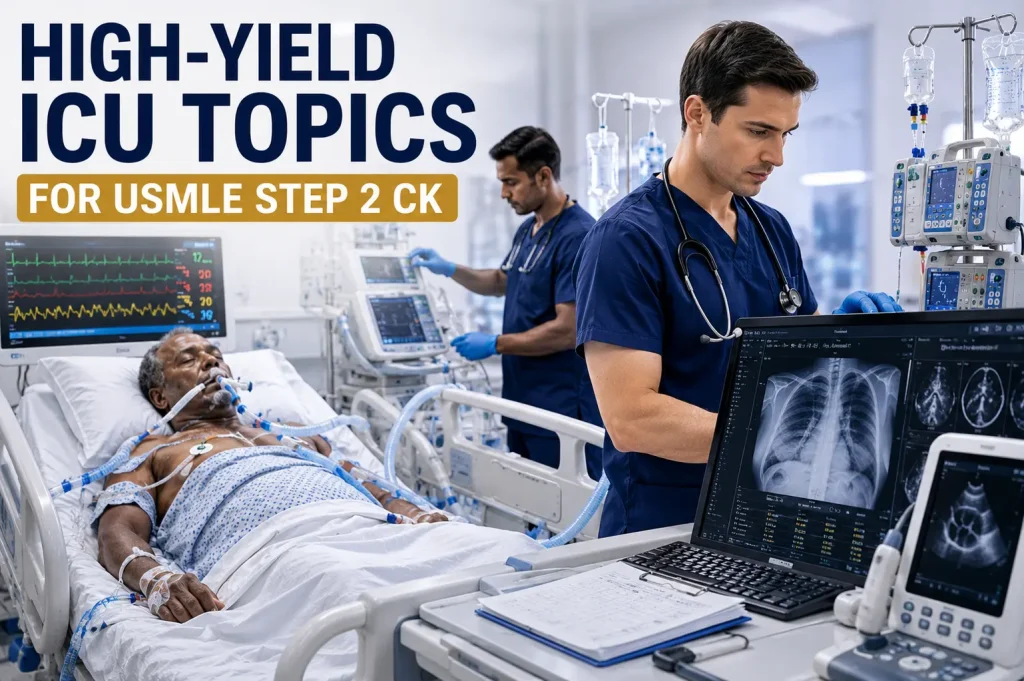

High-Yield ICU Topics for USMLE Step 2 CK are important because ICU questions test rapid recognition, stabilization, ventilator decisions, shock management, sepsis care, acid-base interpretation, and next-best-step reasoning.
Many students struggle with ICU-style questions because every answer choice sounds urgent. The key is knowing what kills the patient first.
Clinical reasoning in the ICU starts with ABCs, hemodynamic stability, oxygenation, perfusion, source control, and medication safety.
This guide breaks down the ICU topics most likely to appear on Step 2 CK and shows you how to approach them in a practical, test-day way.
Free USMLE Training
Free USMLE Step 2 CK Bootcamp
Learn clinical reasoning, emergency management, and high-yield Step 2 CK strategies with SmashUSMLE.
Reserve My SpotHigh-Yield ICU Topics for USMLE Step 2 CK
ICU questions on Step 2 CK are usually management questions. The exam wants to know whether you can stabilize the patient before choosing a diagnostic test or long-term treatment.
The Big ICU Rule
If the patient is unstable, stabilize first. Airway, breathing, circulation, oxygenation, perfusion, and source control come before detailed workup.
Shock
Shock means inadequate tissue perfusion. Step 2 CK commonly tests whether you can identify the shock type and choose the correct immediate treatment.
| Shock Type | Classic Clues | Initial Management |
|---|---|---|
| Hypovolemic | Bleeding, dehydration, low preload | IV fluids or blood products |
| Cardiogenic | MI, pulmonary edema, low cardiac output | Support perfusion, treat cardiac cause |
| Distributive | Sepsis, anaphylaxis, neurogenic shock | Fluids, vasopressors, treat cause |
| Obstructive | PE, tamponade, tension pneumothorax | Relieve obstruction |
Step 2 CK Shortcut
When the patient is in shock, do not delay treatment for a perfect diagnosis. Treat the likely life-threatening cause.
Sepsis and Septic Shock
Sepsis questions often include fever, hypotension, tachycardia, altered mental status, elevated lactate, leukocytosis, or a suspected infection source.
Initial management includes IV fluids, blood cultures when feasible, broad-spectrum antibiotics, lactate measurement, and source control.
Septic Shock
Septic shock means persistent hypotension or poor perfusion despite fluid resuscitation. Norepinephrine is the first-line vasopressor.
ICU Reasoning Worksheet
General Pathology Masterclass Worksheet
Use this worksheet to organize shock, inflammation, sepsis physiology, organ failure, acid-base patterns, and high-yield Step 2 CK clinical reasoning.
- Review shock patterns
- Organize sepsis and organ failure concepts
- Connect physiology to next-best-step questions
- Use alongside NBME and QBank review
Mechanical Ventilation
Mechanical ventilation questions test oxygenation, ventilation, lung protection, and complications.
Oxygenation vs Ventilation
Oxygenation problems are usually managed by changing FiO₂ or PEEP. Ventilation problems are usually managed by changing respiratory rate or tidal volume.
Common Ventilator Complications
- Barotrauma
- Ventilator-associated pneumonia
- Auto-PEEP
- Hypotension from increased intrathoracic pressure
- Oxygen toxicity
ARDS
Acute respiratory distress syndrome causes hypoxemic respiratory failure from diffuse alveolar damage and noncardiogenic pulmonary edema.
Classic causes include sepsis, pneumonia, aspiration, pancreatitis, trauma, transfusion, and burns.
ARDS Management
Use low tidal volume ventilation and adequate PEEP. The goal is lung-protective ventilation.
Vasopressors and Fluids
Fluids and vasopressors are high yield because Step 2 CK often asks what to do after hypotension persists.
Norepinephrine
Norepinephrine is first-line for septic shock after adequate fluid resuscitation.
Epinephrine
Epinephrine is used in anaphylaxis and cardiac arrest scenarios.
Dobutamine
Dobutamine may be used when cardiac output is low and inotropic support is needed.
Acid-Base and Electrolytes in the ICU
ICU patients frequently have mixed acid-base disorders, lactic acidosis, renal failure, DKA, sepsis-related hypoperfusion, respiratory failure, and dangerous electrolyte shifts.
High-Yield ICU Electrolytes
- Hyperkalemia with ECG changes: give IV calcium first
- Severe symptomatic hyponatremia: use hypertonic saline
- Torsades de pointes: give magnesium sulfate
- Severe hypercalcemia: start IV fluids
USMLE-Style Question Box
Question: A patient with pneumonia is febrile, confused, hypotensive, and has a lactate of 5 mmol/L despite IV fluids. What is the next best medication?
Answer: Norepinephrine.
Reasoning: This patient has septic shock with persistent hypoperfusion despite fluids. Norepinephrine is the first-line vasopressor.
ICU Delirium and Sedation
ICU delirium is common and high yield. Risk factors include older age, infection, hypoxia, metabolic abnormalities, sedatives, sleep disruption, and critical illness.
Management includes treating the underlying cause, reorientation, sleep normalization, minimizing unnecessary sedatives, early mobilization, and using antipsychotics only when needed for severe agitation or safety.
Step 2 CK Support
SmashUSMLE Courses and Tutoring
If ICU, emergency medicine, and next-best-step questions feel overwhelming, SmashUSMLE can help you build a stronger clinical reasoning system.
Explore Step 2 CK CourseStudent Success Story
⭐ 4.8 Google Rating | 120+ ReviewsSee How SmashUSMLE Helps Students Think Clinically
ICU questions become easier when you stop memorizing isolated facts and start connecting instability, physiology, and next-best-step management.
If ICU questions feel confusing because every option sounds urgent, clinical reasoning can help you move faster and avoid dangerous traps.
Join Free BootcampNeed Help Mastering Step 2 CK ICU Questions?
If shock, sepsis, ventilators, pressors, and next-best-step questions feel confusing, SmashUSMLE can help you build a structured Step 2 CK approach.
FAQ: High-Yield ICU Topics for USMLE Step 2 CK
What ICU topics are highest yield for Step 2 CK?
Shock, sepsis, ARDS, mechanical ventilation, vasopressors, fluids, acid-base disorders, electrolyte emergencies, delirium, and sedation are especially high yield.
What is the first-line vasopressor for septic shock?
Norepinephrine is the first-line vasopressor for septic shock after appropriate fluid resuscitation.
How do I answer ICU questions on Step 2 CK?
Start with stability. Identify whether the patient needs airway support, oxygenation, fluids, vasopressors, antibiotics, source control, or immediate reversal of a dangerous problem.
What ventilator concept is most important for Step 2 CK?
Understand the difference between oxygenation and ventilation. Oxygenation is adjusted with FiO₂ and PEEP, while ventilation is adjusted with respiratory rate and tidal volume.
Is ARDS high yield for Step 2 CK?
Yes. ARDS is high yield because it tests hypoxemic respiratory failure, diffuse alveolar damage, noncardiogenic pulmonary edema, and low tidal volume ventilation.
Ready to Improve Your USMLE Scores?
USMLE prep becomes easier when you stop memorizing randomly and start using a clinical reasoning system.