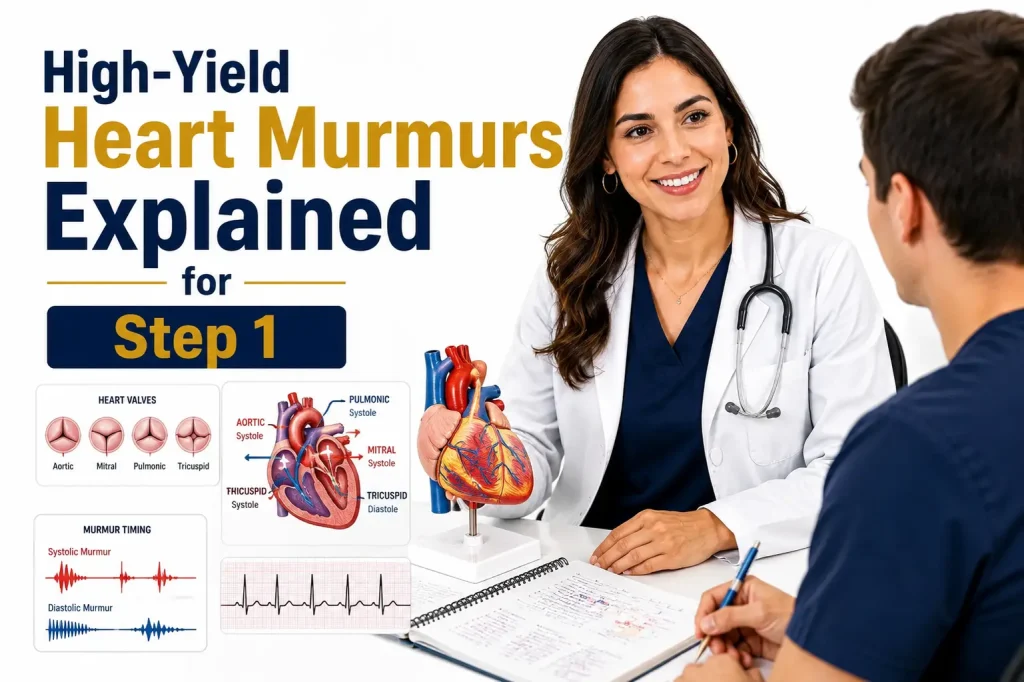

Heart murmurs are one of the most high-yield cardiology topics for USMLE Step 1 because they test anatomy, physiology, pathology, pressure gradients, and clinical reasoning in one question.
Many students memorize murmur names but still miss questions because they do not understand what changes the murmur. Step 1 wants you to know what happens with preload, afterload, squatting, standing, handgrip, Valsalva, and inspiration.
The most important heart murmurs for Step 1 include aortic stenosis, mitral regurgitation, mitral valve prolapse, hypertrophic cardiomyopathy, aortic regurgitation, mitral stenosis, tricuspid regurgitation, and ventricular septal defect.
This guide breaks down the murmurs you need to know, the classic auscultation clues, how maneuvers change them, and how NBME-style questions test them.
Free Worksheet
Download the Cardiology Masterclass Worksheet
Use this worksheet to organize high-yield cardiology concepts, murmur patterns, pressure-volume relationships, and clinical vignette clues for USMLE Step 1.
Get the Free WorksheetFree USMLE Training
Free USMLE Step 1 Bootcamp
Join our free USMLE masterclass where we break down high-yield concepts, NBME strategies, and clinical reasoning systems used by thousands of medical students and IMGs.
Reserve My SpotWhy Heart Murmurs Matter for USMLE Step 1
Heart murmurs are not just sound recognition. Step 1 uses murmurs to test whether you understand blood flow, pressure gradients, chamber size, valve disease, and ventricular physiology.
A strong murmur question usually gives you a patient vignette, a location, radiation pattern, timing, and a maneuver. Your job is to connect those clues to the valve lesion.
The Big Rule
Do not memorize murmurs as isolated sounds. Learn timing, location, radiation, mechanism, and maneuver response together.
Heart Murmur Basics You Must Know
The first step is deciding whether the murmur is systolic or diastolic. Systolic murmurs occur between S1 and S2. Diastolic murmurs occur between S2 and S1.
- Systolic ejection murmur: usually stenosis of a semilunar valve, such as aortic stenosis.
- Holosystolic murmur: usually regurgitation through an AV valve or a septal defect.
- Diastolic murmur: always pathologic until proven otherwise.
- Opening snap: classic for mitral stenosis.
- Click: often points toward mitral valve prolapse.
Step 1 Trap
If a question says the murmur increases with standing or Valsalva, think hypertrophic cardiomyopathy or mitral valve prolapse.
High-Yield Systolic Murmurs
Aortic Stenosis
Aortic stenosis causes a crescendo-decrescendo systolic ejection murmur best heard at the right upper sternal border. It often radiates to the carotids.
- Classic clue: older patient with syncope, angina, and dyspnea.
- Location: right upper sternal border.
- Radiation: carotids.
- Mechanism: narrowed aortic valve increases left ventricular outflow resistance.
Mitral Regurgitation
Mitral regurgitation causes a holosystolic murmur best heard at the apex and radiating to the axilla.
- Classic clue: left-sided volume overload.
- Location: apex.
- Radiation: axilla.
- Mechanism: blood flows backward from the left ventricle into the left atrium during systole.
Hypertrophic Cardiomyopathy
Hypertrophic cardiomyopathy causes a systolic murmur that increases when preload decreases. This is one of the most frequently tested murmur maneuver concepts.
- Classic clue: young athlete with exertional syncope or sudden cardiac death.
- Increases with: standing and Valsalva.
- Decreases with: squatting and handgrip.
- Mechanism: asymmetric septal hypertrophy obstructs left ventricular outflow.
Mitral Valve Prolapse
Mitral valve prolapse causes a midsystolic click followed by a late systolic murmur. It becomes louder and earlier with standing or Valsalva.
- Classic clue: midsystolic click.
- Increases with: standing and Valsalva.
- Decreases with: squatting.
- Mechanism: redundant mitral valve leaflet prolapses into the left atrium.
High-Yield Step 1 Resource
SmashUSMLE High Yield Step 1 Book
Use the SmashUSMLE High Yield Step 1 Book to organize the cardiology concepts, murmur patterns, and clinical reasoning points that matter most for Step 1.
- Strengthen high-yield Step 1 foundations
- Review cardiology mechanisms more efficiently
- Connect murmurs to NBME-style reasoning
- Use alongside SmashUSMLE, NBME review, and QBank practice

High-Yield Diastolic Murmurs
Aortic Regurgitation
Aortic regurgitation causes an early diastolic decrescendo murmur best heard along the left sternal border. It occurs when blood flows backward from the aorta into the left ventricle during diastole.
- Classic clue: wide pulse pressure and bounding pulses.
- Location: left sternal border.
- Timing: early diastolic.
- Mechanism: incompetent aortic valve causes diastolic backflow.
Mitral Stenosis
Mitral stenosis causes a low-pitched diastolic rumble with an opening snap. It is best heard at the apex.
- Classic clue: history of rheumatic fever.
- Location: apex.
- Sound: opening snap plus diastolic rumble.
- Mechanism: narrowed mitral valve limits left atrial emptying into the left ventricle.
Dynamic Maneuvers for Heart Murmurs
Murmur maneuvers are high yield because they force you to understand preload, afterload, and chamber size.
| Maneuver | Physiology | Murmurs That Increase |
|---|---|---|
| Standing | Decreases preload | Hypertrophic cardiomyopathy, mitral valve prolapse |
| Valsalva | Decreases preload | Hypertrophic cardiomyopathy, mitral valve prolapse |
| Squatting | Increases preload and afterload | Most murmurs except hypertrophic cardiomyopathy and mitral valve prolapse |
| Handgrip | Increases afterload | Mitral regurgitation, aortic regurgitation, ventricular septal defect |
| Inspiration | Increases venous return to the right heart | Right-sided murmurs such as tricuspid regurgitation |
High-Yield Murmur Comparison Table
| Murmur | Timing | Best Heard | Classic Clue |
|---|---|---|---|
| Aortic stenosis | Systolic crescendo-decrescendo | Right upper sternal border | Radiates to carotids |
| Mitral regurgitation | Holosystolic | Apex | Radiates to axilla |
| Tricuspid regurgitation | Holosystolic | Left lower sternal border | Increases with inspiration |
| Ventricular septal defect | Holosystolic | Left lower sternal border | Harsh murmur in child |
| Hypertrophic cardiomyopathy | Systolic | Left sternal border | Increases with Valsalva |
| Mitral valve prolapse | Midsystolic click, late systolic murmur | Apex | Click moves earlier with standing |
| Aortic regurgitation | Early diastolic | Left sternal border | Wide pulse pressure |
| Mitral stenosis | Diastolic rumble | Apex | Opening snap, rheumatic fever |
How to Study Heart Murmurs for Step 1
The best way to study murmurs is to use a consistent checklist for every valve lesion.
- Timing: systolic or diastolic?
- Location: where is it best heard?
- Radiation: carotids, axilla, or no radiation?
- Maneuver: what makes it louder or softer?
- Mechanism: what valve problem creates the sound?
- Clinical clue: what patient story points to this lesion?
SmashUSMLE Murmur Method
When reviewing a murmur question, do not stop at the diagnosis. Explain why the maneuver changed the murmur. That is where Step 1 gets tricky.
Student Success Story
⭐ 4.8 Google Rating | 120+ ReviewsSee How This SmashUSMLE Student Passed Step 1
This student’s story shows how structured clinical reasoning, NBME-focused review, and disciplined preparation can help students move forward with confidence.
Want to learn the same clinical reasoning system used by SmashUSMLE students?
Join Free BootcampNeed Help Mastering Cardiology for Step 1?
If murmurs feel confusing, the problem is usually not effort. The problem is structure. You need to connect timing, valve anatomy, pressure changes, and clinical clues into one clear system.
SmashUSMLE Reviews helps students use high-yield review, clinical reasoning, QBank practice, NBME weak-area analysis, and one-on-one tutoring to prepare smarter.
FAQ: High-Yield Heart Murmurs for USMLE Step 1
What are the most important heart murmurs for USMLE Step 1?
The most important murmurs include aortic stenosis, mitral regurgitation, tricuspid regurgitation, ventricular septal defect, hypertrophic cardiomyopathy, mitral valve prolapse, aortic regurgitation, and mitral stenosis.
Which murmur increases with Valsalva?
Hypertrophic cardiomyopathy increases with Valsalva because decreased preload makes the left ventricular outflow obstruction worse. Mitral valve prolapse also becomes earlier and louder with decreased preload.
Which murmur radiates to the carotids?
Aortic stenosis classically radiates to the carotids and is heard best at the right upper sternal border.
Which murmur radiates to the axilla?
Mitral regurgitation classically radiates to the axilla and is heard best at the apex.
How should I memorize heart murmurs for Step 1?
Do not memorize only the sound. Memorize timing, location, radiation, maneuver response, mechanism, and classic clinical vignette clue together.
Ready to Improve Your USMLE Scores?
Step 1 preparation becomes easier when you stop memorizing randomly and start using a system. Join thousands of medical students and IMGs using SmashUSMLE’s clinical reasoning system to prepare for Step 1, Step 2 CK, and Step 3.