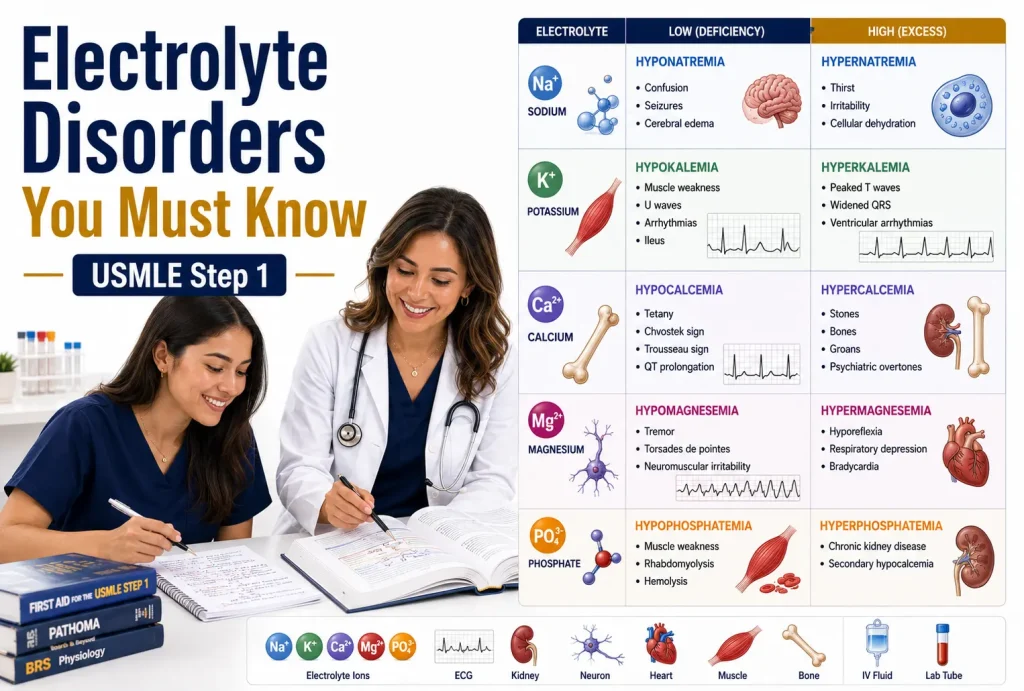

Electrolyte Disorders for USMLE Step 1 are high-yield because they connect physiology, renal function, endocrine control, ECG changes, and clinical symptoms.
These questions can look intimidating at first. However, most electrolyte vignettes become easier once you know the classic pattern.
First, identify the abnormal electrolyte. Next, connect it to the symptom pattern. Then, look for the lab clue, ECG change, or underlying cause.
Free USMLE Training
Free USMLE Step 1 Bootcamp
Join our free USMLE masterclass where we break down high-yield concepts, NBME strategies, and clinical reasoning systems used by thousands of medical students and IMGs.
Reserve My SpotWhy Electrolyte Disorders Matter for Step 1
Electrolyte disorders show up across nephrology, endocrine, cardiology, and physiology. Therefore, they are not isolated facts.
Instead, they test how well you understand homeostasis. They also test whether you can connect lab changes to clinical symptoms.
The Big Step 1 Pattern
Most electrolyte questions follow a predictable structure. First, the stem gives you a risk factor. Then, it gives symptoms.
Finally, the answer choices test the mechanism, ECG finding, or expected lab abnormality.
The Big Rule
Do not memorize electrolytes as separate lists. Instead, connect each abnormality to its neurologic, cardiac, renal, and muscle findings.
Sodium Disorders
Sodium mainly controls serum osmolality and water movement. As a result, sodium disorders often cause neurologic symptoms.
Hyponatremia
Hyponatremia can cause nausea, headache, confusion, seizures, and cerebral edema. Severe cases are dangerous because water shifts into brain cells.
On Step 1, common causes include SIADH, heart failure, cirrhosis, diuretics, adrenal insufficiency, and excess free water intake.
Hypernatremia
Hypernatremia usually reflects water loss greater than sodium loss. Therefore, dehydration is the most important pattern.
Patients may develop thirst, irritability, weakness, altered mental status, and cellular dehydration. Meanwhile, diabetes insipidus is a classic board clue.
Potassium Disorders
Potassium is a major cardiac electrolyte. Because of that, potassium disorders are famous for ECG changes and arrhythmias.
Hypokalemia
Hypokalemia causes muscle weakness, cramps, constipation, ileus, and arrhythmias. On ECG, look for U waves and ST depression.
Common causes include vomiting, diarrhea, loop diuretics, thiazides, hyperaldosteronism, and insulin use.
Hyperkalemia
Hyperkalemia can cause muscle weakness and life-threatening arrhythmias. The classic ECG clue is peaked T waves.
As potassium rises, the QRS may widen. Eventually, severe hyperkalemia can cause a sine-wave pattern and cardiac arrest.
High-Yield ECG Point
Peaked T waves point to hyperkalemia. Meanwhile, U waves point to hypokalemia.
Calcium Disorders
Calcium affects bones, nerves, muscles, and cardiac conduction. Therefore, calcium disorders often show up with neuromuscular findings.
Hypocalcemia
Hypocalcemia causes tetany, paresthesias, muscle cramps, seizures, and QT prolongation. It can also cause Chvostek and Trousseau signs.
Common causes include hypoparathyroidism, vitamin D deficiency, chronic kidney disease, and pancreatitis.
Hypercalcemia
Hypercalcemia causes stones, bones, abdominal groans, and psychiatric overtones. In other words, it affects the kidney, bone, gut, and brain.
Primary hyperparathyroidism and malignancy are common causes. Also, sarcoidosis can increase calcium through excess vitamin D activation.
Magnesium Disorders
Magnesium affects neuromuscular excitability and cardiac rhythm. As a result, abnormal magnesium can create serious ECG problems.
Hypomagnesemia
Hypomagnesemia causes tremor, weakness, seizures, torsades de pointes, and neuromuscular irritability. It can also worsen hypokalemia.
Alcohol use disorder, diarrhea, diuretics, and poor nutrition are common causes. Therefore, these clues should make you think of low magnesium.
Hypermagnesemia
Hypermagnesemia causes hyporeflexia, weakness, hypotension, bradycardia, and respiratory depression. Severe cases may occur in kidney failure.
In Step 1 questions, magnesium toxicity may appear in patients receiving magnesium sulfate, especially with impaired renal clearance.
Phosphate Disorders
Phosphate is important for ATP, bone mineralization, and red blood cell function. Therefore, phosphate disorders can affect energy and muscle function.
Hypophosphatemia
Hypophosphatemia can cause weakness, rhabdomyolysis, hemolysis, respiratory failure, and impaired cardiac function.
Refeeding syndrome is a classic cause. After feeding resumes, insulin drives phosphate into cells and serum phosphate falls.
Hyperphosphatemia
Hyperphosphatemia is commonly associated with chronic kidney disease. As phosphate rises, calcium can fall.
Consequently, patients may develop secondary hyperparathyroidism, bone disease, and calcium-phosphate deposition.
High-Yield Electrolyte Disorder Table
| Electrolyte Disorder | Classic Findings | USMLE Clue |
|---|---|---|
| Hyponatremia | Confusion, seizures, cerebral edema | SIADH, diuretics, excess free water |
| Hypernatremia | Thirst, irritability, dehydration | Water loss, diabetes insipidus |
| Hypokalemia | Weakness, ileus, U waves | Vomiting, diarrhea, diuretics |
| Hyperkalemia | Peaked T waves, wide QRS, arrhythmia | Kidney failure, ACE inhibitors, spironolactone |
| Hypocalcemia | Tetany, QT prolongation, Chvostek sign | Hypoparathyroidism, vitamin D deficiency |
| Hypercalcemia | Stones, bones, groans, psychiatric changes | Hyperparathyroidism, malignancy |
| Hypomagnesemia | Tremor, seizures, torsades | Alcohol use, diarrhea, diuretics |
| Hypermagnesemia | Hyporeflexia, bradycardia, respiratory depression | Renal failure, magnesium therapy |
| Hypophosphatemia | Weakness, rhabdomyolysis, hemolysis | Refeeding syndrome |
| Hyperphosphatemia | Secondary hypocalcemia, bone disease | Chronic kidney disease |
How to Answer Electrolyte Questions Faster
First, identify whether the question is testing symptoms, ECG changes, or mechanism. This step keeps you from guessing too early.
Next, connect the abnormal electrolyte to the most affected organ system. Sodium affects the brain. Potassium affects the heart.
Use the Organ System Shortcut
Calcium affects nerves, bones, and cardiac conduction. Meanwhile, magnesium affects reflexes, rhythm, and neuromuscular stability.
Finally, phosphate affects ATP and muscle function. Once you organize electrolytes this way, the question stem becomes much easier.
Test-Day Pattern
Sodium is brain. Potassium is ECG. Calcium is tetany or stones. Magnesium is reflexes and torsades. Phosphate is ATP and weakness.
High-Yield Nutrition Resource
High Yield USMLE Nutrition Recall
If nutrition and electrolyte questions slow you down, use the High Yield USMLE Nutrition Recall book to review vitamins, minerals, metabolism, and clinical patterns.
- Review high-yield nutrition and mineral disorders
- Master Step 1 clinical patterns faster
- Connect lab clues to board-style vignettes
- Use alongside NBME and QBank practice
Student Success Story
⭐ 4.8 Google Rating | 120+ ReviewsStudent Success Testimonial
See how structured USMLE preparation, clinical reasoning, and focused review can help students move forward with confidence.
Want to learn the same clinical reasoning system used by SmashUSMLE students?
Join Free BootcampNeed Help Mastering Electrolytes for Step 1?
Electrolyte questions become easier when you stop memorizing random lists. Instead, learn the clinical patterns, lab logic, and ECG clues.
SmashUSMLE Reviews helps students simplify high-yield Step 1 topics with clinical reasoning, NBME strategy, and focused review.
FAQ: Electrolyte Disorders for USMLE Step 1
What electrolyte disorder causes peaked T waves?
Hyperkalemia causes peaked T waves. As potassium rises, the QRS can widen and dangerous arrhythmias can occur.
What electrolyte disorder causes U waves?
Hypokalemia causes U waves. It can also cause muscle weakness, constipation, ileus, and arrhythmias.
What electrolyte disorder causes tetany?
Hypocalcemia causes tetany, paresthesias, Chvostek sign, Trousseau sign, and QT prolongation.
What electrolyte disorder is linked to refeeding syndrome?
Hypophosphatemia is the classic electrolyte disorder in refeeding syndrome because insulin drives phosphate into cells.
Ready to Improve Your USMLE Scores?
Step 1 preparation becomes easier when you stop studying randomly and start using a system. Join thousands of medical students and IMGs using SmashUSMLE’s clinical reasoning system.