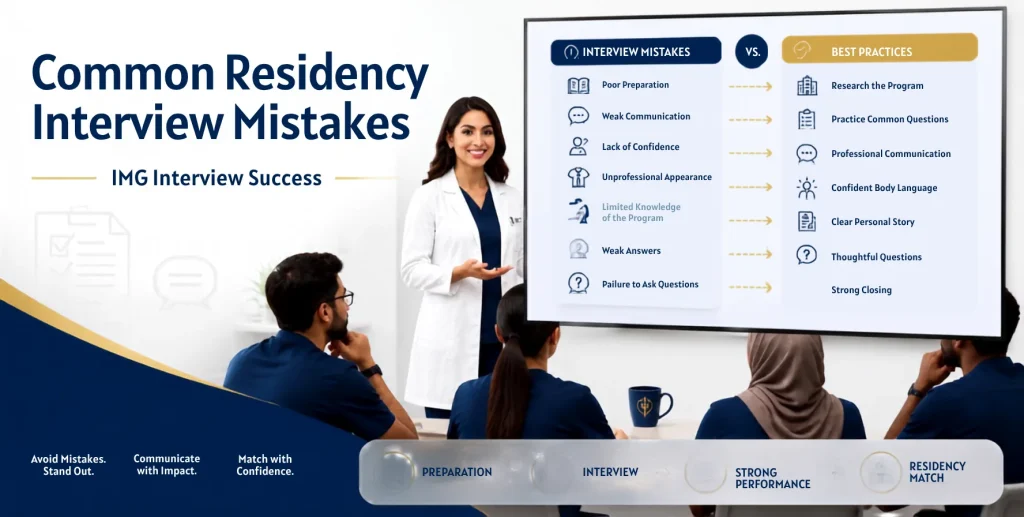

Common residency interview mistakes IMGs make can quietly damage an otherwise strong application.
Many international medical graduates spend months preparing for USMLE exams, personal statements, letters of recommendation, and ERAS, but they underestimate the interview.
The residency interview is where programs decide whether the person matches the application. They want to see maturity, communication, judgment, humility, specialty fit, and readiness for U.S. residency training.
A strong interview can help an IMG rise. A weak interview can make programs hesitate, even when the scores are solid.
This guide breaks down the biggest residency interview mistakes IMGs make and how to avoid them.
Free USMLE Training
Free USMLE Bootcamp
Join our free USMLE masterclass where we break down high-yield concepts, NBME strategies, and clinical reasoning systems used by thousands of medical students and IMGs.
Reserve My SpotWhy Residency Interviews Matter for IMGs
Residency programs use interviews to judge whether you are the kind of person they want to train and work with for several years.
For IMGs, the interview is especially important because programs may want reassurance about U.S. clinical readiness, communication, professionalism, adaptability, and specialty fit.
- Can you communicate clearly?
- Can you explain your journey without sounding scattered?
- Can you discuss red flags with maturity?
- Do you understand the specialty?
- Do you seem teachable and reliable?
- Would residents and faculty enjoy working with you?
The Big Rule
The interview is not just a conversation. It is a trust test. Programs are deciding whether they can trust you with patients, teams, and pressure.
Mistake 1: Sounding Over-Rehearsed
Many IMGs prepare answers so tightly that they sound memorized. This can make the interview feel robotic and disconnected.
Preparation is good. But sounding scripted can make programs wonder whether they are meeting the real person.
How to Fix It
- Prepare key points, not word-for-word speeches.
- Practice answering naturally out loud.
- Keep answers focused but conversational.
- Use real examples from your clinical experience.
- Pause briefly before answering instead of rushing.
Interview Rule
Do not sound memorized. Sound prepared, thoughtful, and human.
Mistake 2: Not Having a Clear Story
Some IMGs have strong experiences but cannot explain their journey clearly. They jump between countries, exams, rotations, gaps, specialties, and personal challenges without a clear thread.
Programs want to understand who you are, why you chose the specialty, what shaped you, and why you are ready now.
Your Interview Story Should Explain
- Where you trained
- Why you chose medicine
- Why this specialty fits you
- How your experiences prepared you
- What you learned from challenges
- Why you are ready for residency now
Story Rule
Your story should make your application easier to understand, not harder.
Mistake 3: Explaining Red Flags Poorly
Red flags do not automatically end your chances, but poor explanations can hurt you badly.
Common red flags include USMLE failures, low scores, graduation gaps, lack of recent clinical experience, specialty changes, visa concerns, professionalism issues, or repeated application cycles.
| Red Flag | Weak Answer | Stronger Answer |
|---|---|---|
| USMLE failure | Blaming the exam, family, or unfair circumstances only | Briefly explain the context, take ownership, and show what changed. |
| Graduation gap | Leaving the timeline vague | Explain what you did clinically, academically, or professionally during the gap. |
| Low score | Apologizing repeatedly | Show growth through later performance, clinical work, and stronger preparation. |
| Specialty switch | Sounding uncertain | Explain the experience that clarified your specialty choice. |
Red Flag Rule
Be honest, brief, accountable, and forward-focused. Do not turn one red flag into the entire interview.
Mistake 4: Not Researching the Program
Programs can tell when applicants know nothing about them. Generic answers make you look like you are applying everywhere without a real reason.
You should know the program’s mission, patient population, curriculum, location, fellowship or career pathways, resident culture, and anything that genuinely connects with your goals.
Before Every Interview, Review
- Program website
- Current residents
- Faculty interests
- Rotation structure
- Patient population
- Research or community work
- Visa policy if relevant
Program Fit Rule
You should be able to explain why that program fits you without sounding like you copied the website.
Mistake 5: Giving Generic Answers
Generic answers are one of the fastest ways to become forgettable. Saying you are hardworking, passionate, dedicated, and eager to learn is not enough.
Those traits matter, but you need examples that prove them.
Turn Generic Answers Into Strong Answers
| Generic Answer | Better Approach | Why It Works |
|---|---|---|
| I am passionate about internal medicine. | Describe a patient case or rotation that shaped your interest. | Specific stories are more memorable. |
| I work well with teams. | Give an example of helping a team solve a problem. | Programs want evidence, not slogans. |
| I am resilient. | Explain a challenge, what you learned, and how you improved. | Growth shows maturity. |
| I want your program because it is excellent. | Name specific features that match your goals. | It shows real interest. |
Mistake 6: Weak Communication Style
Communication matters because residency is built on patient care, teamwork, handoffs, presentations, feedback, and pressure.
Some IMGs lose points not because their English is imperfect, but because their answers are too long, unclear, disorganized, or indirect.
Strong Interview Communication Looks Like This
- Answer the question directly.
- Keep most answers under two minutes.
- Use one clear example when needed.
- Avoid rambling.
- Do not interrupt the interviewer.
- Speak with calm confidence.
- Ask for clarification if needed.
Communication Rule
Clear beats complicated. Programs should never have to work hard to understand your answer.
Mistake 7: Sounding Negative or Defensive
Residency programs notice tone. If you sound bitter, defensive, entitled, or overly critical, that becomes a concern.
This matters especially when discussing exam failures, prior programs, difficult supervisors, visa stress, family pressure, or previous Match attempts.
Avoid Saying
- The exam was unfair.
- My school did not help me.
- No one gave me a chance.
- I deserved more interviews.
- Other applicants had advantages.
- I only need one program to take me.
Instead, focus on accountability, growth, preparation, and what you learned.
Mistake 8: Asking Poor Questions
At the end of the interview, your questions matter. Poor questions can make you look unprepared or focused on the wrong things.
Avoid asking questions that are easily answered on the website or questions that focus too early on vacation, salary, call burden, or benefits.
Better Questions to Ask
- What qualities help residents thrive in this program?
- How does the program support residents who are adjusting to intern year?
- What are the strengths of the clinical training here?
- How do residents receive feedback and mentorship?
- What types of graduates does the program hope to produce?
- How would you describe the resident culture?
Question Rule
Ask questions that show maturity, curiosity, and real interest in becoming a strong resident.
Mistake 9: Poor Follow-Up After Interviews
Follow-up communication should be professional, brief, and respectful. Do not overwhelm coordinators or faculty with repeated messages.
A simple thank-you message can be appropriate when allowed, but it should not sound desperate or generic.
Follow-Up Tips
- Follow program communication rules.
- Send brief thank-you notes if appropriate.
- Personalize the message with one specific detail.
- Do not repeatedly ask for ranking reassurance.
- Do not send emotional or pressure-based messages.
Student Success Story
⭐ 4.8 Google Rating | 120+ ReviewsSee How SmashUSMLE Students Improve Their Scores
Learn how structured clinical reasoning, NBME-focused review, and disciplined preparation can help IMGs break through score plateaus.
Want to learn the same clinical reasoning system used by SmashUSMLE students?
Join Free BootcampNeed Help Preparing for Residency Interviews?
If you are an IMG preparing for residency interviews, you need more than memorized answers. You need a clear story, strong red-flag explanations, confident communication, and a real Match strategy.
SmashUSMLE Reviews helps IMGs strengthen USMLE preparation, clinical reasoning, application readiness, and interview confidence.
FAQ: Common Residency Interview Mistakes IMGs Make
What is the biggest residency interview mistake IMGs make?
One of the biggest mistakes is sounding over-rehearsed or generic. Programs want prepared answers, but they also want honesty, personality, and clear examples.
How should IMGs explain USMLE failures in interviews?
IMGs should explain failures briefly, take ownership, describe what changed, and show evidence of improvement through later exam performance, clinical work, or a stronger study system.
How long should residency interview answers be?
Most answers should be focused and usually under two minutes. Longer answers should still be organized, relevant, and easy to follow.
Should IMGs memorize residency interview answers?
No. IMGs should prepare key points and practice out loud, but word-for-word memorization often sounds robotic and unnatural.
What questions should IMGs ask during residency interviews?
IMGs should ask thoughtful questions about mentorship, resident culture, clinical training, feedback, support during intern year, and what helps residents succeed in the program.
Can a bad interview hurt a strong IMG application?
Yes. A weak interview can hurt even a strong application because programs use interviews to evaluate communication, maturity, professionalism, fit, and readiness for residency.
Ready to Interview With More Confidence?
Residency interviews are easier when your story is clear, your red flags are handled maturely, and your answers sound prepared without sounding memorized. Build your strategy before interview season starts.