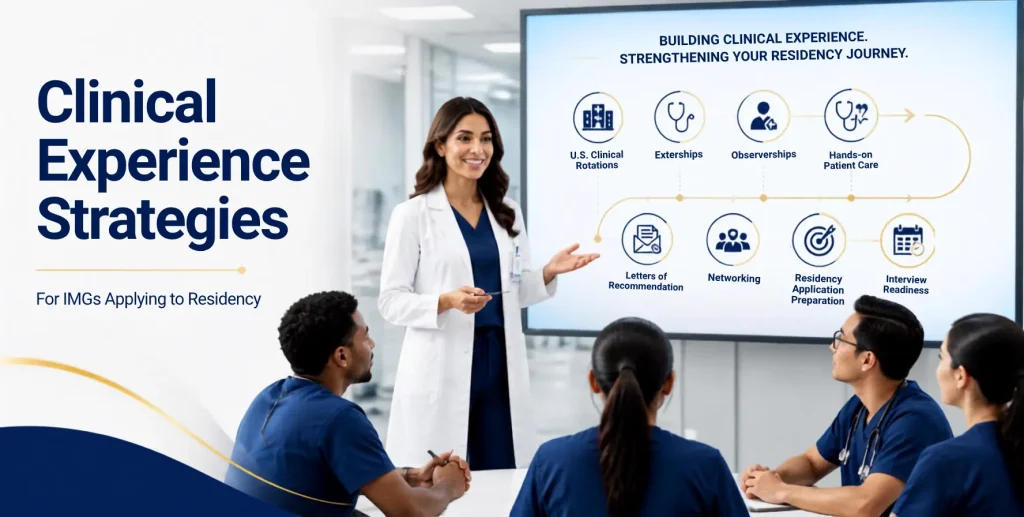

Clinical experience can make or break an IMG residency application. Scores matter, but programs also want proof that you understand the US healthcare system, communicate well with patients and teams, and can function safely in a clinical environment.
Many IMGs focus only on USMLE scores and underestimate how much recent, meaningful clinical experience can strengthen the rest of the application.
The right clinical experience can help you earn stronger letters, clarify your specialty choice, improve interview answers, and show residency programs that you are ready for graduate medical training.
This guide will show you how to choose the right clinical experiences, how to use observerships and externships strategically, how to get better letters, and how to build a stronger IMG residency profile.
Free USMLE Training
Free USMLE Bootcamp
Learn the clinical reasoning, NBME strategy, and study systems used by medical students and IMGs preparing for Step 1, Step 2 CK, and Step 3.
Reserve My SpotWhy Clinical Experience Matters for IMGs
Residency programs want to know that you can transition into the US clinical environment. For IMGs, clinical experience helps answer questions that scores alone cannot answer.
Your clinical experience should show:
- You understand how US hospitals and clinics work.
- You can communicate clearly with patients and healthcare teams.
- You are professional, reliable, and teachable.
- You have recent exposure to the specialty you are applying into.
- You can earn strong letters from physicians who observed your work.
The Big Rule
Clinical experience is not just a box to check. It should create proof that you are ready for residency.
Types of Clinical Experience for IMGs
Not all clinical experiences carry the same weight. Some give you direct patient interaction. Others mainly allow you to observe physicians in the US healthcare system.
| Experience Type | What It Means | Best Use |
|---|---|---|
| Observership | You shadow physicians and observe patient care without hands-on duties. | Helpful for learning US clinical workflow and building professional relationships. |
| Externship | You may have more active involvement depending on the site and rules. | Stronger when it includes patient interaction, presentations, documentation exposure, and feedback. |
| Sub-internship | A more advanced clinical experience, usually for current students. | Useful for showing residency-level readiness if available. |
| Research with Clinical Exposure | Research work connected to a hospital, department, or specialty. | Helpful when paired with mentorship, publications, abstracts, or specialty networking. |
| Volunteer Clinical Role | Service-based clinical exposure in a healthcare setting. | Useful if it shows consistency, patient interaction, and commitment. |
How to Choose the Right US Clinical Experience
The best clinical experience is not always the most expensive one. The best experience is the one that helps your application become more credible.
Before choosing an opportunity, ask:
- Is this experience recent?
- Is it connected to my target specialty?
- Will I work closely enough with an attending to earn a strong letter?
- Will I get meaningful feedback?
- Can I discuss this experience clearly during interviews?
- Does it strengthen a weak part of my application?
Choose With Strategy
Do not collect random clinical experiences. Build a pattern that supports your specialty choice and residency readiness.
How to Make Observerships Stronger
Observerships are common for IMGs, but many students waste them by staying passive. Even if you cannot touch patients or write official notes, you can still show professionalism, curiosity, and clinical growth.
How to Stand Out During an Observership
- Arrive early and dress professionally.
- Read about common diagnoses seen in that clinic or rotation.
- Ask thoughtful questions at the right time.
- Offer to present short topic reviews if appropriate.
- Show consistent interest without interrupting workflow.
- Keep a log of cases and learning points.
- Ask for feedback before the rotation ends.
Your goal is to make the attending comfortable saying, “This applicant is serious, professional, and ready to learn.”
How to Use Externships Strategically
Externships can be powerful because they may give you more active exposure than an observership. If you have the chance to present patients, discuss assessments, or participate in team-based care, take it seriously.
Externship Priorities
- Learn how the team presents patients.
- Practice concise oral presentations.
- Study the most common conditions in that specialty.
- Ask how you can improve after the first few days.
- Be dependable with every assignment.
- Show growth over time.
Externship Rule
Do not treat an externship like a certificate. Treat it like an audition for your professionalism, communication, and clinical reasoning.
How to Earn Strong Letters of Recommendation
Strong letters are one of the biggest reasons clinical experience matters. A generic letter will not help much. A specific letter from a physician who directly observed your growth can make your application stronger.
A strong letter should mention:
- Your clinical reasoning
- Your professionalism
- Your communication skills
- Your reliability
- Your work ethic
- Your improvement during the experience
- Your readiness for residency
How to Ask for a Letter
Ask directly and professionally. Do not ask, “Can you write me a letter?” Ask whether they feel comfortable writing a strong letter supporting your residency application.
Letter Rule
A strong, specific letter from one attending who knows you well is better than a vague letter from a famous physician who barely remembers you.
Use Clinical Experience to Prove Specialty Fit
Residency programs want applicants who understand the specialty they are applying into. Clinical experience helps show that your specialty choice is informed, not random.
If you are applying Internal Medicine, your clinical experience should show comfort with inpatient medicine, outpatient care, chronic disease management, diagnostic reasoning, and team-based care.
If you are applying Family Medicine, your experience should show continuity of care, preventive medicine, broad patient exposure, and comfort with different age groups.
If you are applying Pediatrics, Psychiatry, Emergency Medicine, Surgery, or another specialty, your clinical experience should support that choice with real exposure and clear stories.
Specialty Fit Matters
Programs should be able to read your application and understand why your target specialty makes sense.
How to Present Clinical Experience in ERAS
Do not describe your clinical experiences with vague phrases like “observed patient care” or “learned about medicine.” Be specific about what you saw, what you learned, and how it prepared you for residency.
| Weak Description | Stronger Description |
|---|---|
| Observed physicians in clinic. | Observed outpatient management of diabetes, hypertension, preventive care, and medication counseling while learning US clinic workflow and patient communication. |
| Worked with patients. | Participated in patient intake, case discussions, and follow-up planning under physician supervision in a primary care setting. |
| Learned about internal medicine. | Strengthened clinical reasoning through exposure to common inpatient and outpatient internal medicine presentations. |
| Got a letter of recommendation. | Built a longitudinal mentorship relationship that led to detailed feedback on clinical communication, professionalism, and residency readiness. |
How to Discuss Clinical Experience in Interviews
Your clinical experience should give you strong interview stories. Programs may ask what you learned, why you chose the specialty, how you handled feedback, or what surprised you about the US healthcare system.
Prepare Stories About:
- A patient encounter that confirmed your specialty interest.
- A time you received feedback and improved.
- A physician mentor who influenced your growth.
- A clinical challenge you observed or helped work through.
- What you learned about communication and teamwork.
- How your IMG background shaped your patient care perspective.
Do not memorize robotic answers. Know your stories well enough to explain them naturally, clearly, and with maturity.
Common IMG Clinical Experience Mistakes
1. Waiting Too Long to Get US Clinical Experience
Recent clinical experience is stronger than old experience. Do not wait until the last minute before ERAS opens.
2. Choosing Random Experiences
Random clinical exposure is weaker than a focused pattern that supports your specialty choice.
3. Being Passive During Observerships
You may not be allowed to perform hands-on care, but you can still show preparation, professionalism, and clinical curiosity.
4. Asking for Letters Too Late
Ask for letters while the attending still remembers your performance clearly.
5. Failing to Connect Experience to Your Application Story
Your clinical experience should connect to your personal statement, ERAS descriptions, letters, and interview answers.
IMG Clinical Experience Action Plan
A strong clinical experience plan should be intentional. The goal is to create a profile that feels recent, focused, credible, and consistent.
| Phase | Main Goal | Action Steps |
|---|---|---|
| Phase 1 | Clarify specialty direction | Choose experiences that support your target specialty instead of collecting random rotations. |
| Phase 2 | Secure recent US clinical exposure | Look for observerships, externships, clinics, hospital-based experiences, or research-connected clinical roles. |
| Phase 3 | Perform professionally | Arrive prepared, communicate well, ask thoughtful questions, and show improvement. |
| Phase 4 | Earn strong letters | Build relationships with attendings who can write specifically about your clinical readiness. |
| Phase 5 | Integrate experience into ERAS | Use your clinical experience to strengthen your personal statement, experiences section, and interview stories. |
Student Success Story
⭐ 4.8 Google Rating | 120+ ReviewsSee How SmashUSMLE Students Improve Their Scores
Learn how structured clinical reasoning, NBME-focused review, and disciplined preparation can help IMGs break through score plateaus.
Want to learn the same clinical reasoning system used by SmashUSMLE students?
Join Free BootcampNeed Help Building a Strong IMG Residency Strategy?
If you are an IMG trying to strengthen your clinical experience, USMLE profile, letters, and residency application, you do not need to guess your way through the process.
SmashUSMLE Reviews helps IMGs use structured USMLE preparation, clinical reasoning, QBank practice, NBME weak-area analysis, and one-on-one coaching to build a stronger path toward residency.
FAQ: Clinical Experience Strategies for IMGs
Do IMGs need US clinical experience to match?
US clinical experience is highly valuable because it helps show residency programs that you understand the US healthcare system and can function in a clinical environment.
Is an observership enough for IMG residency applications?
An observership can help, especially if it is recent, specialty-relevant, and leads to a strong letter. However, more active clinical experiences may carry more weight when available.
How many months of clinical experience should an IMG have?
There is no single perfect number, but recent and specialty-relevant experience is important. Quality, letters, and fit matter more than simply collecting months.
How do I get a strong letter of recommendation from clinical experience?
Perform professionally, ask for feedback, show improvement, and ask whether the physician feels comfortable writing a strong letter supporting your residency application.
Can SmashUSMLE help IMGs applying to residency?
Yes. SmashUSMLE can help IMGs strengthen USMLE preparation, clinical reasoning, weak-area strategy, and overall residency readiness.
Ready to Strengthen Your IMG Residency Application?
Strong clinical experience can help your application feel more recent, focused, and credible. Combine that with smart USMLE preparation, better letters, and a clear residency strategy, and you give yourself a stronger chance to move forward.