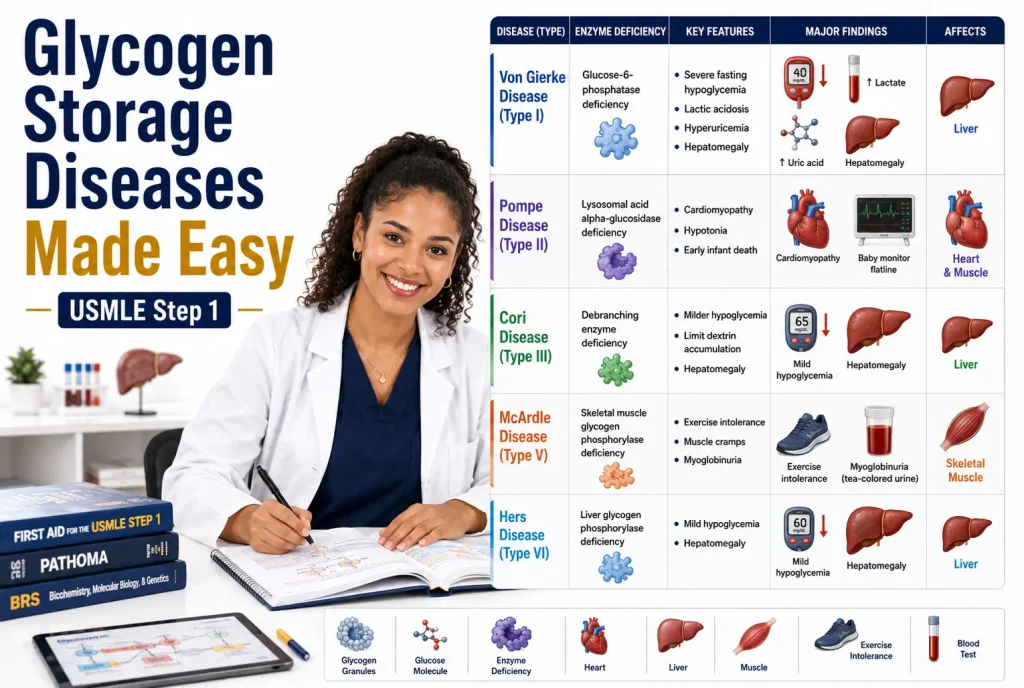

Glycogen Storage Diseases are high-yield USMLE Step 1 disorders that test enzyme defects, fasting hypoglycemia, hepatomegaly, cardiomyopathy, exercise intolerance, and glycogen metabolism.
At first, these diseases can feel like a memorization trap. However, they become much easier when you organize them by organ system.
First, ask whether the disease affects the liver, muscle, heart, or lysosome. Next, connect that organ to the symptom pattern. Finally, match the enzyme defect.
Free USMLE Training
Free USMLE Step 1 Bootcamp
Join our free USMLE masterclass where we break down high-yield concepts, NBME strategies, and clinical reasoning systems used by thousands of students.
Reserve My SpotWhy Glycogen Storage Diseases Matter for Step 1
Glycogen storage diseases are tested because they connect biochemistry to real clinical findings. Therefore, Step 1 often asks about the enzyme defect and the presentation.
Most questions give you a child with hypoglycemia, hepatomegaly, muscle cramps, cardiomyopathy, or exercise intolerance. Then, the answer choices test which enzyme is missing.
The Big Pattern
Liver glycogen diseases usually cause fasting hypoglycemia and hepatomegaly. In contrast, muscle glycogen diseases cause exercise intolerance and cramps.
Meanwhile, Pompe disease is different because it is a lysosomal storage disease. As a result, it causes cardiomyopathy and hypotonia.
The Big Rule
If the vignette says fasting hypoglycemia, think liver. If it says exercise cramps, think muscle. If it says cardiomyopathy in an infant, think Pompe.
Von Gierke Disease, Type I
Von Gierke disease is caused by glucose-6-phosphatase deficiency. Because the liver cannot release free glucose, patients develop severe fasting hypoglycemia.
Classic Clinical Findings
High-yield findings include severe fasting hypoglycemia, lactic acidosis, hyperuricemia, hyperlipidemia, and hepatomegaly.
Also, these patients may have seizures from low glucose. Therefore, any question with severe fasting hypoglycemia should make you think of Von Gierke.
Step 1 Clue
Von Gierke equals glucose-6-phosphatase deficiency with severe fasting hypoglycemia, lactic acidosis, and hyperuricemia.
Pompe Disease, Type II
Pompe disease is caused by lysosomal acid alpha-glucosidase deficiency. Unlike many other glycogen diseases, it involves lysosomal glycogen breakdown.
Classic Clinical Findings
Infants often present with cardiomyopathy, hypotonia, macroglossia, and respiratory weakness. Unfortunately, severe untreated cases can lead to early death.
In addition, the heart is a major clue. Therefore, infant cardiomyopathy plus glycogen accumulation should point to Pompe disease.
Cori Disease, Type III
Cori disease is caused by debranching enzyme deficiency. As a result, patients accumulate abnormal glycogen called limit dextrin.
Classic Clinical Findings
Cori disease can cause hepatomegaly, mild fasting hypoglycemia, and muscle weakness. However, it is usually less severe than Von Gierke disease.
On Step 1, the key difference is severity. Von Gierke causes severe fasting hypoglycemia. Meanwhile, Cori causes milder hypoglycemia.
McArdle Disease, Type V
McArdle disease is caused by skeletal muscle glycogen phosphorylase deficiency. Because muscle cannot break down glycogen well, exercise becomes difficult.
Classic Clinical Findings
Patients develop exercise intolerance, painful muscle cramps, fatigue, and myoglobinuria. Also, symptoms often appear during intense exercise.
A classic test clue is failure of lactate to rise with exercise. Therefore, this disease is mainly a muscle energy problem.
Step 1 Clue
McArdle equals muscle cramps, exercise intolerance, myoglobinuria, and no lactate rise after exercise.
Hers Disease, Type VI
Hers disease is caused by liver glycogen phosphorylase deficiency. Because it mainly affects the liver, it can cause hepatomegaly and mild hypoglycemia.
Classic Clinical Findings
Compared with Von Gierke disease, Hers disease is usually milder. In addition, many patients have better fasting tolerance.
For Step 1, remember the organ. Liver phosphorylase deficiency points to Hers disease. Muscle phosphorylase deficiency points to McArdle disease.
High-Yield Glycogen Storage Disease Table
| Disease | Enzyme Defect | Classic Step 1 Clue |
|---|---|---|
| Von Gierke, Type I | Glucose-6-phosphatase | Severe fasting hypoglycemia, lactic acidosis, hyperuricemia, hepatomegaly |
| Pompe, Type II | Lysosomal acid alpha-glucosidase | Infant cardiomyopathy, hypotonia, lysosomal glycogen accumulation |
| Cori, Type III | Debranching enzyme | Limit dextrin, mild hypoglycemia, hepatomegaly |
| McArdle, Type V | Skeletal muscle glycogen phosphorylase | Exercise intolerance, cramps, myoglobinuria, no lactate rise |
| Hers, Type VI | Liver glycogen phosphorylase | Mild hypoglycemia and hepatomegaly |
How to Answer Glycogen Storage Disease Questions Faster
First, identify the organ system. Liver disease causes fasting hypoglycemia. Muscle disease causes exercise symptoms.
Next, look for severity. Severe fasting hypoglycemia points to Von Gierke. Milder hypoglycemia points toward Cori or Hers.
Use the Organ Shortcut
If the heart is involved in an infant, think Pompe. Meanwhile, if exercise causes cramps and myoglobinuria, think McArdle.
Finally, match the enzyme. This approach is faster than memorizing every disease as a separate list.
Student Success Story
Student Success Testimonial
See how structured USMLE preparation, clinical reasoning, and focused review can help students move forward with confidence.
Need Help Mastering Biochemistry for Step 1?
Biochemistry becomes easier when you connect pathways to clinical findings. Instead of memorizing isolated facts, learn the disease pattern.
SmashUSMLE Reviews helps students simplify Step 1 with clinical reasoning, NBME strategy, and high-yield review.
FAQ: Glycogen Storage Diseases for USMLE Step 1
Which glycogen storage disease causes severe fasting hypoglycemia?
Von Gierke disease causes severe fasting hypoglycemia due to glucose-6-phosphatase deficiency.
Which glycogen storage disease causes cardiomyopathy?
Pompe disease causes cardiomyopathy due to lysosomal acid alpha-glucosidase deficiency.
Which glycogen storage disease causes exercise intolerance?
McArdle disease causes exercise intolerance, cramps, and myoglobinuria due to skeletal muscle glycogen phosphorylase deficiency.
How do I remember glycogen storage diseases?
Use the organ shortcut. Liver means fasting hypoglycemia. Muscle means exercise cramps. Heart in an infant means Pompe.
Ready to Improve Your USMLE Scores?
Step 1 preparation becomes easier when you stop studying randomly and start using a system.