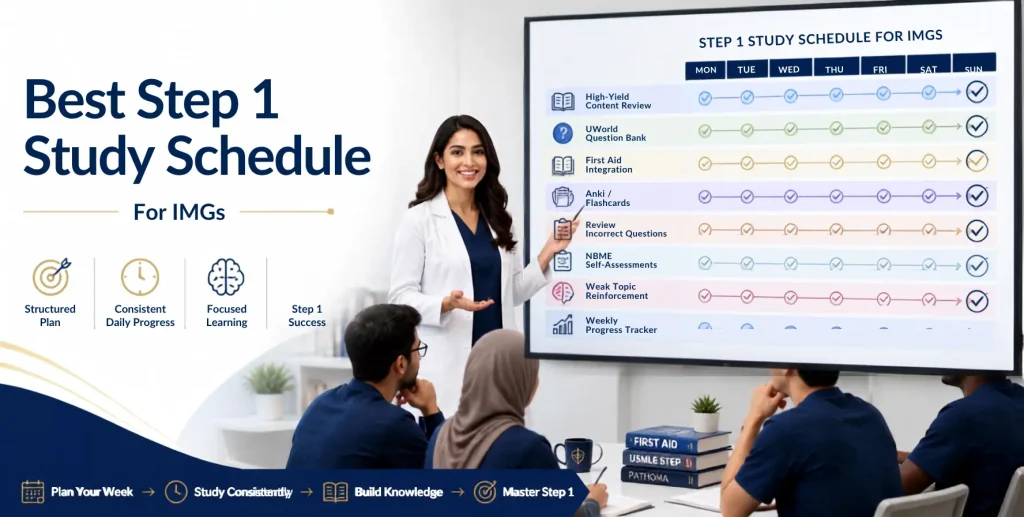

The best Step 1 study schedule for IMGs is not the same schedule used by a traditional U.S. medical student with a protected dedicated study period, recent basic science coursework, and fewer outside responsibilities.
Many IMGs are studying after graduation, after a long gap from foundational sciences, while working, supporting family, managing visa pressure, or trying to rebuild confidence after low NBME scores.
That means your Step 1 study schedule has to be structured, honest, and score-driven. You cannot afford random studying. You need a plan that tells you what to study, when to do questions, when to take NBMEs, how to review mistakes, and how to know when you are truly ready.
This guide will show you how to build a realistic IMG Step 1 schedule using SmashUSMLE Reviews, the Masterclass with AI, the self-paced course, the SmashUSMLE QBank, UWorld, NBME exams, and one-on-one tutoring when needed.
Free USMLE Training
Free USMLE Step 1 Bootcamp
Join our free USMLE masterclass where we break down high-yield concepts, NBME strategies, and clinical reasoning systems used by thousands of medical students and IMGs.
Reserve My SpotWhy IMGs Need a Different Step 1 Study Schedule
IMGs often need a different Step 1 schedule because they are not starting from the same place. Some graduated years ago. Some studied medicine in a curriculum that did not teach in NBME-style clinical vignettes. Some have strong medical knowledge but struggle with U.S. exam patterns.
The mistake is copying someone else’s 6-week dedicated schedule without asking whether your baseline supports that plan.
A strong IMG Step 1 study schedule should do four things:
- Rebuild weak foundational science areas.
- Train NBME-style clinical reasoning.
- Use QBank practice daily.
- Measure progress with scheduled NBME exams.
The IMG Rule
Your schedule should be based on your baseline NBME score, not your anxiety, not someone else’s timeline, and not a random test date you picked too early.
Start With a Baseline NBME Before Building Your Schedule
Before you create your Step 1 study schedule, take a baseline NBME or structured assessment. This tells you where you actually stand.
Many IMGs avoid taking an NBME early because they are afraid of the score. That is understandable, but it is also dangerous. Without a baseline, your study schedule is mostly guessing.
What Your Baseline Tells You
- Which organ systems are weakest.
- Whether your problem is content, application, timing, or fatigue.
- How much time you likely need before exam day.
- Whether you need structured coaching early.
- Which resources should become your priority.
| Baseline Situation | What It Usually Means | Recommended Study Timeline |
|---|---|---|
| Very low baseline | Major foundation gaps and weak NBME reasoning | 12-16+ weeks with structured content repair |
| Moderate baseline | Some foundation exists but application is inconsistent | 8-12 weeks with QBank and NBME-driven review |
| Near passing baseline | Content is close, but weak areas and test strategy need tightening | 6-8 weeks with focused remediation |
| Stuck after multiple attempts | The study method is likely not diagnosing the real problem | One-on-one coaching strongly recommended |
How Long Should IMGs Study for Step 1?
Most IMGs should plan for 8-12 weeks of focused study if they already have a reasonable baseline. If the foundation is weak, 12-16 weeks may be more realistic.
The goal is not to study forever. The goal is to study long enough to become consistently safe on NBME-style assessments.
Do Not Rush Step 1
Passing Step 1 is too important to gamble. If your NBME scores are not where they need to be, moving your exam is usually better than taking it unprepared.
Simple Timeline Recommendation
| IMG Type | Best Schedule Length | Main Focus |
|---|---|---|
| Recent graduate with decent foundation | 8 weeks | QBank practice, NBME review, weak-area repair |
| Graduate with long study gap | 12 weeks | Content rebuild, daily questions, structured review |
| Working IMG | 12-16 weeks | Consistent weekday blocks and longer weekend study |
| Repeat test taker or very low NBME | 12-16+ weeks | Coaching, diagnostic review, targeted remediation |
Best Daily Step 1 Study Schedule for IMGs
A good daily Step 1 schedule should balance learning, questions, review, and memory reinforcement. Most students fail when they only watch videos or only do questions without deep review.
Full-Time IMG Daily Schedule
| Time Block | Task | Purpose |
|---|---|---|
| Morning | SmashUSMLE lesson or Masterclass review | Rebuild weak foundational concepts. |
| Late Morning | Focused QBank block | Apply the topic immediately. |
| Afternoon | Deep question review | Identify content gaps, distractor traps, and reasoning errors. |
| Evening | UWorld or SmashUSMLE QBank mixed questions | Build endurance and integrated reasoning. |
| Night | Flashcards or missed-concept notebook | Reinforce repeated weak points. |
Working IMG Daily Schedule
| Time Block | Task | Purpose |
|---|---|---|
| Before work | 30-45 minutes of high-yield review | Keep momentum daily. |
| After work | One QBank block | Practice active application. |
| Evening | Review missed questions deeply | Convert mistakes into learning points. |
| Weekend | Longer content review plus NBME analysis | Catch up on deeper weak-area repair. |
Best Weekly Step 1 Study Schedule for IMGs
Your weekly schedule should have a clear rhythm. Every week should include content repair, QBank practice, mixed review, and one score-driven adjustment.
| Day | Main Focus | Study Plan |
|---|---|---|
| Monday | Weak system review | Study your weakest NBME system using SmashUSMLE lessons and focused questions. |
| Tuesday | Pathology and physiology | Connect mechanisms to clinical presentations and QBank explanations. |
| Wednesday | Pharmacology and microbiology | Focus on mechanisms, adverse effects, organisms, and clinical clues. |
| Thursday | Mixed QBank practice | Use timed mixed blocks to build integration. |
| Friday | Error review | Review your missed-concept notebook and repeated traps. |
| Saturday | Long study day | Do longer blocks, deeper review, and high-yield system repair. |
| Sunday | Reset and planning | Review the week, adjust weak areas, and plan the next week. |
8-Week Step 1 Study Schedule for IMGs
An 8-week Step 1 schedule works best for IMGs who already have a reasonable baseline and can study full-time or near full-time.
| Week | Main Goal | Study Focus |
|---|---|---|
| Week 1 | Baseline and weak-area mapping | Take a baseline NBME, analyze weak systems, and begin SmashUSMLE Masterclass with AI. |
| Week 2 | Foundation repair | Review weak systems with SmashUSMLE lessons and focused QBank blocks. |
| Week 3 | Question integration | Increase daily QBank volume and review misses by mechanism. |
| Week 4 | NBME reassessment | Take another NBME, compare weak areas, and adjust the study plan. |
| Week 5 | Mixed blocks | Use timed mixed blocks while still repairing persistent weak systems. |
| Week 6 | Clinical reasoning refinement | Focus on distractor traps, question interpretation, and NBME patterns. |
| Week 7 | Final readiness check | Take another NBME or Free 120 and review every miss carefully. |
| Week 8 | Final review | Review high-yield mistakes, sleep strategy, pacing, breaks, and test-day readiness. |
12-Week Step 1 Study Schedule for IMGs
A 12-week Step 1 study schedule is often better for IMGs who need more foundation repair or who are balancing work, family, or other responsibilities.
| Phase | Weeks | Main Goal |
|---|---|---|
| Phase 1 | Weeks 1-4 | Rebuild weak foundations using SmashUSMLE lessons, Masterclass with AI, and focused QBank blocks. |
| Phase 2 | Weeks 5-8 | Increase question volume, start more mixed blocks, and use NBMEs to guide adjustments. |
| Phase 3 | Weeks 9-11 | Focus on NBME readiness, high-yield weak areas, timing, and clinical reasoning. |
| Phase 4 | Week 12 | Final review, Free 120, test-day strategy, and confidence building. |
When to Choose 12 Weeks
Choose a 12-week schedule if your baseline is low, you have been away from basic sciences for a while, or your first NBME shows multiple weak systems.
High-Yield Step 1 Resource
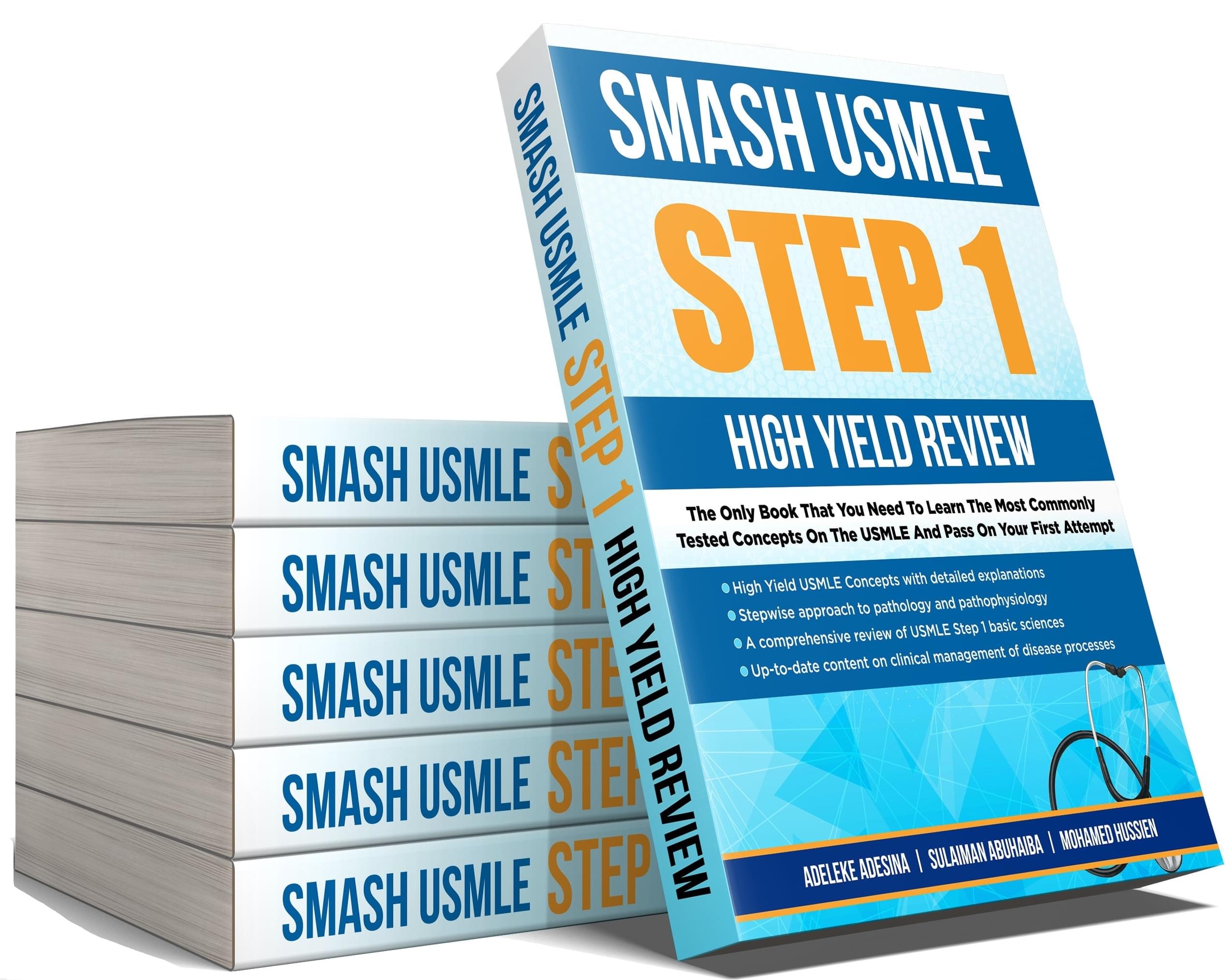
SmashUSMLE High Yield Step 1 Book
If you need a focused Step 1 review resource, use the SmashUSMLE High Yield Step 1 Book to organize the concepts, patterns, and clinical reasoning points that matter most for Step 1.
- Strengthen high-yield Step 1 foundations
- Review core systems more efficiently
- Connect concepts to NBME-style reasoning
- Use alongside SmashUSMLE, NBME review, and QBank practice
Best Step 1 Resources for IMGs
The best resources for IMGs are the ones that give structure, explain concepts clearly, and force active application through questions.
Do not build your schedule around collecting more books, videos, or PDFs. Build it around improving your NBME performance.
| Resource | Purpose | How IMGs Should Use It |
|---|---|---|
| SmashUSMLE Reviews | Structured content review, clinical reasoning, QBank practice, coaching, and NBME strategy | Use as your main system for rebuilding foundations and organizing your schedule. |
| SmashUSMLE Masterclass with AI | High-yield guided review | Use early to reduce overwhelm and create structure. |
| SmashUSMLE QBank | Targeted practice | Use focused blocks for weak areas, then timed mixed blocks later. |
| UWorld | Application and clinical reasoning | Use as a learning tool, not just a percentage tracker. |
| NBME Exams | Readiness assessment | Use every 2-3 weeks to measure improvement and adjust your plan. |
| First Aid | Reference guide | Use as a map, not your only learning source. |
| Anki | Spaced repetition | Use selectively for weak facts and repeated misses. |
How IMGs Should Use NBME Exams
NBMEs should control your Step 1 schedule. After every NBME, your plan should change based on what the exam reveals.
Do not take an NBME, feel bad about the score, and then go back to studying the same way. That is how students stay stuck.
After Every NBME, Ask These Questions
- Which systems were weakest?
- Which subjects were weakest: physiology, pathology, pharmacology, microbiology, biochemistry, immunology, or biostatistics?
- Did I miss questions because I did not know the content?
- Did I miss questions because I misunderstood the vignette?
- Did I keep choosing tempting wrong answers?
- Did fatigue affect my performance?
NBME Strategy
Your next two weeks of studying should be built from your NBME mistakes. Do not study everything equally when your NBME already told you what is weak.
How to Use UWorld and QBank Practice in Your IMG Step 1 Schedule
Questions are the center of Step 1 improvement, but only if you review them correctly.
Many IMGs do thousands of questions and still do not improve because they treat QBank review like reading. That is not enough. You need to diagnose the reason behind every miss.
The Correct QBank Review Method
- Do timed blocks when you are building endurance.
- Do focused blocks when repairing weak systems.
- Review every missed question by mechanism.
- Write one short takeaway from each miss.
- Track repeated errors in a missed-concept notebook.
- Redo weak topics after several days to confirm retention.
| QBank Mistake | What Students Usually Do | What You Should Do Instead |
|---|---|---|
| Content gap | Read the explanation and move on | Return to the topic in SmashUSMLE and rebuild the concept. |
| Application gap | Say “I knew that” | Write why you failed to apply the concept in the vignette. |
| Distractor trap | Blame the question | Identify the clue that separated the right answer from the wrong one. |
| Timing problem | Just do more questions | Practice timed blocks and decision-making rhythm. |
Common IMG Step 1 Study Mistakes
1. Studying Without a Baseline NBME
Without a baseline, you do not know whether you need 6 weeks, 8 weeks, 12 weeks, or more. Start with data.
2. Watching Too Many Videos Without Doing Questions
Videos can help rebuild foundations, but Step 1 is passed through application. Every major topic should be followed by questions.
3. Reviewing Questions Too Passively
Reading explanations is not enough. You need to identify why you missed the question and what pattern you must recognize next time.
4. Taking NBMEs Too Late
If you wait until the final weeks to take an NBME, you may discover serious weak areas too late.
5. Ignoring Help When Scores Are Stuck
If you have studied for weeks and your NBME scores are not improving, the problem is usually your method. One-on-one tutoring can help identify the real issue faster.
Student Success Story
⭐ 4.8 Google Rating | 120+ ReviewsSee How SmashUSMLE Students Improve Their Scores
Learn how structured clinical reasoning, NBME-focused review, and disciplined preparation can help IMGs break through score plateaus.
Want to learn the same clinical reasoning system used by SmashUSMLE students?
Join Free BootcampNeed Help Building a Step 1 Study Schedule as an IMG?
If you are overwhelmed by UWorld, NBME scores, First Aid, Anki, and resource overload, you are not alone. Most IMGs do not need more resources. They need a better system.
SmashUSMLE Reviews helps IMGs use the Masterclass with AI, self-paced course, QBank practice, NBME weak-area analysis, and one-on-one tutoring to build a smarter Step 1 preparation plan.
FAQ: Best Step 1 Study Schedule for IMGs
What is the best Step 1 study schedule for IMGs?
The best Step 1 study schedule for IMGs is usually an 8-12 week plan built around baseline NBME testing, structured content review, daily QBank practice, deep question review, and repeat NBME assessments.
How many hours should an IMG study for Step 1 each day?
Full-time IMGs often study 6-8 hours per day. Working IMGs may study 2-4 hours on weekdays and longer blocks on weekends. The key is consistency and score-based adjustment.
Should IMGs take an NBME before starting Step 1 preparation?
Yes. A baseline NBME helps identify weak systems, estimate how much time you need, and prevent wasting weeks on random studying.
Is 8 weeks enough for IMG Step 1 preparation?
Eight weeks can be enough if your baseline is close to passing and you can study consistently. If your foundation is weak or your baseline is low, a 12-week or longer plan is usually safer.
Should IMGs use SmashUSMLE before UWorld?
Yes. SmashUSMLE can help IMGs rebuild foundations, create structure, and improve clinical reasoning before and during UWorld review.
When should an IMG get Step 1 tutoring?
Consider tutoring if your NBME scores are stuck, you have failed before, you keep missing the same question types, or you cannot identify why your study plan is not working.
Ready to Improve Your USMLE Scores?
Step 1 preparation becomes easier when you stop studying randomly and start using a system. Join thousands of medical students and IMGs using SmashUSMLE’s clinical reasoning system to prepare for Step 1, Step 2 CK, and Step 3.