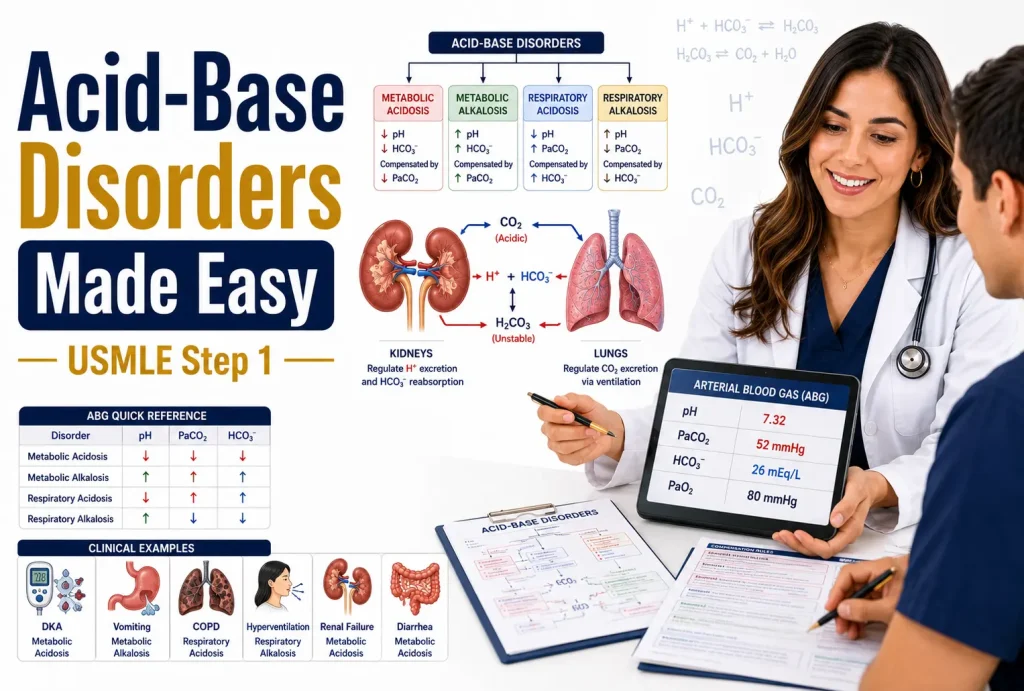

Acid-Base Disorders are one of the highest-yield physiology topics tested on USMLE Step 1. Learning how to interpret ABGs, recognize metabolic and respiratory disorders, calculate the anion gap, and understand compensation will help you solve common clinical vignettes faster.
Most students struggle because they look at the ABG and panic. However, acid-base questions usually follow a predictable pattern. First, identify the pH. Next, decide whether the primary problem is metabolic or respiratory. Then, check compensation.
This guide will show you how to recognize metabolic acidosis, metabolic alkalosis, respiratory acidosis, respiratory alkalosis, mixed disorders, and high anion gap patterns.
Free USMLE Training
Free USMLE Step 1 Bootcamp
Join our free USMLE masterclass where we break down high-yield physiology, NBME strategies, and clinical reasoning systems.
Reserve My SpotThe 3-Step Acid-Base Method
Acid-base questions are not meant to be guessed. Instead, you should walk through the same process every time.
Step 1: Start With the pH
First, decide whether the patient is acidemic or alkalemic.
| pH | Meaning |
|---|---|
| Less than 7.35 | Acidemia |
| Greater than 7.45 | Alkalemia |
| 7.35 to 7.45 | Normal or compensated disorder |
Step 2: Find the Primary Problem
PaCO₂ reflects the lungs. HCO₃⁻ reflects the metabolic system and kidneys.
| Disorder | pH | Main Abnormality |
|---|---|---|
| Metabolic acidosis | Low | Low HCO₃⁻ |
| Metabolic alkalosis | High | High HCO₃⁻ |
| Respiratory acidosis | Low | High PaCO₂ |
| Respiratory alkalosis | High | Low PaCO₂ |
Step 3: Check Compensation
If the primary disorder is metabolic, the lungs compensate. If the primary disorder is respiratory, the kidneys compensate.
High-Yield Rule
Compensation never overcorrects the pH. If the pH moves to the opposite side, suspect a mixed acid-base disorder.
Metabolic Acidosis
Metabolic acidosis means bicarbonate is low. As a result, the blood becomes acidic. The lungs compensate by blowing off CO₂ through hyperventilation.
Common USMLE Causes
- Diabetic ketoacidosis
- Lactic acidosis
- Renal failure
- Diarrhea
- Methanol, ethylene glycol, or salicylate toxicity
High Anion Gap vs Normal Anion Gap
Once you identify metabolic acidosis, check the anion gap.
Anion Gap Formula
Anion gap = Na⁺ − Cl⁻ − HCO₃⁻
| Type | Classic Causes |
|---|---|
| High anion gap metabolic acidosis | DKA, lactic acidosis, renal failure, methanol, ethylene glycol, salicylates |
| Normal anion gap metabolic acidosis | Diarrhea, renal tubular acidosis, acetazolamide |
If the vignette says deep, rapid breathing in a patient with diabetes, think diabetic ketoacidosis. That breathing pattern is Kussmaul respiration.
Metabolic Alkalosis
Metabolic alkalosis means bicarbonate is high. Therefore, the blood becomes alkaline. The lungs compensate by retaining CO₂ through hypoventilation.
Common USMLE Causes
- Vomiting
- Nasogastric suction
- Loop diuretics
- Thiazide diuretics
- Hyperaldosteronism
Memory Hook
Vomiting removes acid from the stomach, so the blood becomes alkaline.
Respiratory Acidosis
Respiratory acidosis means PaCO₂ is high. Since CO₂ acts like an acid in the blood, poor ventilation causes CO₂ retention and a low pH.
Common USMLE Causes
- COPD
- Opioid overdose
- Neuromuscular weakness
- Severe asthma
- Airway obstruction
Acute vs Chronic Respiratory Acidosis
| Type | Pattern |
|---|---|
| Acute respiratory acidosis | High PaCO₂, low pH, little HCO₃⁻ increase |
| Chronic respiratory acidosis | High PaCO₂, near-normal pH, elevated HCO₃⁻ |
Respiratory Alkalosis
Respiratory alkalosis means PaCO₂ is low. This happens when a patient hyperventilates and blows off too much CO₂.
Common USMLE Causes
- Panic attack
- High altitude
- Pregnancy
- Sepsis
- Early salicylate toxicity
A young patient with anxiety, tingling around the mouth, and lightheadedness is usually hyperventilating. Therefore, the likely disorder is respiratory alkalosis.
Mixed Acid-Base Disorders
Mixed disorders happen when more than one primary acid-base problem occurs at the same time.
Classic Example: Salicylate Toxicity
Salicylate toxicity can cause respiratory alkalosis early because it stimulates the respiratory center. Later, it causes metabolic acidosis due to accumulation of organic acids.
USMLE Toxicology Pattern
Salicylates can cause both respiratory alkalosis and metabolic acidosis.
USMLE Acid-Base Pattern Table
| Disorder | pH | PaCO₂ | HCO₃⁻ | Classic Clue |
|---|---|---|---|---|
| Metabolic acidosis | Low | Low compensation | Low | DKA, diarrhea, renal failure |
| Metabolic alkalosis | High | High compensation | High | Vomiting, diuretics |
| Respiratory acidosis | Low | High | High if chronic | COPD, opioid overdose |
| Respiratory alkalosis | High | Low | Low if chronic | Panic, pregnancy, altitude |
High-Yield Step 1 Resource
SmashUSMLE High Yield Step 1 Book
If you need a focused Step 1 review resource, use the SmashUSMLE High Yield Step 1 Book to organize the concepts and clinical reasoning points that matter most.
- Strengthen high-yield Step 1 foundations
- Review renal and respiratory physiology more efficiently
- Connect acid-base patterns to NBME-style reasoning
- Use alongside SmashUSMLE, NBME review, and QBank practice

Student Success Story
⭐ 4.8 Google Rating | 120+ ReviewsSee How Dr. Evelyn Passed Step 1 and Step 2
Dr. Evelyn’s story shows how structured clinical reasoning, NBME-focused review, and disciplined preparation can help students move forward with confidence.
Want to learn the same clinical reasoning system used by SmashUSMLE students?
Join Free BootcampNeed Help Mastering Acid-Base Disorders for Step 1?
Acid-base disorders become easier when you learn the pattern. If you are overwhelmed by renal physiology, respiratory physiology, ABGs, and compensation rules, SmashUSMLE can help you study with a clearer system.
FAQ: Acid-Base Disorders for USMLE Step 1
What is the fastest way to solve acid-base questions?
Start with the pH, identify whether the primary problem is metabolic or respiratory, then check compensation.
How do I remember metabolic acidosis?
Metabolic acidosis means low bicarbonate. Common causes include DKA, lactic acidosis, renal failure, diarrhea, and toxic alcohol ingestion.
What causes metabolic alkalosis on USMLE?
The classic causes are vomiting, nasogastric suction, loop diuretics, thiazide diuretics, and hyperaldosteronism.
What is the classic acid-base disorder in salicylate toxicity?
Salicylate toxicity classically causes early respiratory alkalosis and later high anion gap metabolic acidosis.
Does compensation ever overcorrect the pH?
No. Compensation does not overcorrect. If the pH crosses to the opposite side, suspect a mixed acid-base disorder.
Ready to Improve Your USMLE Scores?
Step 1 preparation becomes easier when you stop studying randomly and start using a system. Join thousands of medical students and IMGs using SmashUSMLE’s clinical reasoning system.