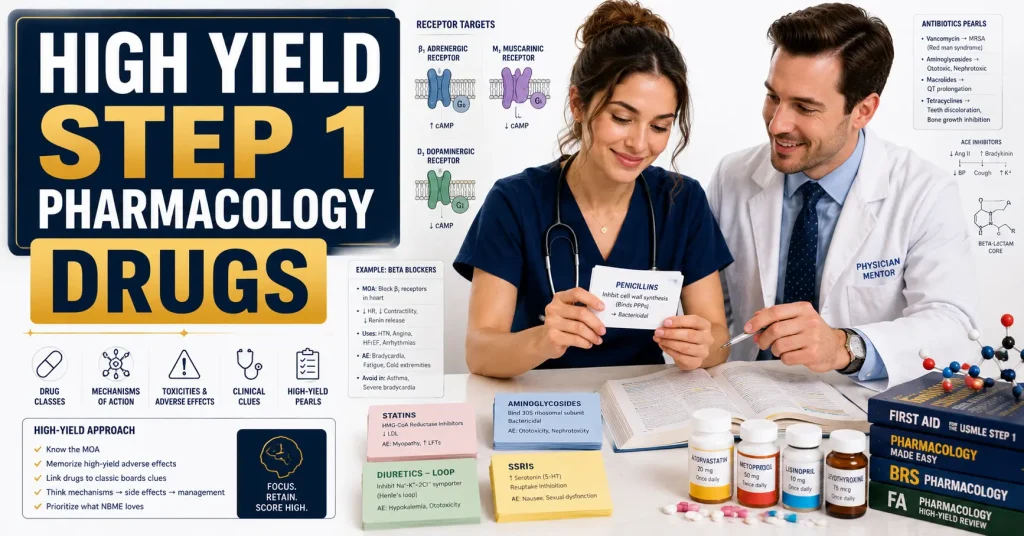

Most Common Pharmacology Drugs Tested on Step 1 can feel overwhelming because the exam rarely asks simple drug-name recall.
Students often struggle because they memorize long drug lists without understanding mechanisms, receptor effects, toxicities, contraindications, and clinical clues.
The best way to master Step 1 pharmacology is to connect each drug to a mechanism, a disease pattern, an adverse effect, and a classic vignette clue.
This guide breaks down the highest-yield pharmacology drug classes for Step 1 so you can study smarter, recognize common test patterns, and avoid wasting time on low-yield memorization.
Free USMLE Training
Free USMLE Step 1 Bootcamp
Join our free USMLE masterclass where we break down high-yield pharmacology, NBME strategies, and clinical reasoning systems used by thousands of medical students and IMGs.
Reserve My SpotMost Common Pharmacology Drugs Tested on Step 1
The most common pharmacology drugs tested on Step 1 usually appear through mechanisms, adverse effects, contraindications, receptor changes, or clinical outcomes.
Instead of asking, “What does this drug do?” Step 1 often asks, “Which mechanism explains this effect?” or “Which adverse effect is most likely?”
The Step 1 Pharmacology Rule
For every drug class, know the mechanism, major use, major toxicity, contraindication, and classic vignette clue.
Autonomic Pharmacology
Autonomic drugs are high yield because they test receptors, second messengers, organ effects, and toxidromes.
| Drug or Class | High-Yield Mechanism | Classic Step 1 Clue |
|---|---|---|
| Beta blockers | Block beta-adrenergic receptors | Bradycardia, asthma caution, reduced renin release |
| Alpha-1 blockers | Block vascular alpha-1 receptors | Orthostatic hypotension, BPH symptom relief |
| Muscarinic agonists | Increase parasympathetic activity | Salivation, lacrimation, urination, diarrhea |
| Atropine | Muscarinic antagonist | Hot, dry, blind, mad, tachycardic |
| Organophosphates | Inhibit acetylcholinesterase | Cholinergic toxicity treated with atropine and pralidoxime |
Cardiovascular Drugs
Cardiovascular pharmacology is heavily tested because it connects physiology, receptors, ion channels, renal effects, and adverse reactions.
- ACE inhibitors: decrease angiotensin II and aldosterone; watch for cough, angioedema, hyperkalemia, and teratogenicity.
- ARBs: block angiotensin II receptors without the classic bradykinin cough.
- Loop diuretics: inhibit NKCC in the thick ascending limb; cause hypokalemia, ototoxicity, and hypocalcemia.
- Thiazides: inhibit NCC in the distal tubule; cause hypercalcemia, hyperuricemia, and hypokalemia.
- Statins: inhibit HMG-CoA reductase; know myopathy and hepatotoxicity.
- Amiodarone: antiarrhythmic with pulmonary fibrosis, thyroid dysfunction, liver toxicity, and corneal deposits.
Step 1 Pharmacology Worksheet
Download the High-Yield Pharmacology Worksheet
Use this worksheet to organize drug classes, mechanisms, adverse effects, contraindications, and classic USMLE vignette clues.
- Organize drug classes by system
- Track major toxicities
- Review mechanisms faster
- Connect drugs to NBME-style clues
Antibiotics
Antibiotics are among the most common pharmacology drugs tested on Step 1 because they combine microbiology, mechanisms, resistance, and toxicities.
| Drug Class | Mechanism | High-Yield Toxicity |
|---|---|---|
| Beta-lactams | Inhibit cell wall synthesis | Hypersensitivity reactions |
| Vancomycin | Binds D-Ala-D-Ala | Red man syndrome, nephrotoxicity, ototoxicity |
| Aminoglycosides | Bind 30S ribosomal subunit | Nephrotoxicity, ototoxicity |
| Tetracyclines | Bind 30S ribosomal subunit | Tooth discoloration, photosensitivity, avoid in pregnancy |
| Macrolides | Bind 50S ribosomal subunit | QT prolongation, GI upset |
| Fluoroquinolones | Inhibit DNA gyrase/topoisomerase | Tendon rupture, QT prolongation, cartilage toxicity |
Antivirals and Antifungals
Antivirals and antifungals are usually tested through mechanism, viral enzyme target, fungal cell membrane effect, or toxicity.
- Acyclovir: guanosine analog used for herpesviruses; toxicity includes crystal nephropathy.
- Ganciclovir: CMV drug; toxicity includes bone marrow suppression.
- Oseltamivir: neuraminidase inhibitor for influenza.
- Azoles: inhibit ergosterol synthesis; can cause hepatotoxicity and drug interactions.
- Amphotericin B: binds ergosterol; causes nephrotoxicity and infusion reactions.
- Echinocandins: inhibit fungal cell wall beta-glucan synthesis.
Psychiatric Drugs
Psychiatric pharmacology is high yield because Step 1 loves adverse effects, receptor profiles, overdose patterns, and drug interactions.
Psych Pharm Tip
Do not only memorize the drug name. Know the receptor effect, time to benefit, withdrawal issue, overdose finding, and classic toxicity.
- SSRIs: first-line antidepressants; know sexual dysfunction and serotonin syndrome.
- TCAs: anticholinergic effects, cardiotoxicity, sodium channel blockade.
- MAO inhibitors: tyramine crisis and serotonin syndrome risk.
- Lithium: tremor, hypothyroidism, nephrogenic diabetes insipidus, Ebstein anomaly.
- Clozapine: agranulocytosis, seizures, myocarditis.
- Haloperidol: extrapyramidal symptoms and neuroleptic malignant syndrome.
Endocrine Drugs
Endocrine pharmacology questions often test hormones, receptors, metabolic effects, and adverse reactions.
- Insulin: hypoglycemia and weight gain.
- Metformin: decreases hepatic gluconeogenesis; watch for lactic acidosis.
- Sulfonylureas: increase insulin release; hypoglycemia risk.
- Levothyroxine: thyroid hormone replacement.
- Methimazole/PTU: inhibit thyroid hormone synthesis; PTU also blocks peripheral conversion.
- Bisphosphonates: inhibit osteoclast activity; esophagitis is a classic adverse effect.
Cancer and Immunology Drugs
Cancer drugs are commonly tested through cell-cycle specificity, mechanism, and toxicities.
| Drug | Mechanism | Classic Toxicity |
|---|---|---|
| Doxorubicin | Topoisomerase II inhibitor, free radicals | Dilated cardiomyopathy |
| Bleomycin | Free radical formation | Pulmonary fibrosis |
| Cyclophosphamide | Alkylating agent | Hemorrhagic cystitis |
| Methotrexate | Inhibits dihydrofolate reductase | Myelosuppression, mucositis, hepatotoxicity |
| Vincristine | Microtubule inhibitor | Peripheral neuropathy |
High-Yield Drug Toxicities
Drug toxicity questions are extremely common because they test whether you can recognize a medication from an adverse effect.
- ACE inhibitors: cough, angioedema, hyperkalemia, fetal toxicity.
- Aminoglycosides: nephrotoxicity and ototoxicity.
- Vancomycin: red man syndrome.
- Statins: myopathy and hepatotoxicity.
- Amiodarone: pulmonary fibrosis and thyroid dysfunction.
- Warfarin: teratogenicity and bleeding.
- Heparin: HIT and bleeding.
- Lithium: nephrogenic DI and hypothyroidism.
- Clozapine: agranulocytosis.
- Bleomycin: pulmonary fibrosis.
USMLE-Style Pharmacology Question Box
Question: A patient taking medication for bipolar disorder develops tremor, polyuria, and hypothyroidism. Which drug is most likely responsible?
Answer: Lithium.
Reasoning: Lithium is high yield for Step 1 because it can cause tremor, hypothyroidism, nephrogenic diabetes insipidus, and teratogenic cardiac defects.
Recommended Step 1 Resource
High Yield Step 1 Review Book
The High Yield Step 1 Review Book helps students organize pharmacology mechanisms, toxicities, and clinical patterns without getting lost in low-yield drug lists.
Get the High Yield Step 1 Book
Student Success Story
⭐ 4.8 Google Rating | 120+ ReviewsSee How Dr. Mark Passed Step 1
Dr. Mark’s story shows how structured Step 1 preparation, high-yield review, and clinical reasoning can help students build confidence and move forward successfully.
Want to learn the same Step 1 strategy used by SmashUSMLE students?
Join Free BootcampNeed Help Mastering Step 1 Pharmacology?
If drug mechanisms, toxicities, autonomic pharmacology, antibiotics, and psych drugs feel overwhelming, SmashUSMLE can help you study pharmacology through clinical reasoning instead of memorizing random lists.
FAQ: Most Common Pharmacology Drugs Tested on Step 1
What are the Most Common Pharmacology Drugs Tested on Step 1?
The most common pharmacology drugs tested on Step 1 include autonomic drugs, antibiotics, antivirals, antifungals, cardiovascular drugs, psychiatric medications, endocrine drugs, cancer drugs, and drugs with classic toxicities.
How should I study pharmacology for Step 1?
Study each drug by mechanism, clinical use, adverse effect, contraindication, and classic vignette clue. Avoid memorizing drug lists without understanding how the drug works.
Are drug toxicities high yield for Step 1?
Yes. Step 1 commonly tests drug toxicities because adverse effects help distinguish one medication from another in clinical vignettes.
Which antibiotics are most high yield for Step 1?
High-yield antibiotics include beta-lactams, vancomycin, aminoglycosides, tetracyclines, macrolides, fluoroquinolones, sulfonamides, and metronidazole.
What is the biggest mistake students make with Step 1 pharmacology?
The biggest mistake is memorizing isolated drug names without connecting them to mechanisms, receptors, side effects, contraindications, and clinical clues.
Ready to Improve Your USMLE Scores?
Step 1 pharmacology becomes easier when you stop memorizing random drug lists and start using a clinical reasoning system. SmashUSMLE helps students prepare with structured review, high-yield strategy, courses, tutoring, and free training.