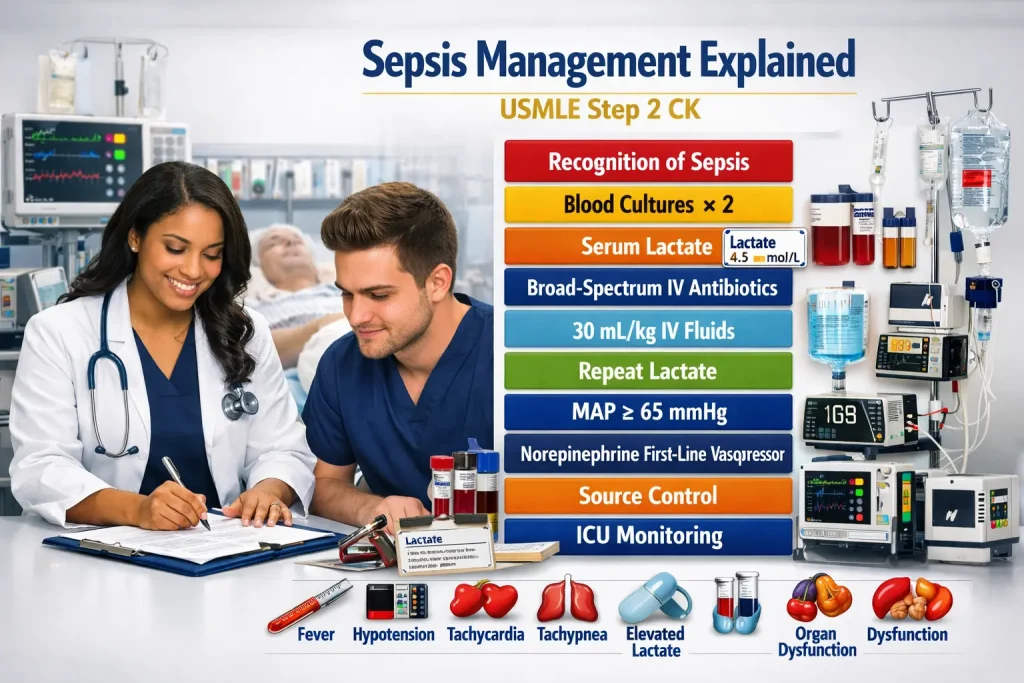

Sepsis management for Step 2 CK is one of the most important emergency medicine topics because it tests rapid recognition, early treatment, and escalation when shock does not improve.
The exam usually gives you a sick patient with fever, hypotension, tachycardia, altered mental status, pneumonia, pyelonephritis, cellulitis, meningitis, intra-abdominal infection, or an infected line.
Your job is to recognize sepsis early, obtain key labs and cultures, give broad-spectrum antibiotics, provide IV fluids, and start vasopressors when hypotension persists.
This guide breaks down the sepsis algorithm, septic shock management, antibiotic timing, fluid resuscitation, vasopressor choice, source control, and the most common Step 2 CK traps.
Free USMLE Training
Free USMLE Step 2 CK Bootcamp
Join our free USMLE masterclass where we break down high-yield clinical reasoning, emergency medicine algorithms, and board-style decision making.
Reserve My SpotWhy Sepsis Matters for Step 2 CK
Sepsis questions are high-yield because they test whether you can act before the patient crashes. Step 2 CK rewards early recognition and early treatment.
These questions often look like pneumonia, UTI, cellulitis, cholangitis, meningitis, or intra-abdominal infection. However, the real question is usually about unstable infection management.
The Big Rule
If the patient has suspected infection plus organ dysfunction or hypotension, do not wait. Start sepsis management immediately.
How to Recognize Sepsis
Sepsis is life-threatening organ dysfunction caused by a dysregulated response to infection. On Step 2 CK, you do not need a perfect definition to act.
Look for infection plus signs of systemic illness or organ dysfunction.
- Fever or hypothermia
- Tachycardia
- Tachypnea
- Hypotension
- Altered mental status
- Elevated lactate
- Acute kidney injury
- Thrombocytopenia
- Hypoxemia
Exam Trap
Elderly, immunocompromised, and diabetic patients may not have a high fever. Do not rule out sepsis just because the temperature is normal.
Initial Sepsis Management
The initial management of sepsis should happen quickly. Step 2 CK often tests the correct order of actions.
- Assess airway, breathing, and circulation.
- Place IV access and monitor vital signs.
- Measure serum lactate.
- Obtain blood cultures before antibiotics if this does not delay treatment.
- Give broad-spectrum IV antibiotics early.
- Give IV crystalloid fluids for hypotension or elevated lactate.
- Start norepinephrine if hypotension persists after fluids.
- Search for the source and obtain source control.
Board Rule
Cultures are important, but antibiotics should not be delayed in a sick septic patient.
When to Give Antibiotics in Sepsis
Broad-spectrum IV antibiotics should be given early when sepsis or septic shock is suspected. The antibiotic choice depends on the likely source, severity, local resistance, and patient risk factors.
For Step 2 CK, the exact antibiotic may matter less than recognizing that unstable sepsis requires early empiric coverage.
- Pneumonia source: Cover common respiratory pathogens.
- Urinary source: Cover gram-negative organisms.
- Skin source: Cover Staphylococcus and Streptococcus.
- Intra-abdominal source: Cover gram-negatives and anaerobes.
- Line infection: Consider MRSA and gram-negative coverage.
Do Not Miss This
If the patient is unstable, give antibiotics now. Do not wait for imaging, culture results, or a perfect source diagnosis.
IV Fluids in Sepsis
IV crystalloid fluids are used for sepsis-induced hypotension or elevated lactate. The classic board-style starting dose is 30 mL/kg crystalloid.
After fluids, reassess perfusion. Look at blood pressure, urine output, mental status, capillary refill, lactate trend, and signs of volume overload.
- Preferred fluid: Isotonic crystalloid.
- Goal: Improve perfusion.
- Reassess: Blood pressure, urine output, lactate, mental status.
- Be careful: Heart failure, renal failure, and pulmonary edema risk.
Vasopressors in Septic Shock
Septic shock means sepsis with persistent hypotension requiring vasopressors despite adequate fluid resuscitation, often with elevated lactate.
The first-line vasopressor for septic shock is norepinephrine.
High-Yield Step 2 CK Rule
If the patient remains hypotensive after IV fluids, start norepinephrine. Do not keep giving endless fluids while perfusion worsens.
Source Control in Sepsis
Antibiotics are critical, but some septic patients will not improve until the source is controlled.
Source control means removing, draining, or correcting the infectious source.
- Drain an abscess.
- Remove an infected central line.
- Decompress an obstructed infected kidney.
- Perform surgery for perforated bowel.
- Drain infected biliary obstruction.
Exam Trap
Septic shock from an abscess, obstructed infected stone, or perforated abdomen needs source control. Antibiotics alone may not be enough.
Common Step 2 CK Sepsis Scenarios
Urosepsis With Obstructing Stone
A septic patient with flank pain, hydronephrosis, and an obstructing stone needs antibiotics plus urgent decompression.
Septic Shock From Pneumonia
A patient with fever, cough, infiltrate, hypotension, and elevated lactate needs broad-spectrum antibiotics, fluids, and vasopressors if hypotension persists.
Cholangitis
Fever, right upper quadrant pain, jaundice, hypotension, or altered mental status suggests ascending cholangitis. Management requires antibiotics and biliary drainage.
Necrotizing Fasciitis
Severe pain out of proportion, fever, toxicity, crepitus, or rapidly spreading skin infection requires broad antibiotics and urgent surgical debridement.
Sepsis Management Summary Table
| Step | What to Do | Step 2 CK Point |
|---|---|---|
| Recognize sepsis | Suspected infection plus organ dysfunction | Do not wait for perfect confirmation |
| Measure lactate | Check tissue hypoperfusion | Elevated lactate suggests severity |
| Blood cultures | Obtain before antibiotics if feasible | Do not delay antibiotics in unstable patients |
| Antibiotics | Give broad-spectrum IV antibiotics early | Cover likely source and resistant organisms |
| Fluids | Give isotonic crystalloid for hypotension or elevated lactate | Classic dose is 30 mL/kg |
| Vasopressors | Start norepinephrine if hypotension persists | Norepinephrine is first-line |
| Source control | Drain, remove, decompress, or operate | Required when antibiotics alone cannot fix the source |
Student Success Story
⭐ 4.8 Google Rating | 120+ ReviewsSee How SmashUSMLE Helps Students Think Clinically
Sepsis questions become easier when you recognize the unstable patient, start treatment early, and know when to escalate to vasopressors or source control.
Want to learn the same clinical reasoning system used by SmashUSMLE students?
Join Free BootcampNeed Help Mastering Step 2 CK Algorithms?
If sepsis questions feel confusing, the problem is usually not effort. The problem is not having a clear emergency medicine decision pathway.
SmashUSMLE helps students connect clinical findings to diagnosis, treatment, escalation, and next best step reasoning.
FAQ: Sepsis Management for Step 2 CK
What is the first step in sepsis management?
First, recognize suspected infection with organ dysfunction or hypotension. Then begin early sepsis management with lactate, cultures if feasible, IV antibiotics, fluids, and monitoring.
Should blood cultures be drawn before antibiotics?
Blood cultures should be obtained before antibiotics when feasible. However, antibiotics should not be delayed in an unstable septic patient.
What fluid is used in sepsis?
Isotonic crystalloid is used for sepsis-induced hypotension or elevated lactate. The classic board-style initial dose is 30 mL/kg.
What is the first-line vasopressor in septic shock?
Norepinephrine is the first-line vasopressor for septic shock when hypotension persists after adequate fluid resuscitation.
What is source control in sepsis?
Source control means draining, removing, decompressing, or surgically correcting the infectious source, such as an abscess, infected line, obstructed kidney, or perforated bowel.
Ready to Improve Your Step 2 CK Score?
Step 2 CK becomes easier when you stop memorizing isolated facts and start recognizing clinical patterns. SmashUSMLE helps students build the reasoning system needed to answer board-style questions faster and more accurately.