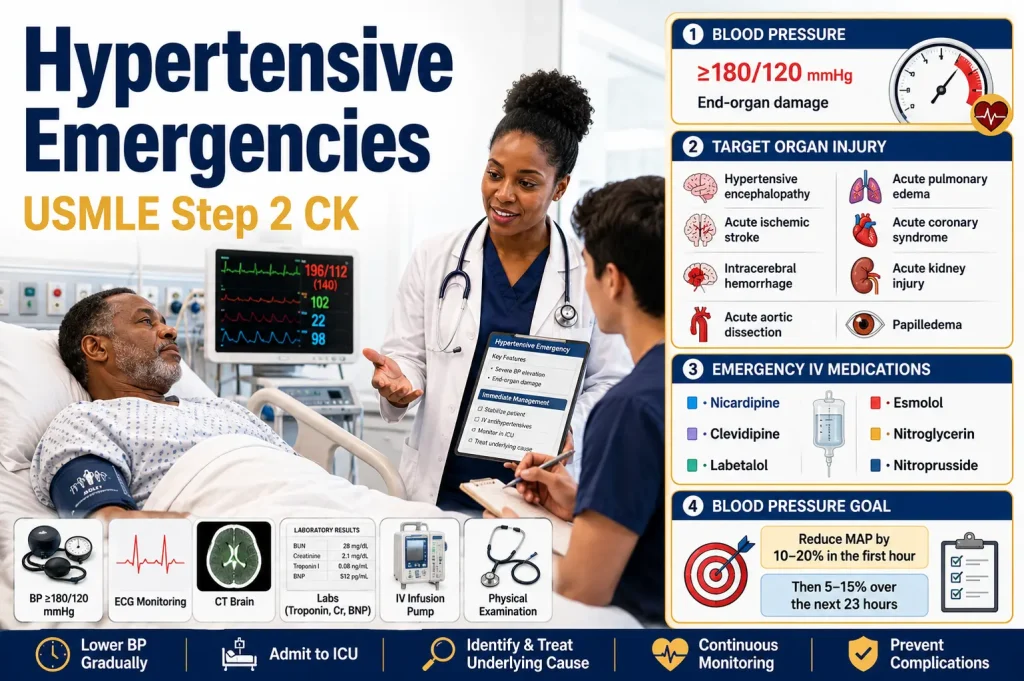

Hypertensive emergencies for Step 2 CK are tested because the exam wants to know whether you can identify end-organ damage and treat the patient safely.
A very high blood pressure number alone does not equal hypertensive emergency. The key is acute target-organ damage, such as stroke, encephalopathy, acute coronary syndrome, pulmonary edema, aortic dissection, acute kidney injury, or papilledema.
Step 2 CK often tests the difference between hypertensive urgency and hypertensive emergency. That difference changes everything.
This guide breaks down recognition, exam traps, blood pressure goals, IV medications, and the specific clinical scenarios you must know for boards.
Free USMLE Training
Free USMLE Step 2 CK Bootcamp
Join our free USMLE masterclass where we break down high-yield clinical reasoning, emergency medicine algorithms, and board-style next-best-step questions.
Reserve My SpotWhy Hypertensive Emergency Matters for Step 2 CK
Hypertensive emergency questions are high-yield because they test rapid clinical judgment. The exam gives you a severe blood pressure elevation, then forces you to decide whether the patient needs oral outpatient therapy or immediate IV treatment.
Do not treat the number alone. Treat the patient, the symptoms, and the evidence of organ injury.
The Big Rule
Hypertensive emergency equals severe hypertension plus acute end-organ damage. Without end-organ damage, it is not a hypertensive emergency.
Hypertensive Emergency vs Hypertensive Urgency
This is the most important distinction. A patient can have a blood pressure above 180/120 and still not have a hypertensive emergency.
| Condition | Key Feature | Treatment |
|---|---|---|
| Hypertensive Emergency | Severe hypertension with acute end-organ damage | IV antihypertensive medication and monitored setting |
| Hypertensive Urgency | Severe hypertension without acute end-organ damage | Oral medication adjustment and close follow-up |
Exam Trap
Do not rapidly lower blood pressure in asymptomatic severe hypertension. Rapid drops can cause cerebral, coronary, or renal hypoperfusion.
End-Organ Damage You Must Recognize
Step 2 CK usually gives clues that point to acute organ injury. Once you see these findings, you should think hypertensive emergency.
- Brain: hypertensive encephalopathy, stroke, intracranial hemorrhage, confusion, seizure.
- Heart: acute coronary syndrome, myocardial infarction, acute heart failure.
- Lungs: flash pulmonary edema.
- Aorta: acute aortic dissection.
- Kidney: acute kidney injury, hematuria, rising creatinine.
- Eye: papilledema, retinal hemorrhages, visual symptoms.
- Pregnancy: preeclampsia or eclampsia with severe features.
Board Rule
Severe headache alone is not enough. Look for neurologic deficits, altered mental status, papilledema, seizure, hemorrhage, or other objective end-organ damage.
Initial Management of Hypertensive Emergency
The initial step is to confirm the emergency, assess for organ damage, and place the patient in a monitored setting.
- Repeat blood pressure with correct cuff size.
- Assess airway, breathing, circulation, neurologic status, and chest pain.
- Check ECG, troponin, creatinine, urinalysis, and electrolytes when appropriate.
- Order chest imaging if pulmonary edema or aortic dissection is suspected.
- Order brain imaging if stroke, hemorrhage, or severe neurologic symptoms are present.
- Start IV antihypertensive therapy when acute end-organ damage is present.
Do Not Miss This
Hypertensive emergency is treated with IV medications, not slow outpatient medication adjustment.
Blood Pressure Reduction Goals
In most hypertensive emergencies, the goal is controlled reduction, not sudden normalization.
A common board-style target is to reduce mean arterial pressure by about 20% to 25% in the first hour, then gradually lower over the next 24 to 48 hours.
High-Yield Rule
Do not drop the blood pressure to normal immediately unless the scenario has a special target, such as aortic dissection.
High-Yield IV Medications
Step 2 CK usually tests medication selection based on the clinical scenario. Labetalol and nicardipine are common choices for many hypertensive emergencies.
- Nicardipine: common IV option for many hypertensive emergencies.
- Labetalol: useful in many settings, including pregnancy-related severe hypertension.
- Nitroglycerin: useful when acute coronary syndrome or pulmonary edema is present.
- Nitroprusside: potent arterial and venous dilator, but toxicity concerns make it less favored in many board-style scenarios.
- Hydralazine: sometimes used in pregnancy, though response can be less predictable.
Medication Trap
Avoid choosing oral medications for true hypertensive emergency. Acute end-organ damage needs IV therapy and monitoring.
Common Step 2 CK Scenarios
Aortic Dissection
Severe tearing chest pain radiating to the back with pulse deficits or widened mediastinum should make you think aortic dissection.
Treat first with IV beta blockade, such as esmolol or labetalol, to reduce heart rate and shear stress. Then add vasodilator therapy if needed.
Hypertensive Encephalopathy
Severe hypertension with confusion, headache, vomiting, visual changes, or seizures suggests hypertensive encephalopathy.
Treat with IV blood pressure control in a monitored setting. Do not suddenly normalize the pressure.
Acute Pulmonary Edema
Severe hypertension with respiratory distress, crackles, hypoxia, and pulmonary edema requires rapid afterload reduction and supportive care.
Nitroglycerin is often tested when pulmonary edema or acute coronary syndrome is present.
Pregnancy: Severe Preeclampsia or Eclampsia
Severe hypertension in pregnancy with headache, visual symptoms, right upper quadrant pain, abnormal labs, pulmonary edema, or seizures requires urgent treatment.
Use magnesium sulfate for seizure prophylaxis or treatment. Labetalol, hydralazine, or nifedipine may be used for blood pressure control depending on the scenario.
Acute Ischemic Stroke
Blood pressure management in acute ischemic stroke depends on whether thrombolysis is being considered. Do not reflexively lower every elevated blood pressure in stroke.
Hypertensive Emergency Summary Table
| Scenario | Key Clue | Step 2 CK Management |
|---|---|---|
| Hypertensive Urgency | Severe BP, no end-organ damage | Oral medication adjustment and follow-up |
| Hypertensive Emergency | Severe BP with acute end-organ damage | IV antihypertensive therapy and monitoring |
| Aortic Dissection | Tearing chest pain to back, pulse deficit | IV beta blocker first, then vasodilator if needed |
| Hypertensive Encephalopathy | Confusion, seizure, severe headache, visual symptoms | Controlled IV BP reduction |
| Acute Pulmonary Edema | Dyspnea, crackles, hypoxia, pulmonary edema | IV nitroglycerin and supportive care |
| Preeclampsia or Eclampsia | Pregnancy plus severe BP and symptoms or seizure | Magnesium sulfate plus BP control |
| Severe Asymptomatic Hypertension | No acute organ injury | Do not rapidly lower BP |
Student Success Story
⭐ 4.8 Google Rating | 120+ ReviewsSee How SmashUSMLE Helps Students Think Clinically
Hypertensive emergency questions become easier when you focus on end-organ damage, not just the blood pressure number.
Want to learn the same clinical reasoning system used by SmashUSMLE students?
Join Free BootcampNeed Help Mastering Step 2 CK Emergency Algorithms?
If hypertensive emergency questions feel confusing, the problem is usually not the blood pressure number. The problem is knowing what organ damage changes management.
SmashUSMLE helps students connect clinical findings to diagnosis, treatment, escalation, and next best step reasoning.
FAQ: Hypertensive Emergencies for Step 2 CK
What is hypertensive emergency?
Hypertensive emergency is severe hypertension with acute end-organ damage, such as encephalopathy, stroke, myocardial infarction, pulmonary edema, aortic dissection, acute kidney injury, or papilledema.
What is the difference between hypertensive emergency and urgency?
Hypertensive emergency has acute end-organ damage and needs IV therapy. Hypertensive urgency has severe blood pressure elevation without acute end-organ damage and is treated with oral medication adjustment and follow-up.
How fast should blood pressure be lowered in hypertensive emergency?
In most hypertensive emergencies, reduce mean arterial pressure by about 20% to 25% in the first hour, then lower gradually over the next 24 to 48 hours.
What is the first treatment for aortic dissection with hypertension?
Start IV beta blockade first, such as esmolol or labetalol, to reduce heart rate and shear stress before adding vasodilator therapy if needed.
Should asymptomatic severe hypertension be treated with IV medications?
No. Severe asymptomatic hypertension without acute end-organ damage should not be rapidly lowered with IV medications.
Ready to Improve Your Step 2 CK Score?
Step 2 CK becomes easier when you stop memorizing isolated facts and start recognizing clinical patterns. SmashUSMLE helps students build the reasoning system needed to answer board-style questions faster and more accurately.