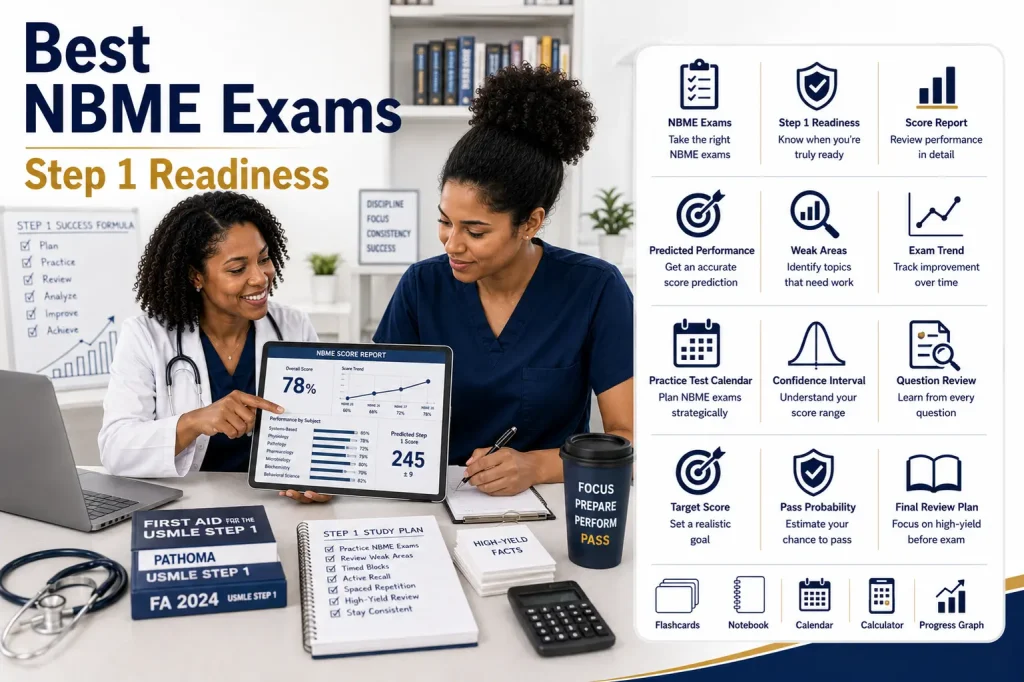

The best NBME exams for predicting Step 1 readiness are the ones you use strategically, not randomly.
Your readiness should be based on score trend, repeated performance above your safety margin, weak-area improvement, timing, and how you perform under exam-like conditions.
One NBME score can give you useful information, but it should not be the only thing you use to decide whether you are ready. The better approach is to look at your pattern across multiple assessments.
Free USMLE Training
Free USMLE Step 1 Bootcamp
Learn how to use NBME exams, weak-area review, QBank practice, and clinical reasoning to prepare smarter for Step 1.
Reserve My SpotWhy NBME Exams Matter
NBME exams are valuable because they show how well you apply concepts in a Step 1-style format. They are not just score reports. They are diagnostic tools.
- They identify weak systems
- They expose timing issues
- They test clinical application
- They show whether your study plan is working
- They help guide your final exam decision
The Big Rule
Do not use NBME exams only to check if you passed. Use them to find what still needs to be fixed.
Best NBME Exams to Use
Use newer available NBME forms closer to your exam because they better reflect the current testing style. Older forms can still help with practice, but your final readiness decision should rely more heavily on recent assessments.
| Assessment | Best Use | Timing |
|---|---|---|
| Baseline NBME | Find weak areas | Start of dedicated study |
| Middle NBME | Check progress | Halfway through study plan |
| Final NBME | Confirm readiness | 1 to 2 weeks before exam |
| Free 120 | Exam-style practice and final confidence check | Final week |
NBME Selection Rule
Save your most predictive and most recent practice exams for the final phase of preparation.
How to Use Free 120
Free 120 should be treated like a final exam simulation. Do it timed, focused, and without distractions.
- Use it close to test day
- Take it under realistic conditions
- Review every missed question
- Look for repeated weak patterns
- Do not use it as your first practice exam
Why Score Trend Matters More Than One Score
A single NBME score can be misleading. You may have had a lucky day, a bad day, a familiar topic mix, or a test form that exposed a specific weakness.
A stronger readiness decision comes from your trend.
| Pattern | Meaning | What to Do |
|---|---|---|
| Scores rising steadily | Your study plan is working | Continue focused review and confirm readiness |
| Scores flat | Your current strategy is not fixing weak areas | Change your review method and target weak systems |
| Scores inconsistent | Possible timing, fatigue, or knowledge gaps | Review missed-question patterns carefully |
| One passing score only | Helpful but not enough alone | Confirm with another assessment or Free 120 |
Signs You Are Ready for Step 1
- Your NBME scores are consistently in a safe passing range
- Your weak areas are improving
- You can finish timed blocks comfortably
- You understand why wrong answers are wrong
- You are not relying on one lucky score
- Your Free 120 performance supports your NBME trend
- You have reviewed repeated mistakes instead of just reading explanations
Readiness Rule
You are not looking for perfection. You are looking for consistent, safe performance.
Signs You Are Not Ready Yet
- Your scores are inconsistent
- You are below or barely at passing range
- You keep missing the same systems
- You have not reviewed biostatistics or ethics
- You are running out of time on blocks
- You do not know why you are missing questions
- You are hoping test day will go better without evidence
Delay Rule
If your NBME trend is unsafe, delaying is often smarter than gambling.
Common NBME Readiness Mistakes
1. Relying on One Passing Score
One passing NBME is encouraging, but repeated safe performance is stronger.
2. Taking NBMEs Too Close Together
You need time between exams to fix weak areas. Taking exams back-to-back without repair usually does not help.
3. Ignoring Weak Systems
If the same topics keep showing up as weak, they need focused review before test day.
4. Reviewing Only Correct Answers
You must understand why the wrong answer choices were wrong. That is where many NBME gains come from.
Student Success Story
⭐ 4.8 Google Rating | 120+ ReviewsSee How SmashUSMLE Students Improve Their Scores
Learn how structured clinical reasoning, NBME-focused review, and disciplined preparation can help students move forward with confidence.
Want to learn the same clinical reasoning system used by SmashUSMLE students?
Join Free BootcampNeed Help Knowing If You Are Ready for Step 1?
If your NBME scores are confusing or inconsistent, you do not need more guessing. You need a clear score trend review, weak-area analysis, and a focused plan.
SmashUSMLE Reviews helps students use NBME data, QBank practice, clinical reasoning, and one-on-one tutoring to prepare smarter.
FAQ: Best NBME Exams for Predicting Step 1 Readiness
Which NBME is best for Step 1 readiness?
The best predictor is not one form alone. It is your trend across multiple recent NBME exams plus Free 120 performance.
Should I rely on one passing NBME?
No. One passing score is reassuring, but repeated safe performance is stronger.
When should I take Free 120?
Most students use Free 120 during the final week as an exam-style practice and confidence check.
What if my NBME scores are inconsistent?
Inconsistent scores usually mean you need to review weak systems, timing, fatigue, and question interpretation before taking the real exam.
Ready to Improve Your Step 1 Readiness?
Step 1 preparation becomes easier when you stop guessing and start using a system. SmashUSMLE can help you review NBME scores, fix weak areas, and build a safer path to exam day.