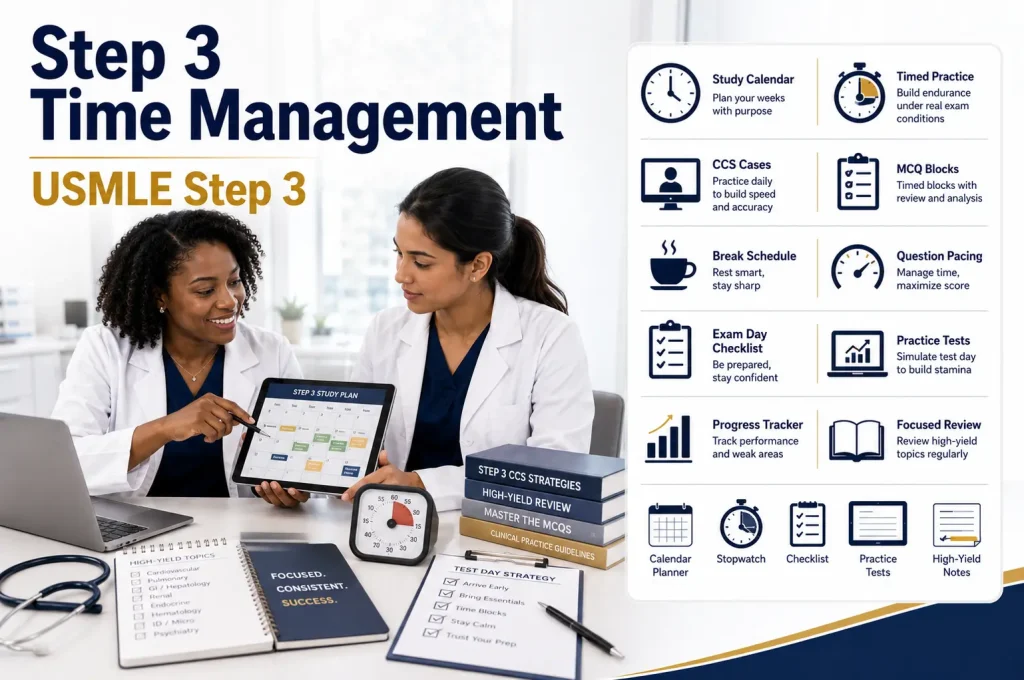

Step 3 time management strategies are essential because USMLE Step 3 is not only testing what you know. It is testing whether you can think clearly under pressure, move through long question blocks, and make safe decisions without wasting time.
Many students know enough medicine to pass Step 3, but they lose points because they spend too long on difficult questions, panic during CCS cases, or run out of mental energy before the exam is over.
The goal is not to rush. The goal is to build a repeatable pacing system that helps you stay calm, avoid traps, and finish each section with control.
Free USMLE Training
Free USMLE Step 3 Bootcamp
Join our free USMLE training where we break down Step 3 strategy, clinical reasoning, CCS cases, and exam-day pacing.
Reserve My SpotWhy Time Management Matters on Step 3
Step 3 is long, mentally demanding, and clinically broad. You must manage questions, CCS cases, fatigue, breaks, and decision-making pressure across two exam days.
Strong time management helps you:
- Finish question blocks without rushing at the end
- Avoid wasting time on low-yield details
- Protect mental stamina across both test days
- Handle difficult questions without panic
- Move efficiently through CCS cases
- Use breaks strategically instead of randomly
The Big Rule
Do not let one difficult question steal time from five easier questions.
How to Pace Step 3 Question Blocks
Your goal during each block is to keep steady forward motion. Step 3 questions can be long, but most can be answered by identifying the clinical problem, the patient’s stability, and the next best step.
| Timing Problem | What Usually Causes It | Best Strategy |
|---|---|---|
| Running out of time | Spending too long on hard questions | Make a decision, mark it, and move on. |
| Reading too slowly | Trying to memorize every detail in the stem | Read for age, setting, chief complaint, stability, and key abnormal findings. |
| Changing correct answers | Overthinking during review | Only change an answer if you find a clear reason. |
| Losing focus late in the block | Mental fatigue | Use brief posture resets and deep breaths between questions. |
| Getting trapped by distractors | Answering before identifying the real diagnosis | Summarize the case in one sentence before selecting. |
Pacing Rule
If you are stuck between two answers, choose the safer and more clinically appropriate option, mark the question, and keep moving.
What to Do With Hard Questions
Hard questions are not the problem. The problem is letting hard questions disrupt your rhythm.
The 3-Step Hard Question Method
- Step 1: Identify the patient’s main problem.
- Step 2: Decide whether the patient is stable or unstable.
- Step 3: Pick the safest next step and move forward.
Do not chase perfection. Step 3 rewards safe clinical judgment, not emotional attachment to every question.
How to Use Break Time Wisely on Step 3
Break strategy matters because Step 3 is a stamina exam. Poor breaks can make the second half of the day feel much harder than it needs to.
Smart Break Strategy
- Use breaks before you feel completely exhausted
- Eat small, predictable snacks
- Hydrate without overdoing it
- Avoid checking stressful messages
- Stretch your back, neck, and legs
- Reset your breathing before the next block
Break Rule
Breaks are not just rest. They are part of your scoring strategy.
CCS Case Time Management
CCS cases require a different type of timing. You must act efficiently, but not recklessly. The key is to create a repeatable case flow.
| CCS Step | What to Do | Timing Goal |
|---|---|---|
| Initial Assessment | Check vitals, setting, stability, and chief complaint | Move quickly and identify urgency. |
| Orders | Place essential diagnostic and treatment orders | Do not delay life-saving treatment. |
| Reassessment | Advance time carefully and monitor response | Look for clinical improvement or deterioration. |
| Prevention | Add counseling, vaccines, screening, and follow-up when appropriate | Do not forget outpatient safety. |
| Closure | Finalize disposition, follow-up, and patient education | End with a complete management plan. |
CCS Rule
Treat the emergency first, reassess often, then add prevention, counseling, and follow-up.
How to Practice Timing Before Exam Day
You cannot fix time management by thinking about it the night before the exam. You need to practice timing during your question blocks and CCS cases before test day.
Weekly Timing Practice Plan
- Do timed mixed question blocks at least several times per week
- Review how many questions you rushed at the end
- Track why you spent too long on certain questions
- Practice moving on from difficult questions
- Complete CCS cases under timed conditions
- Simulate breaks during longer study sessions
Timing improves when you stop treating every question like a personal battle.
Common Step 3 Time Management Mistakes
1. Spending Too Long on the First Half of the Block
If you move too slowly early, you create pressure later. Keep a steady pace from the first question.
2. Refusing to Move On
Some questions are designed to be difficult. Make your best decision and protect the rest of the block.
3. Using Breaks Randomly
Breaks should be planned. Do not wait until you are mentally drained before stepping away.
4. Practicing Only Untimed Questions
Untimed learning is helpful early, but Step 3 requires timed decision-making.
5. Forgetting CCS Reassessment
In CCS cases, time advancement matters. You must reassess after treatment and respond to patient changes.
Student Success Story
⭐ 4.8 Google Rating | 120+ ReviewsSee How SmashUSMLE Students Improve Their Scores
Learn how structured clinical reasoning, disciplined preparation, and exam-day strategy help students approach Step 3 with more confidence.
Want to learn the same clinical reasoning system used by SmashUSMLE students?
Join Free BootcampNeed Help With Step 3 Timing and Strategy?
If you are running out of time, overthinking questions, or getting overwhelmed by CCS cases, you do not need more random studying. You need a better system.
SmashUSMLE Reviews helps students prepare for Step 3 using clinical reasoning, high-yield review, QBank practice, CCS strategy, and one-on-one tutoring.
FAQ: Step 3 Time Management Strategies
Why is time management important for Step 3?
Time management is important because Step 3 tests clinical judgment under pressure. Poor pacing can cause students to rush easier questions, lose focus, or mismanage CCS cases.
How do I stop running out of time on Step 3 question blocks?
Practice timed mixed blocks, avoid overanalyzing difficult questions, mark questions strategically, and move forward when you are stuck between two reasonable answers.
Should I review marked questions at the end of each block?
Yes, but only change an answer if you identify a clear mistake. Do not change answers just because you feel uncertain.
How should I manage time on CCS cases?
Start with stability, place essential orders, reassess after treatment, advance time carefully, and finish with prevention, counseling, follow-up, and disposition.
How can I practice Step 3 timing before exam day?
Use timed question blocks, timed CCS cases, longer study simulations, planned breaks, and post-block review to identify where you are losing time.
Ready to Improve Your Step 3 Strategy?
Step 3 becomes easier when you stop guessing your way through question blocks and start using a system. SmashUSMLE can help you build the clinical reasoning, CCS strategy, and exam-day timing skills you need.