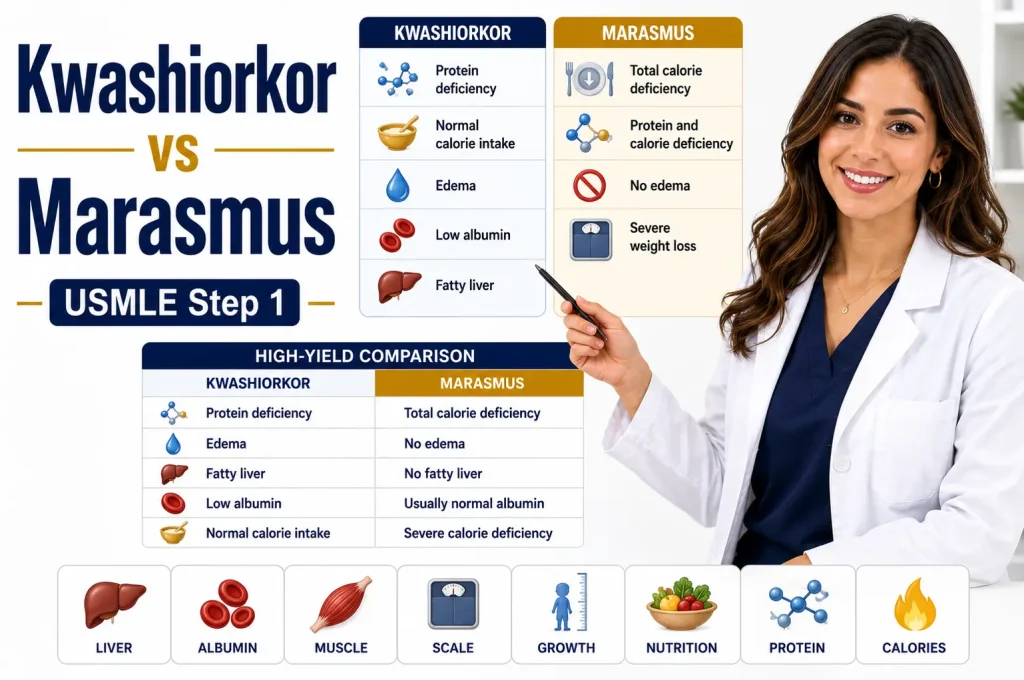

Kwashiorkor vs Marasmus is a high-yield USMLE Step 1 comparison that tests protein-energy malnutrition, edema, hypoalbuminemia, fatty liver, and severe muscle wasting.
Kwashiorkor is mainly a protein deficiency with relatively preserved calorie intake. Marasmus is total calorie deficiency with both protein and energy depletion.
The fastest way to separate them is simple: kwashiorkor causes edema, fatty liver, and low albumin. Marasmus causes severe wasting without edema.
Free USMLE Training
Free USMLE Step 1 Bootcamp
Join our free USMLE masterclass where we break down high-yield concepts, NBME strategies, and clinical reasoning systems used by thousands of students and IMGs.
Reserve My SpotThe Main Difference Between Kwashiorkor and Marasmus
The key difference is the type of malnutrition. Kwashiorkor is primarily protein deficiency, while marasmus is total calorie deficiency.
This matters because protein deficiency decreases albumin production. As a result, kwashiorkor causes edema, ascites, and a distended abdomen.
Marasmus does not usually cause edema because the child is globally calorie-depleted. Instead, the child appears severely wasted with loss of muscle and subcutaneous fat.
The Big Rule
Kwashiorkor equals edema. Marasmus equals muscle wasting without edema.
Kwashiorkor for Step 1
Kwashiorkor occurs when a child has severe protein deficiency despite some calorie intake. This often happens after weaning when the diet becomes carbohydrate-heavy but protein-poor.
Classic Findings
- Edema
- Distended abdomen
- Fatty liver
- Low albumin
- Flaky paint dermatitis
- Sparse or discolored hair
- Irritability or apathy
The fatty liver occurs because protein deficiency reduces apolipoprotein synthesis. Without enough apolipoproteins, the liver cannot export triglycerides properly.
High-Yield Mechanism
Kwashiorkor causes fatty liver because decreased apolipoprotein synthesis traps triglycerides in the liver.
Marasmus for Step 1
Marasmus is severe total calorie deficiency. The child lacks both protein and energy intake, so the body breaks down fat and muscle for survival.
Classic Findings
- Severe muscle wasting
- Loss of subcutaneous fat
- Prominent ribs
- Thin extremities
- Old man appearance
- No edema
- Usually no fatty liver
Marasmus is usually more visually obvious because the patient looks profoundly emaciated. However, the absence of edema is the major board clue.
Kwashiorkor vs Marasmus Table
| Feature | Kwashiorkor | Marasmus |
|---|---|---|
| Main deficiency | Protein deficiency | Total calorie deficiency |
| Calories | Relatively preserved | Severely decreased |
| Edema | Present | Absent |
| Albumin | Low | Often relatively preserved |
| Liver | Fatty liver | No fatty liver classically |
| Body appearance | Distended abdomen with thin extremities | Severe wasting and old man appearance |
| Skin and hair | Flaky paint dermatitis, sparse discolored hair | Dry skin, severe loss of fat and muscle |
| Best clue | Edema plus fatty liver | Severe wasting without edema |
How to Answer Kwashiorkor vs Marasmus Questions Fast
First, look for edema. If the child has edema, ascites, or a distended abdomen, think kwashiorkor.
Next, look for severe muscle wasting without edema. That points to marasmus.
Finally, check for liver findings. Fatty liver strongly supports kwashiorkor because protein deficiency decreases apolipoprotein synthesis.
Test-Day Shortcut
Edema plus fatty liver equals kwashiorkor. Severe wasting with no edema equals marasmus.
High-Yield Nutrition Resource
High Yield USMLE Nutrition Recall
If nutrition questions keep slowing you down, use the High Yield USMLE Nutrition Recall book to review vitamins, deficiencies, malnutrition, metabolism, and clinical nutrition patterns.
- Master high-yield nutrition concepts
- Review kwashiorkor, marasmus, and vitamin deficiencies
- Connect nutrition clues to Step 1 vignettes
- Use alongside NBME and QBank practice
Student Success Story
⭐ 4.8 Google Rating | 120+ ReviewsStudent Success Testimonial
See how structured USMLE preparation, clinical reasoning, and focused review can help students move forward with confidence.
Want to learn the same clinical reasoning system used by SmashUSMLE students?
Join Free BootcampNeed Help Mastering USMLE Nutrition?
Nutrition becomes much easier when you stop memorizing random facts and start recognizing clinical patterns. SmashUSMLE Reviews helps you simplify high-yield Step 1 topics with clear systems and exam-focused teaching.
FAQ: Kwashiorkor vs Marasmus for Step 1
What is the main difference between kwashiorkor and marasmus?
Kwashiorkor is mainly protein deficiency, while marasmus is total calorie deficiency.
Why does kwashiorkor cause edema?
Kwashiorkor causes edema because protein deficiency lowers albumin, which decreases plasma oncotic pressure.
Why does kwashiorkor cause fatty liver?
Kwashiorkor causes fatty liver because decreased apolipoprotein synthesis prevents proper triglyceride export from the liver.
Does marasmus cause edema?
No. Marasmus classically causes severe wasting without edema.
Ready to Improve Your USMLE Scores?
Step 1 preparation becomes easier when you stop studying randomly and start using a system. Join thousands of medical students and IMGs using SmashUSMLE’s clinical reasoning system.