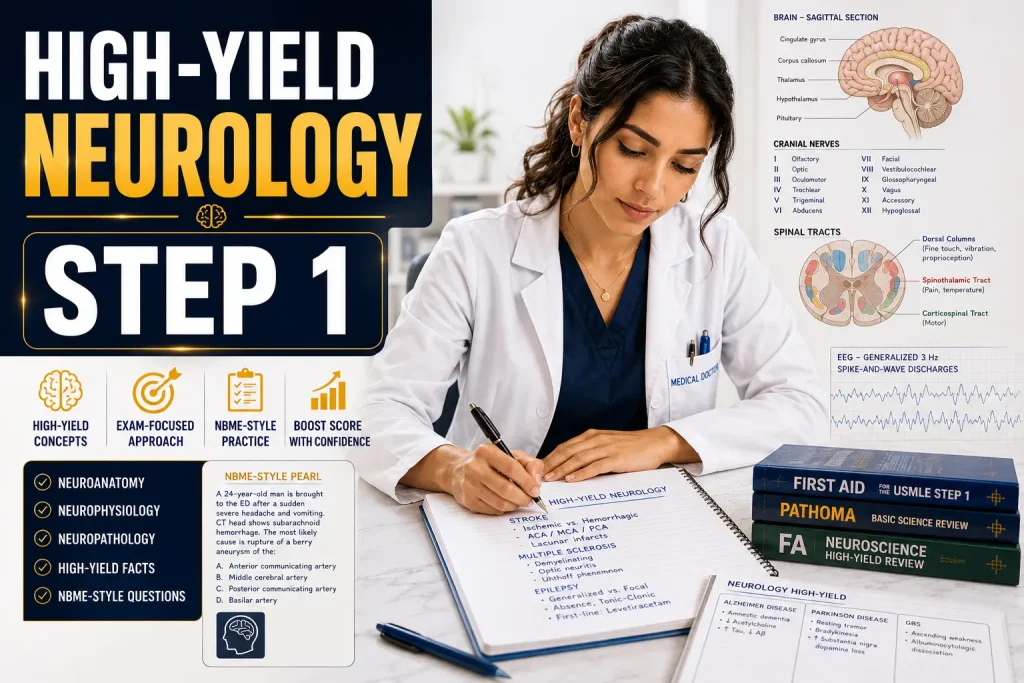
USMLE Step 1 • Neurology
Highest Yield Neurology Topics for USMLE Step 1
Master the Step 1 neurology topics most likely to appear on NBME-style questions, including neuroanatomy, lesion localization, stroke syndromes, spinal cord lesions, cranial nerves, seizures, movement disorders, demyelinating disease, and neuropharmacology.
Highest yield neurology topics for USMLE Step 1 are challenging because neurology combines anatomy, physiology, pathology, pharmacology, and clinical localization in one question.
Many students struggle with neurology because they memorize cranial nerves, tracts, and diseases separately instead of learning how to localize the lesion.
Step 1 neurology becomes much easier when you ask one question first: where is the lesion?
In this guide, we will break down the highest-yield neurology topics for USMLE Step 1 and show you how to study them using clinical reasoning, NBME-style patterns, and high-yield mechanisms.
Free USMLE Training
Free USMLE Step 1 Bootcamp
Join our free USMLE masterclass where we break down high-yield concepts, NBME strategies, and clinical reasoning systems used by thousands of medical students and IMGs.
Reserve My SpotHighest Yield Neurology Topics for USMLE Step 1
Neurology is one of the most testable Step 1 subjects because it rewards students who can connect symptoms to anatomy. The exam does not usually ask, “What is the tract?” directly. Instead, it gives weakness, sensory loss, vision changes, reflex findings, gait problems, eye movement problems, or speech changes.
The best students do not guess. They localize.
The Neurology Rule
Before choosing an answer, ask: where is the lesion, what pathway is involved, and what mechanism explains the patient’s symptoms?
Neuroanatomy and Lesion Localization
Neuroanatomy is the foundation of Step 1 neurology. If you cannot localize lesions, every neurology question feels like memorization.
Focus on the corticospinal tract, dorsal columns, spinothalamic tract, cerebellum, basal ganglia, brainstem, and visual pathway.
| Finding | Likely Location | High-Yield Clue |
|---|---|---|
| Contralateral weakness | Motor cortex or internal capsule | Upper motor neuron signs |
| Ipsilateral facial weakness with contralateral body weakness | Brainstem | Crossed findings |
| Loss of vibration and proprioception | Dorsal columns | Positive Romberg sign |
| Loss of pain and temperature | Spinothalamic tract | Often contralateral below lesion |
| Ataxia and dysmetria | Cerebellum | Ipsilateral findings |
Neurology Worksheet
Neurology Masterclass Worksheet
Download the Neurology Masterclass Worksheet to organize neuroanatomy, spinal cord lesions, cranial nerves, strokes, seizures, movement disorders, and neuromuscular disease patterns for Step 1.
- Organize high-yield neuroanatomy pathways
- Review spinal cord lesion patterns
- Strengthen cranial nerve localization
- Connect neurology topics to NBME-style reasoning
Stroke Syndromes
Stroke syndromes are extremely high yield because they test vascular anatomy and clinical localization at the same time.
| Stroke Territory | Classic Presentation | Step 1 Pattern |
|---|---|---|
| ACA | Contralateral leg weakness and sensory loss | Leg affected more than arm |
| MCA | Contralateral face and arm weakness | Aphasia if dominant hemisphere, neglect if nondominant |
| PCA | Contralateral homonymous hemianopia | Macular sparing |
| PICA | Lateral medullary syndrome | Dysphagia, hoarseness, vertigo, crossed sensory loss |
| ASA | Medial medullary syndrome | Contralateral weakness, tongue deviation, proprioception loss |
Spinal Cord Lesions
Spinal cord lesions are tested because each tract has a predictable function. Once you know the tract, the symptoms become logical.
- Brown-Sequard syndrome: ipsilateral motor and proprioception loss with contralateral pain and temperature loss.
- Anterior cord syndrome: bilateral motor, pain, and temperature loss with preserved proprioception.
- Syringomyelia: cape-like loss of pain and temperature from anterior white commissure damage.
- Tabes dorsalis: dorsal column damage from tertiary syphilis.
- Subacute combined degeneration: vitamin B12 deficiency affecting dorsal columns and corticospinal tracts.
Cranial Nerves
Cranial nerves are tested through eye movement, facial weakness, gag reflex, hearing, swallowing, tongue deviation, and brainstem localization.
| Cranial Nerve | Deficit | High-Yield Clue |
|---|---|---|
| CN III | Eye down and out, ptosis, mydriasis | Posterior communicating artery aneurysm |
| CN IV | Difficulty looking down and in | Trouble walking downstairs |
| CN V | Facial sensation and mastication | Afferent limb of corneal reflex |
| CN VI | Failure of eye abduction | Increased intracranial pressure |
| CN VII | Facial expression weakness | Bell palsy, hyperacusis, taste loss |
| CN IX/X | Dysphagia, hoarseness, palate weakness | Nucleus ambiguus lesion |
| CN XII | Tongue deviation | Tongue points toward LMN lesion |
Step 1 Masterclass
Step 1 Masterclass With AI and Self-Paced Course
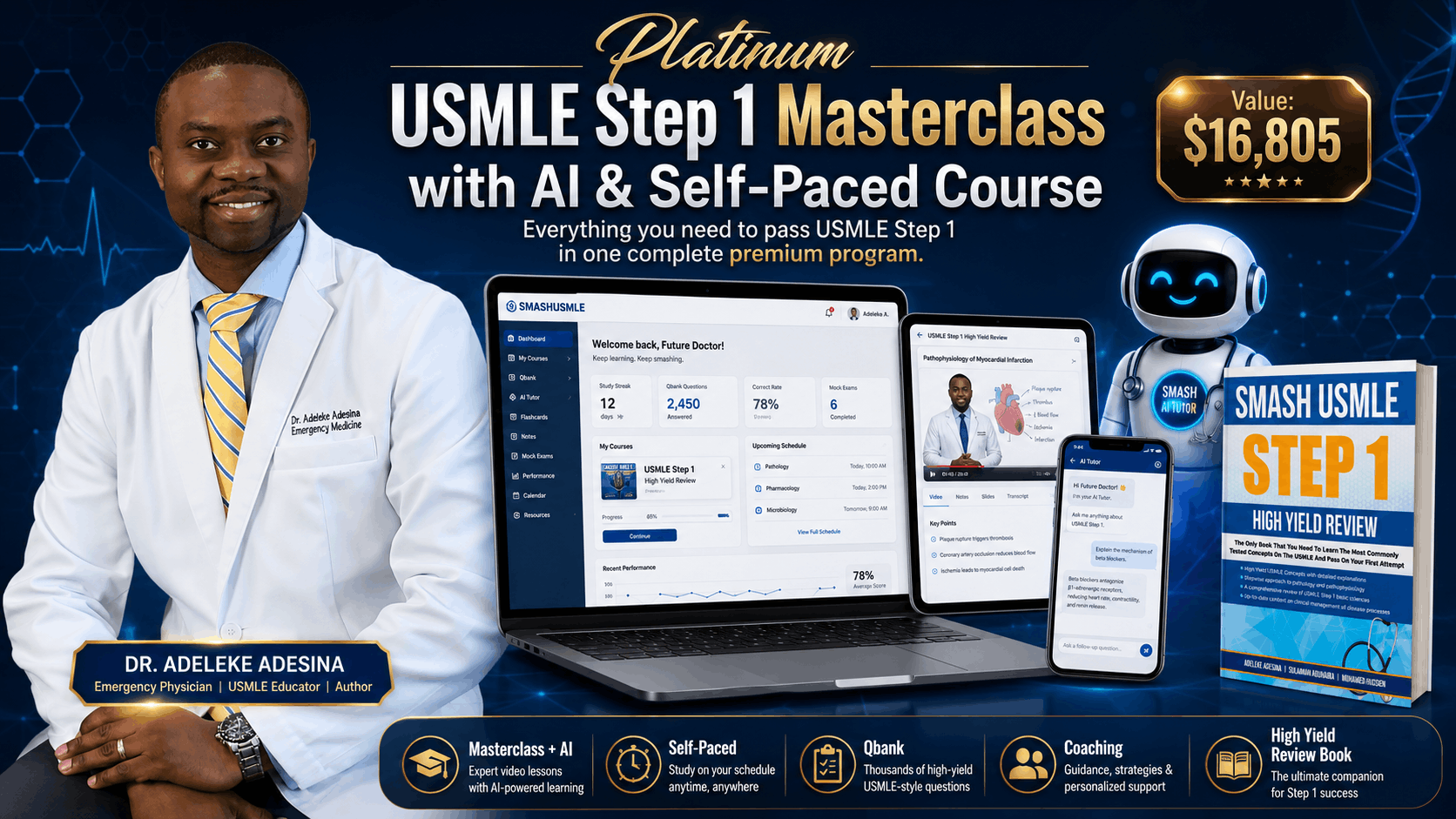
Use SmashUSMLE’s Step 1 Masterclass with AI and self-paced course to organize high-yield neurology, rebuild weak foundations, and strengthen NBME-style clinical reasoning.
- Master neuroanatomy using clinical localization
- Review Step 1 mechanisms with structure
- Build stronger NBME-style reasoning
- Stop studying neurology as random memorization
Seizures and Antiepileptic Drugs
Step 1 commonly tests seizure type, EEG pattern, medication mechanism, and drug toxicity.
- Absence seizures: brief staring spells, 3-Hz spike-and-wave, treated with ethosuximide.
- Focal seizures: start in one brain region and may or may not impair awareness.
- Generalized tonic-clonic seizures: loss of consciousness with tonic and clonic activity.
- Febrile seizures: common in young children and usually benign.
Know classic antiepileptic toxicities. Phenytoin causes gingival hyperplasia, hirsutism, teratogenicity, and CYP450 induction. Valproate can cause hepatotoxicity, pancreatitis, and neural tube defects. Carbamazepine can cause SIADH, agranulocytosis, and CYP450 induction.
Movement Disorders
Movement disorders are high yield because they test the basal ganglia, dopamine pathways, and classic clinical patterns.
| Disease | Key Finding | Mechanism |
|---|---|---|
| Parkinson disease | Resting tremor, rigidity, bradykinesia | Loss of dopaminergic neurons in substantia nigra |
| Huntington disease | Chorea, dementia, psychiatric symptoms | CAG repeat expansion with caudate atrophy |
| Wilson disease | Movement disorder, liver disease, Kayser-Fleischer rings | ATP7B mutation causing copper accumulation |
| Hemiballismus | Flinging movements | Subthalamic nucleus lesion |
Demyelinating and Neuromuscular Disorders
Demyelinating and neuromuscular diseases are tested because they force students to separate CNS, peripheral nerve, neuromuscular junction, and motor neuron disease.
- Multiple sclerosis: optic neuritis, internuclear ophthalmoplegia, plaques separated in time and space.
- Guillain-Barre syndrome: ascending weakness, areflexia, albuminocytologic dissociation.
- Myasthenia gravis: fatigable weakness from antibodies against postsynaptic acetylcholine receptors.
- Lambert-Eaton syndrome: proximal weakness improves with use due to antibodies against presynaptic calcium channels.
- ALS: upper and lower motor neuron findings without sensory loss.
Brain Tumors
Brain tumors are tested through age, location, histology, and classic associations.
- Glioblastoma multiforme: aggressive adult tumor crossing the corpus callosum.
- Meningioma: dural-based tumor with psammoma bodies.
- Pilocytic astrocytoma: childhood cerebellar tumor with Rosenthal fibers.
- Medulloblastoma: childhood cerebellar tumor with Homer Wright rosettes.
- Ependymoma: fourth ventricle tumor with perivascular pseudorosettes.
- Oligodendroglioma: frontal lobe tumor with fried egg cells and chicken-wire capillaries.
Recommended Step 1 Book
High Yield Step 1 Review Book
The High Yield Step 1 Review Book helps organize classic Step 1 mechanisms, high-yield patterns, and board-style concepts without getting buried in low-yield details.
- Strengthen high-yield Step 1 foundations
- Review classic mechanisms efficiently
- Connect concepts to NBME-style reasoning
- Use alongside QBank and NBME review

Neuropharmacology
Neuropharmacology is high yield because the exam often tests mechanism of action, receptor effect, neurotransmitter changes, and toxicity.
- Antiepileptic drugs
- Parkinson disease drugs
- Antipsychotics
- Antidepressants
- Anesthetics
- Opioids
- Neuromuscular blockers
Neuropharmacology Rule
Do not memorize drug lists only. Know the neurotransmitter, receptor, mechanism, clinical use, and classic adverse effect.
Student Success Story
⭐ 4.8 Google Rating | 120+ ReviewsSee How Dr. Taquela Williams Passed Step 1
Dr. Taquela Williams’ story shows how structured review and focused Step 1 preparation can help students move forward with confidence.
Want to learn the same clinical reasoning system used by SmashUSMLE students?
Join Free BootcampNeed Help Mastering Step 1 Neurology?
If neuroanatomy, spinal cord lesions, seizures, and cranial nerves feel overwhelming, SmashUSMLE can help you build a structured Step 1 study plan.
You do not need more random resources. You need a system that teaches you how to localize, reason, and apply high-yield concepts inside clinical vignettes.
FAQ: Highest Yield Neurology Topics for USMLE Step 1
What are the highest yield neurology topics for USMLE Step 1?
The highest yield neurology topics for USMLE Step 1 include neuroanatomy, lesion localization, stroke syndromes, spinal cord lesions, cranial nerves, seizures, movement disorders, demyelinating disease, neuromuscular disorders, brain tumors, and neuropharmacology.
How should I study neurology for Step 1?
Study neurology by localization. Ask where the lesion is, which pathway is affected, and what clinical findings that lesion should cause.
Are spinal cord lesions high yield for Step 1?
Yes. Brown-Sequard syndrome, anterior cord syndrome, syringomyelia, tabes dorsalis, and subacute combined degeneration are classic Step 1 topics.
Are cranial nerves important for Step 1?
Yes. Cranial nerves are frequently tested through eye movement, facial weakness, tongue deviation, swallowing problems, and brainstem localization.
What is the best way to improve neurology questions?
Review every missed question by identifying the lesion location, affected pathway, key clinical clue, and reason each wrong answer was tempting.
Ready to Improve Your USMLE Scores?
Step 1 preparation becomes easier when you stop studying randomly and start using a system. Join thousands of medical students and IMGs using SmashUSMLE’s clinical reasoning system to prepare for Step 1, Step 2 CK, and Step 3.